
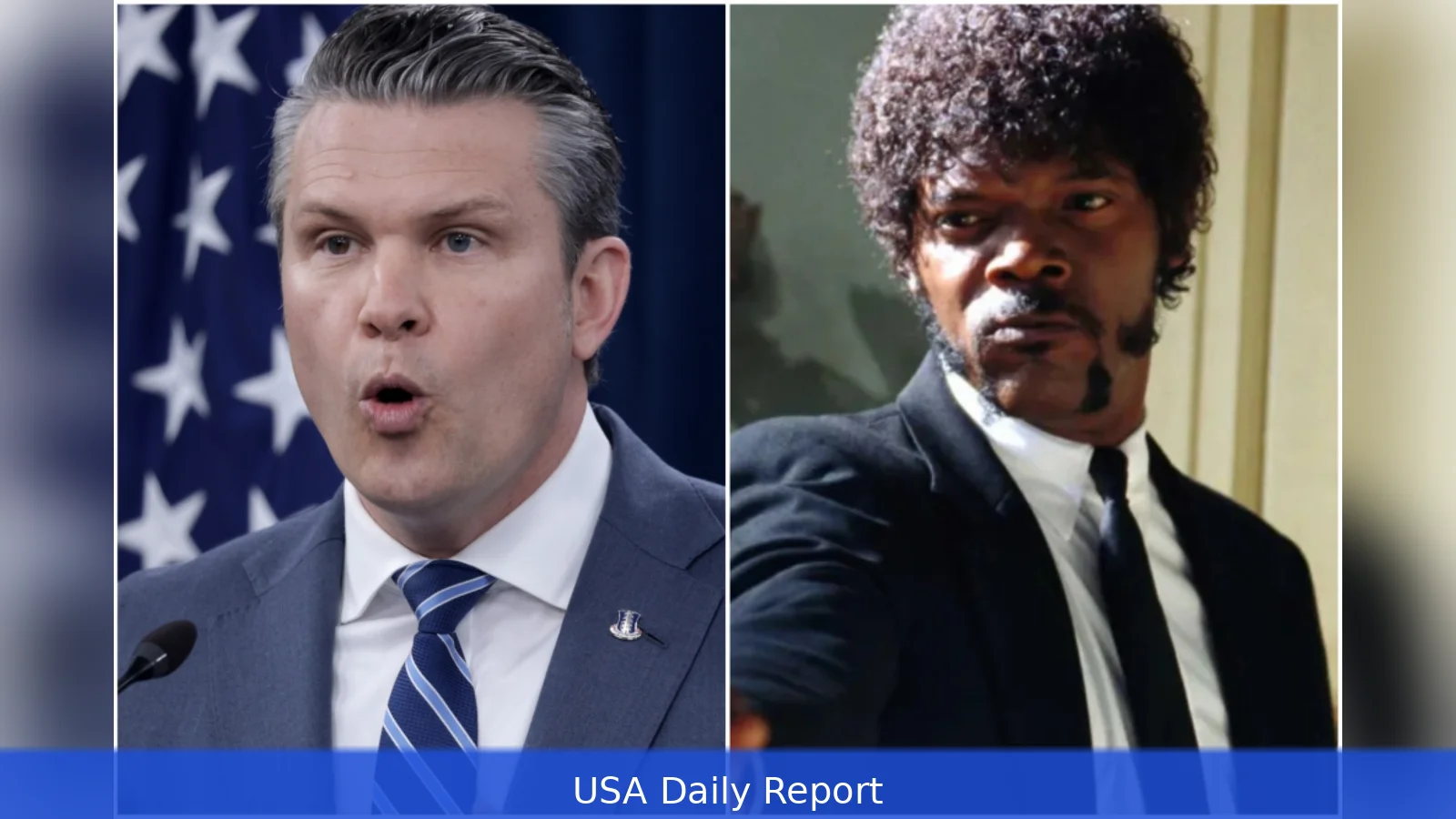
Defense Secretary Pete Hegseth quoted a line from Pulp Fiction. He read the passage during a Pentagon prayer service after a Combat Search and Rescue mission brought a downed U.S. Pilot home.
What Hegseth said
Defense Secretary Pete Hegseth told worshippers at a Pentagon service that a prayer had been recited by the "Sandy 1" crew involved in the recent rescue of a U.S. Aviator in Iran. He said the prayer was known among crews as "CSAR 25:17," which he suggested echoed the Bible verse Ezekiel 25:17. Then he asked the room to "pray with me," and read a passage that closely matches the extended, nonbiblical version of Ezekiel 25:17 delivered by Samuel L. Jackson's character in Quentin Tarantino's 1994 film Pulp Fiction.
Hegseth read: "The path of the downed aviator is beset on all sides by the inequities of the selfish and the tyranny of evil men. Blessed is he who in the name of camaraderie and duty shepherds the lost through the valley of darkness, for he is truly his brother's keeper and the finder of lost children. And I will strike down upon thee with great vengeance and furious anger those who attempt to capture and destroy my brother, and you will know my call sign is Sandy 1 when I lay my vengeance upon thee. Amen."
He framed the passage as a field prayer tied to the Sandy 1 CSAR team. A religion-focused blog, A Public Witness, flagged the wording and noted its close match to the movie monologue that Jackson's character Jules Winnfield repeats before carrying out a murder scene in Pulp Fiction.
Hegseth's prayer was brief, yet it got noticed inside the building; multiple outlets reported the Pulp Fiction echo. The prayer came amid high-profile public interest in the rescue operation and in broader U.S. Military activity tied to tensions with Iran.
Origins and scripture
The lines Hegseth read aren't the text of the biblical Ezekiel passage.
The King James Version of Ezekiel 25:17 reads: "And I will execute great vengeance upon them with furious rebukes; and they shall know that I am the Lord, when I shall lay my vengeance upon them." That verse is concise and framed as a prophetic act of divine judgment.
Quentin Tarantino and co-writer Roger Avary dramatically expanded and altered that short passage for Pulp Fiction, creating an extended, quasi-biblical monologue that serves the film's character development. Tarantino drew on an even earlier source: the line appears to echo a speech in the 1973 Japanese martial-arts film Bodyguard Kiba, where an attribution to Ezekiel is also misplaced.
Samuel L. Jackson's delivery in Pulp Fiction has long been one of the film's most widely quoted moments. It borrows biblical language but adds themes and phrasing not present in the original scripture. Hegseth's version adjusted some words to fit the CSAR context, swapping references to "the righteous man" for "the downed aviator" and inserting a call sign.

Political and diplomatic implications
The timing was sensitive — the rescue of an airman from Iran has already drawn intense attention, and reporters picked up on the comment. The rescue of a U.S. Pilot from inside Iran attracted intense political attention and raised questions about command decisions, risk to personnel and the message Washington sends to Tehran. A senior Defense official quoting a Hollywood script at a Pentagon worship service intersects with those larger controversies.
Politicians will seize on lines like this to attack the Defense Department's messaging; A Public Witness and other outlets already flagged the quote. Critics often scrutinize how senior officials frame military action; borrowing a movie line and presenting it as a field prayer could be used to question professionalism, judgment or cultural sensitivity.
Some service members might read it as a salute to the rescue team's esprit de corps — Hegseth himself said the wording was used by 'Sandy 1.' Military units often develop rituals and informal phrases that are meaningful to members but opaque to outsiders. Hegseth said the wording was used by crews, and that context may limit how damaging the misstep becomes.
Internationally, the moment may affect how allies and adversaries interpret U.S. Civil-military messaging. Opponents could seize on the exchange to suggest that U.S. Leaders blur operational seriousness with theatrical rhetoric. Allies might privately ask whether such public remarks reflect an institutional culture that takes its symbolic language from entertainment rather than established doctrine and tradition.
Impact on civil-military relations and morale
Public messaging by senior defense leaders shapes perceptions inside the military as well as outside it. The Pentagon is both an operations center and a public institution. When a top official names a prayer that closely echoes a film, it makes people wonder about the boundary between morale-building and public-facing professionalism.
Service members witness those boundaries up close. Rituals that bind crews together can boost morale, especially after risky operations. Yet those same rituals, when shared publicly in an altered form and tied to scripture, can complicate efforts to present the military as neutral and disciplined in politically charged environments.
Visible prayers from senior officers can trigger scrutiny; reporters noted the prayer's origins after A Public Witness highlighted the wording. The reading didn't include coercion or an explicit order. Still, senior officers are aware that visible acts of religiosity by high-ranking officials invite scrutiny and, sometimes, litigation.
Communications and oversight
The Defense Department has a formal communications apparatus. Public affairs officers and speechwriters typically vet remarks by senior leaders for operational security and diplomatic consequences. This event will likely prompt internal review of how remarks for ceremonial or faith-based events are cleared and contextualized.
Hegseth's comment also touches on how quickly modern political controversies spread. Video and social posts amplified the lines within hours. That rapid diffusion magnifies the stakes for officials at every level. Small phrasing choices can become national talking points before staff have time to prepare a considered response.
At a press briefing the day after the prayer service, Hegseth again used religious language while addressing reporters, drawing a line between journalistic scrutiny and moral judgment. He compared members of the press to Pharisees, and accused sections of the media of persistent negativity over the administration's actions toward Iran. That exchange added another layer to the controversy, linking the prayer reading to the secretary's broader relationship with the press corps.
Context and precedent
Senior officials invoking faith in public isn't new. Presidents and defense secretaries have long appeared at services and memorials. The difference here is the invocation's clear origin in a piece of popular culture and its adaptation into what Hegseth presented as a field prayer. That blend of filmic language and military ritual is unusual at this level of public visibility.
History shows that public missteps by senior military leaders can reverberate. They influence confirmation fights, congressional oversight, and public trust. Lawmakers on both sides of the aisle watch Pentagon communications for gaps they can use in hearings or in public debates about defense policy and funding.
What happens next will depend on whether Hegseth and his staff treat the episode as an internal matter or as a public relations issue that requires fuller explanation. For now, the prayer remains a short, pointed moment that ties together a high-stakes rescue, Hollywood mythology and the politics of defense messaging.
Related Articles
The King James Version of Ezekiel 25:17 reads: "And I will execute great vengeance upon them with furious rebukes; and they shall know that I am the Lord, when I shall lay my vengeance upon them."


