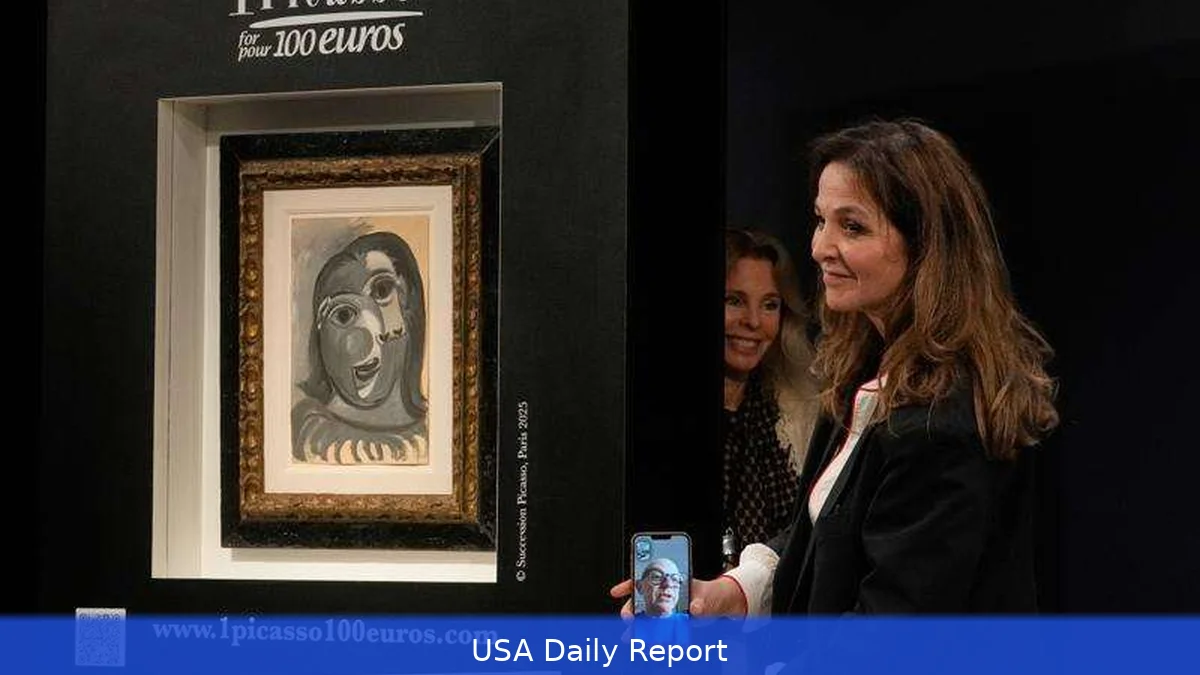
He paid $117. He won a Picasso valued at about $1 million.
Lucky ticket in a Paris restaurant
Ari Hodara, 58, said he could hardly believe the call from organizers after Tuesday's draw at Christie's in Paris. "How do I check that it's not a hoax?" Hodara told reporters, identifying himself as a sales engineer and an art amateur who'd bought a ticket over the weekend after hearing about the lottery while dining out.
Hodara said his first move would be to tell his wife, who was still at work, and that "at first, I think I'll take advantage of it and keep it."
Look, the numbers behind the event are what made the headlines: the lottery, marketed as "1 Picasso for 100 euros," sold 120,000 tickets worldwide and raised 12 million euros — roughly $14 million. The prize was a Pablo Picasso gouache-on-paper portrait called "Head of a Woman," painted in 1941 and portraying Dora Maar, Picasso's longtime muse and partner.
How the raffle was structured
The draw was staged at Christie's auction house in Paris and organized by the Alzheimer Research Foundation, which is based at one of the city's major public hospitals. Organizers said the raffle's proceeds are earmarked to support the foundation's medical research on Alzheimer's disease. Of the money raised from ticket sales, 1 million euros was paid to Opera Gallery, the international art dealer that provided the painting.
Gilles Dyan, founder of Opera Gallery, said he agreed to a preferential price to allow the painting to be offered through the charity lottery; organizers said the public market value would have been about 1.45 million euros. The dealer's cooperation — the gallery reducing the usual sale price to free up funds for charity — was central to making the raffle work.
Basically, they sold many cheap tickets so lots of people chipped in and one person walked away with a major work — that's how the raffle turned small donations into a big prize. The two prior editions of the lottery used the same formula. The first, in 2013, awarded Picasso's "Man in the Opera Hat" to a Pennsylvania man who worked in a fire-sprinkler business. In 2020, an accountant in Italy, Claudia Borgogno, won a still life dating from 1921 after her son bought the ticket as a gift.
Charity, market and public attention
The Alzheimer Research Foundation says the raffle has become a major fundraising tool since it was founded in 2004. Organizers noted the first two Picassos raised more than 10 million euros for cultural and humanitarian projects, including work in Lebanon and water and hygiene programs in Africa. This latest event adds another substantial infusion for the foundation's research budget.
Thing is, david Nahmad, a billionaire art collector who previously sold a piece that was raffled in 2020, defended the practice in an interview ahead of this year's draw, arguing that "Picasso would have approved of his work being raffled." That endorsement from a high-end collector helped blunt criticism that raffles trivialize great works or undercut traditional sales channels.
But this kind of raffle does pose real questions for the art market. Auction houses and dealers rely on scarcity and record prices to set expectations. When high-value works are offered through lotteries, they detach final ownership from market bidding. That can shift how collectors and the public view access to major works — not by paying millions at auction but by buying a low-cost chance. For buyers and sellers in the secondary market, that's a change in rules, even if dealers like Dyan are willing to support it for philanthropic reasons.
Why American audiences might care
This Paris raffle could matter outside France for a few clear reasons. First, because the U.S. is a major player in the art market, fundraising experiments that grab headlines here tend to get copied elsewhere. U.S. Museums, collectors and philanthropic groups have increasingly explored creative fundraising — ticketed events, benefit exhibitions, sweepstakes and targeted campaigns — to raise large sums for research, preservation and acquisitions. The simple mechanics here — many small donors producing a large pool of money — fit well with digital fundraising platforms and international marketing.
Second, the story touches on consumer expectations. For many Americans who follow the art market, the idea that a one-in-120,000 chance could land you an original Picasso is striking. It makes headlines because it narrows the distance between ordinary buyers and elite objects. That shock-value approach can spark interest in charity-linked cultural promotions, and I wouldn't be surprised if some U.S. nonprofits and galleries start testing similar raffles.
And don't forget the legal and tax side — winning a major artwork can trigger reporting and import/export rules that matter to institutions and collectors. While the organizers handled the Paris sale within French systems, art transactions often carry tax consequences, reporting requirements and questions about import or export should the winner choose to transfer the work abroad. Those are practical matters U.S. Owners and institutions deal with all the time when major works cross borders; a prize-winning ticket can trigger the same paperwork as a direct sale.
Where the money goes — and what’s at stake
The Alzheimer Research Foundation, the raffle's organizer, has framed the lottery as a rapid way to fund medical research. Pairing Picasso with Alzheimer's fundraising was a clear play: the famous name draws attention and the cause motivates donations. Large sums like this can quickly boost a foundation's grants, bankroll clinical work, or pay for lab gear and staff. For a disease that has major health and economic costs globally, those funds aren't trivial.
That said, some in the cultural sector have raised concerns in the past about relying on spectacle to finance science and heritage. Critics argue that while headline-grabbing efforts bring short-term cash, they may not build long-term donor relationships or sustainable revenue streams. Proponents reply that the model introduces new donors to causes who may continue to give.
Winner faces a choice
Hodara told organizers he'll decide what to do next; he mentioned keeping the painting initially. Winners in past raffles have sometimes chosen to sell the work, donate it to museums or keep it privately. The decision affects not only the individual but institutions and markets: a prize held in a private collection reduces public access, while a donation can increase a museum's holdings and public exposure.
For now, Hodara's win is also a human story: a 58-year-old who sat down for a meal, learned about a raffle and bought a ticket that changed his life overnight. "First, I will tell the news to my wife," he said. The practicalities — authentication, paperwork and the question of whether to sell, loan or display the painting — will come next.
Related Articles
- Home Equity Loans: When to Tap Your House
- Iran War Reshapes Asia's Energy Future
- Sánchez tells Xi: 'We are a stable, predictable country' during Beijing talks
Organizers said all 120,000 tickets sold, raising 12 million euros, with 1 million euros paid to Opera Gallery.


