
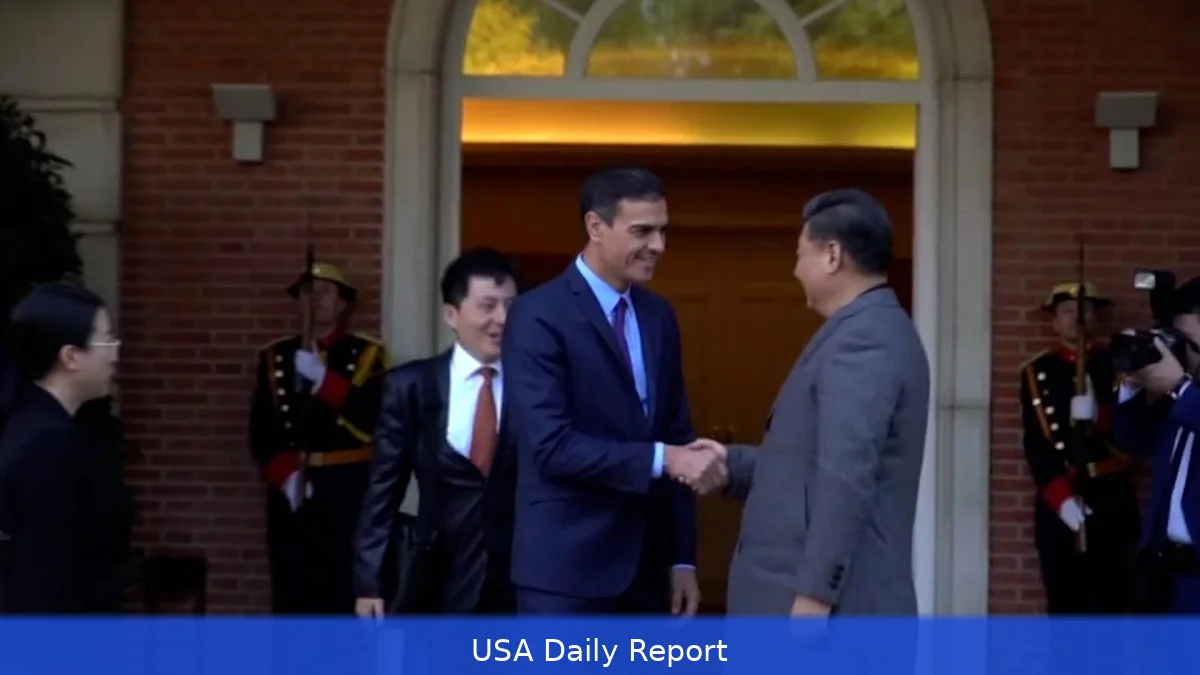
Pedro Sánchez met Xi Jinping in Beijing.
Short meeting, clear message
Pedro Sánchez flew to Beijing to meet Xi Jinping; official statements say the talks emphasized respect for international law and a shared sense of justice. Look, the two leaders emphasized respect for international law and a shared "sense of justice," according to statements released after their meeting.
His trip took place amid rising tensions tied to the United States, Israel and Iran — a security backdrop noted in coverage of the visit. That backdrop framed parts of the discussion in Beijing and gave extra weight to both leaders' insistence on legal norms rather than unilateral force.
What Sánchez said — and why he said it
Pedro Sánchez, Spain's prime minister, told Chinese hosts and the press that "we are a stable, predictable country." The phrase was offered as both reassurance and positioning: Spain wants to be seen as a steady European partner that seeks dialogue over escalation.
Sánchez and Xi Jinping together stressed respect for international law and a common sense of justice. Sánchez's comments work on two levels: reassuring voters at home and signaling Madrid's intentions to foreign governments. Domestically, they signal to voters and businesses that Madrid aims for continuity in foreign relations. Internationally, they're a pitch to Beijing that Spain is a reliable interlocutor during a period of wider instability.
Diplomatic ripple effects for Washington
The meeting matters to U.S. policymakers because it highlights how European capitals balance relations with Washington and Beijing; that balancing act shapes alliance conversations. Spain is a NATO member, and yet its leader chose to accentuate legal norms in a conversation with China's head of state rather than deliver a harsh critique of Beijing.
That stance may open more diplomatic channels and reduce the appeal of unilateral action; diplomats and trade officials will notice the change. For one, it makes room for European diplomacy to pursue parallel channels with China on questions such as regional security, sanctions, and de-escalation. For another, it signals to U.S. Strategists that allies in Europe may press for multilateral approaches rather than U.S.-led responses alone.
Trade and investment — why the meeting matters economically
Beijing is a major economic partner for many European nations, including Spain. Meetings like this one keep trade and investment ties on the agenda even as security tensions rise elsewhere. Sánchez framed his trip as part of normal state-to-state engagement, meant to protect economic links and ensure predictability for Spanish firms with China exposure.

And that predictability matters to U.S. Firms too. Many American companies operate in Europe and Asia simultaneously; a steady Madrid-Beijing relationship helps reduce sudden policy shocks that ripple through global supply chains. If Spain leans toward predictable engagement rather than abrupt policy swings, businesses can better plan for contracts, shipping, and joint ventures.
Strategic balancing without breaking ranks
The meeting offers a snapshot of how middle powers manage great-power competition. Spain is keeping its NATO commitments while also engaging with Beijing on shared principles. Neither leader framed the visit as a shift in alliance structures. Instead, both highlighted international law as the common ground for negotiation.
That choice of language—grounded in legal norms—lets Madrid argue for multilateral problem-solving. It also gives Spain space to act as a mediator or an honest broker on issues where Europe, China and the United States have overlapping concerns.
Limits to what was said
There were no new trade deals or security pacts announced after the talks, according to the official statements released. No new trade deals, no security pacts, no joint declarations on the regional conflict mentioned in public statements. The emphasis was on tone and principles rather than on immediate, binding steps.
Still, tone matters. A public pairing of words like "stable" and "predictable" from a European leader in Beijing sends an unmistakable signal to markets, diplomats and capitals in Washington.
How analysts might read the trip
Observers are likely to see Sánchez's visit as part of a wider European pattern of engagement: steady, rules-focused, and pragmatic. That pattern complicates simple narratives about a Europe uniformly aligning with U.S. Pressure on China. Spain's language — stressing law and justice — is a way to keep dialogue open without endorsing policies that run counter to its allies.
Point is, Madrid is staking out a middle ground. It wants to preserve security ties with NATO partners while keeping economic and diplomatic channels with Beijing functioning. That posture can help defuse immediate tensions, or at least prevent them from widening rapidly.
What this means for markets and multinationals
Investors and multinational firms prefer predictable policies because predictability generally reduces immediate volatility in trade and investment decisions. When a European capital signals steadiness in relations with China, investors take notice. Even if no immediate agreement emerges, the tone of a summit can reduce volatility for companies that rely on transcontinental supply chains.
For U.S. Businesses, the knock-on effect is practical: smoother trade logistics and fewer surprises in tariff or regulatory moves from European partners that might otherwise react sharply to geopolitical shocks. That eases planning for contracts, inventories and investment flows.
Room for mediation, and room for tension
Sánchez's comments open the door to diplomatic outreach aimed at calming regional conflicts. At the same time, the visit illustrated the tightrope Madrid — and other European capitals — must walk between supporting allies and keeping lines open to Beijing.
So the trip was deliberate rather than dramatic: words meant to steady markets, reassure partners, and preserve policy options as tensions swirl elsewhere.
Related Articles
- Lebanon Wants Peace — But Hezbollah Answers to Tehran, Analyst Says
- Hamas Rejects Gaza Disarmament Plan, Stalling U.S.-Backed Phase Two
“We are a stable, predictable country,” Pedro Sánchez said in Beijing.
This article was created with AI assistance.


