Wondering what capital gains tax you'll owe in 2026? It really depends on how long you held your asset, your income, and your state. Here's a breakdown of federal rates, extra taxes, some state examples, how to calculate your tax, common pitfalls, and tips to reduce what you owe.
Quick-reference: key figures at a glance (2026)
Just pick a line to see the key numbers quickly.
- Federal long-term capital gains rates: 0%, 15%, 20%.
- Short-term capital gains: taxed as ordinary income — top federal rate 37%.
- Net Investment Income Tax (NIIT): additional 3.8% for high earners (thresholds: $200,000 single, $250,000 married filing jointly, $125,000 married filing separately).
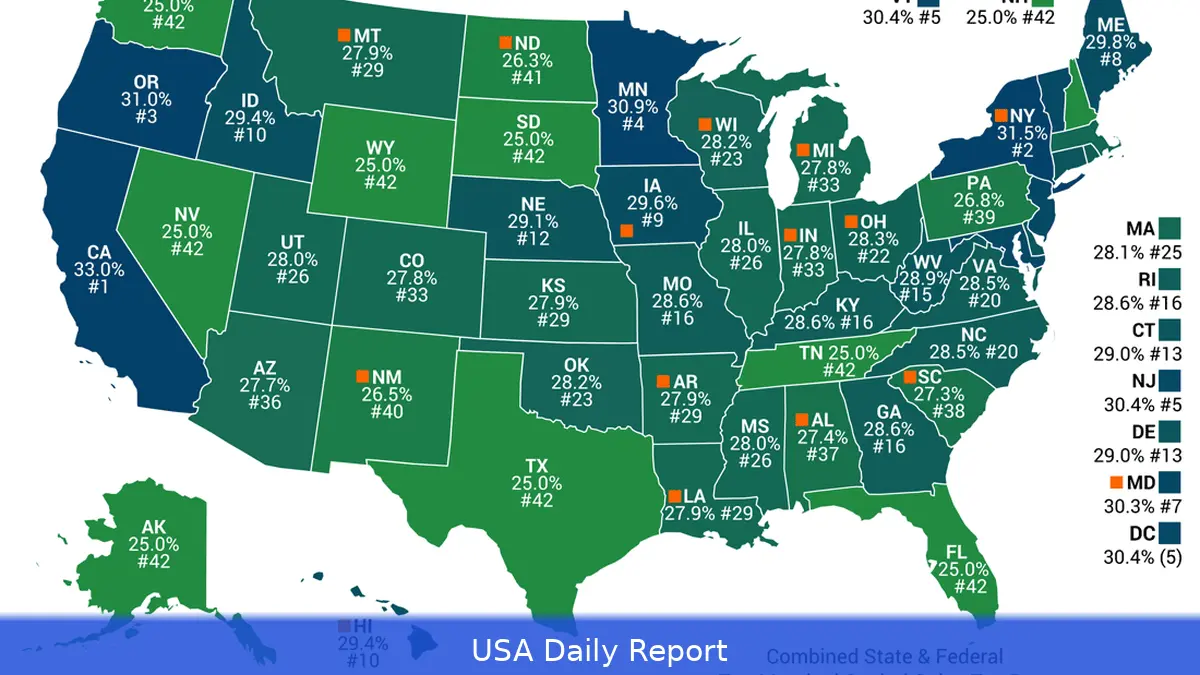
- State tax examples: California top rate 13.3%; Oregon top rate ~9.9%; Florida has no state income tax.
- Typical brokerage trade cost: many brokers offer $0 stock/ETF trades; specialized fees (mutual fund loads, advice fees) vary from $0 to several hundred dollars annually.
- IRS forms used: Form 8949 and Schedule D attach to Form 1040.
Detailed federal breakdown
Capital gains fall into two main categories.
Short-term gains — assets held one year or less — are taxed as ordinary income. Federal ordinary-income rates top out at 37%. So if you sell an asset after 11 months, your gain can be taxed at 10%, 12%, 22%, 24%, 32%, 35% or 37% depending on your taxable income bracket.
Long-term gains — assets held more than one year — get preferential federal rates: 0%, 15% or 20% depending on taxable income. Those three rates are the starting point for most investors in 2026.
High earners can face extra surtaxes. The Net Investment Income Tax (NIIT) adds 3.8% on top of the federal rate when modified adjusted gross income exceeds the thresholds: $200,000 for single filers, $250,000 for married filing jointly, and $125,000 for married filing separately.
That means high earners might pay 23.8% federal tax on qualifying long-term gains.
The top federal short-term result can be steep: 37% ordinary income tax plus 3.8% NIIT equals 40.8% before state tax.
How states change the math
State taxes vary: some treat capital gains like regular income, while others don't tax them.
- California: taxes capital gains as ordinary income. State top rate 13.3%. Example: a wealthy Californian with a long-term gain could face 20% (federal) + 3.8% (NIIT) + 13.3% (CA) = 37.1% total federal+state tax on that gain.
- Oregon: high state rates — top marginal rate around 9.9%. Combined example: 20% + 3.8% + 9.9% = 33.7%.
- Florida, Texas, Washington: no state income tax. Example: 20% + 3.8% NIIT = 23.8% for high earners.
- New York State: top state rate near 10.9% for very high incomes — city taxes can add more for NYC residents.
Nine states have no broad-based personal income tax (Alaska, Florida, Nevada, South Dakota, Tennessee, Texas, Washington, Wyoming, and New Hampshire — though New Hampshire taxes interest/dividends differently). That can cut your total capital gains bill substantially.
Step-by-step: calculate the capital gains tax you owe
You need to do this for every sale in your taxable account.
- Find your basis: what you paid for the asset, plus commissions, plus reinvested dividends. Example: buy 100 shares at $10 = $1,000; $10 commission means basis $1,010.
- Determine sale proceeds: price times shares minus selling costs. Example: sell for $50 per share = $5,000 proceeds; $0 commission on many brokers.
- Compute gain or loss: proceeds minus basis. Example: $5,000 - $1,010 = $3,990 gain.
- Check holding period: >1 year = long-term; ≤1 year = short-term.
- Net gains and losses across sales: short-term losses first offset short-term gains; long-term losses offset long-term gains. Excess losses offset the other bucket, then up to $3,000 of excess losses can offset ordinary income per year, with the remainder carried forward.
- Apply rates: long-term gains use 0/15/20. Short-term gains use ordinary tax brackets up to 37%. Add NIIT 3.8% if your income is above thresholds.
- File forms: report transactions on Form 8949, summarize on Schedule D, and include both with Form 1040.
Examples with numbers
Example A — moderate earner, long-term gain:
- Gain: $40,000.
- Long-term rate assumed: 15% → federal tax $6,000.
- No NIIT because MAGI below $200,000. No state tax in Florida → total tax $6,000 (15% effective).
Example B — high earner in California:
- Gain: $100,000 long-term.
- Federal 20% = $20,000.
- NIIT 3.8% = $3,800.
- California tax ~13.3% = $13,300.
- Total tax ≈ $37,100 → effective rate 37.1%.
Example C — short-term loss offset:
- Short-term loss: $5,000; short-term gain: $2,000 → net short-term loss $3,000.
- That $3,000 offsets ordinary income directly, cutting tax at ordinary rates.
Costs, fees and paperwork
Brokerages now commonly offer $0 stock and ETF trades. Still, watch for:
- Mutual fund loads and 12b-1 fees: can be up to 1% or more annually.
- Advisory fees: 0.25%–1.5% of assets under management per year.
- Cost-basis reporting: brokers issue Form 1099-B. If your broker lacks basis info for older lots, the IRS expects accurate buyer-supplied basis reporting — keep records.
- Tax prep costs: DIY software $0–$200; professional tax prep $200–$1,000+ depending on complexity.
Common mistakes to avoid
- Misreporting basis — forgetting reinvested dividends or commissions can overstate tax.
- Triggering a wash sale — repurchasing the same or substantially identical security within 30 days disallows the loss.
- Ignoring state tax on capital gains — it can add 5% to 13% more tax depending on the state.
- Assuming inherited assets always create taxable gains — most inherited assets get a stepped-up basis to fair market value at death, often eliminating gains accrued before inheritance.
- Forgetting to net short- and long-term gains correctly — they’re netted in separate buckets before cross-offsets.
Alternatives and strategies to lower tax
- Tax-loss harvesting: sell losers to offset gains; you can carry forward unused losses indefinitely.
- Hold at least one year to get long-term rates — that alone can drop the federal rate from as high as 37% to as low as 0% or 15%.
- Use tax-advantaged accounts: Roth IRAs and 401(k)s grow tax-free; sales inside don’t trigger capital gains taxes now.
- 1031 exchanges for real estate (deferred tax on like-kind real property exchanges when rules met).
- Gifting and charitable giving: gifting to family or donating appreciated assets to a qualified charity can avoid capital gains tax and produce other tax benefits.
Forecast and what to watch in 2026
Policy discussions sometimes target capital gains — proposals range from taxing gains at ordinary rates for very high earners to changing how inflation is counted into basis. Nothing permanent changed federal long-term rates entering 2026: the three-tier 0/15/20 system and the 3.8% NIIT remain in place. Still, Congress can change tax law, and state tax rules keep shifting — especially in states debating higher top rates. If taxable income rises with inflation, more taxpayers will cross NIIT thresholds and higher brackets.
Related Articles
- How to file taxes as a 1099 contractor in 2026
- How much is self-employment tax in 2026: rates, caps, examples, and how to calculate it
- How to apply for federal income tax (2026): step-by-step guide
Capital gains tax in 2026 is still built on three federal long-term rates (0%, 15%, 20%), short-term gains taxed as ordinary income up to 37%, and a 3.8% NIIT for higher earners. State tax rules can move your bill dramatically — from about 23.8% in no-income-tax states for high earners to north of 37% in high-tax states like California. Calculate carefully: basis, holding period, netting, and state rules all matter. Keep records, harvest losses where it makes sense, and use tax-advantaged accounts when possible.


