
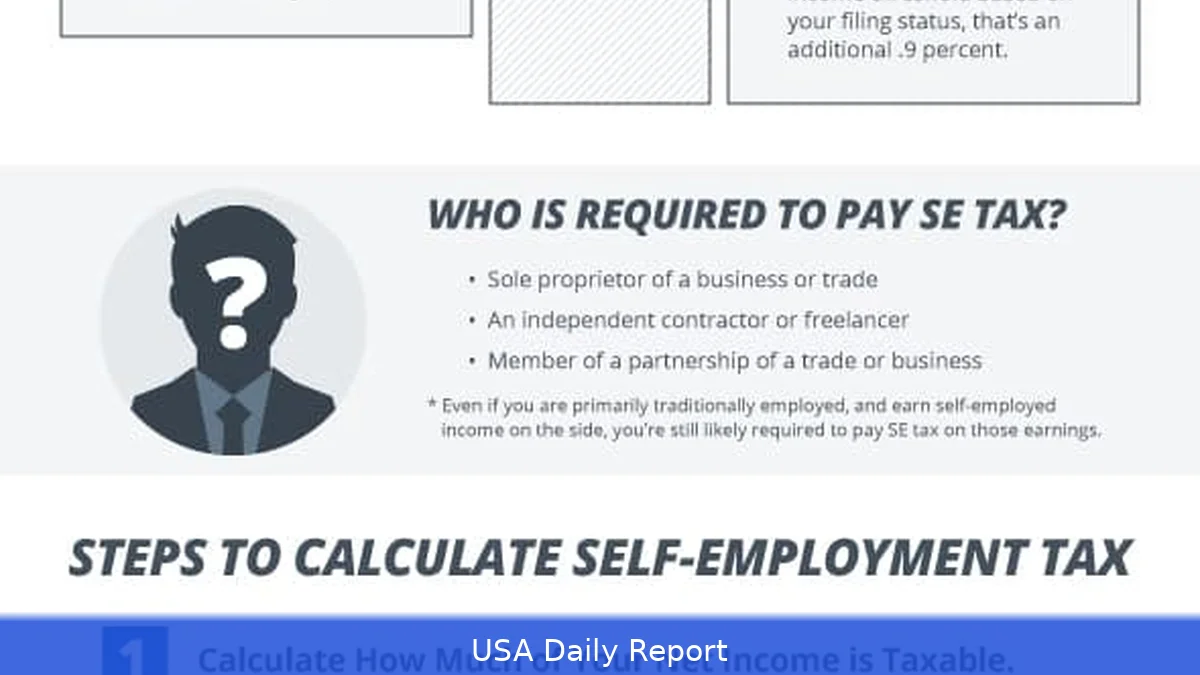
Self-employment tax covers the Social Security and Medicare taxes you must pay if you run your own business. It's not income tax — it's the payroll tax for self-employed people. I'll walk through the 2026 rates, who owes the tax, how to calculate it step by step, how to file and pay, and common mistakes to avoid.
Quick-reference summary
- What it is: Payroll tax for self-employed people — Social Security + Medicare.
- 2026 combined rate: 15.3% total — 12.4% Social Security + 2.9% Medicare.
- Tax base: Applies to net self-employment earnings of $400 or more in a tax year.
- Calculation detail: Tax is computed on 92.35% of net earnings (multiply net profit by 0.9235).
- Additional Medicare tax: 0.9% applies on earnings over $200,000 for single filers; $250,000 for married filing jointly; $125,000 for married filing separately.
- Deduction: You can deduct half of your self-employment tax (50%) as an adjustment to income on Form 1040.
- Forms & pages: File Schedule SE (Form 1040). IRS page: https://www.irs.gov/businesses/small-businesses-self-employed/self-employment-tax-social-security-and-medicare-taxes
- Estimated payments: Use Form 1040-ES and pay quarterly via EFTPS or IRS Direct Pay: https://www.irs.gov/payments/estimated-taxes and https://www.eftps.gov
- Social Security wage base and benefit info: check Social Security Administration: https://www.ssa.gov
Prerequisites
Before calculating or paying self employment tax, gather these key items. You'll save time and reduce errors.
- Net profit or loss from your business — after all deductible business expenses — from bookkeeping or Schedule C (Form 1040). That profit figure is the starting point.
- Record of any wages you earned as an employee during the year (W-2s). If you had employer wages, those count separately toward Social Security wage limits.
- Access to the IRS pages and PDF forms: Schedule SE (Form 1040) at https://www.irs.gov/forms-pubs/about-schedule-se-form-1040 and Form 1040-ES at https://www.irs.gov/forms-pubs/about-form-1040-es
- Bank account and routing info, or enrollment in EFTPS (Electronic Federal Tax Payment System) for reliable federal tax payments: https://www.eftps.gov. You can also use IRS Direct Pay or pay by card (processing fees apply).
- Awareness of estimated tax due dates: generally April 15, June 15, September 15, and January 15 of the following year. Missing these can trigger penalties and interest.
- Basic calculator or tax software. Software automates the 0.9235 adjustment and the two-part tax calculation, and often handles withholding credits and estimated payments.
Step-by-step: How to calculate and pay self employment tax
-
Confirm whether you owe self-employment tax.
Sure, self employment tax applies if net earnings from self-employment are $400 or more for the year. If net earnings are under $400, you generally don't owe self-employment tax, though you may still need to file a return if your gross income meets filing thresholds.
-
Get your net profit number.
Start with net profit from Schedule C (or other business return). That number is revenue minus ordinary and necessary business expenses. If you operate several businesses, combine net profits and losses across them to determine total net earnings from self-employment.
-
Apply the 92.35% adjustment.
Multiply your net profit by 0.9235 to get the amount subject to self-employment tax — for example, $50,000 × 0.9235 = $46,175. Example: if your net profit is $50,000, your SE tax base is $50,000 × 0.9235 = $46,175.
-
Compute the two-part tax.
Multiply that SE tax base by the Social Security rate (12.4% in 2026) and the Medicare rate (2.9%) to calculate each portion of the tax. So continue the example: $46,175 × 12.4% = $5,726. $46,175 × 2.9% = $1,339. Add them for total SE tax of $7,065.
Remember additional Medicare: if your combined earnings exceed $200,000 (single) or $250,000 (married filing jointly), add 0.9% on the amount above those thresholds. That extra tax is applied only to Medicare — there's no employer match on the additional 0.9%.

-
Look at the Social Security wage base.
Social Security tax only applies up to the annual wage base set by the SSA, so high earners stop paying the Social Security portion after that cap. Check current wage base figures at https://www.ssa.gov because that cap can change annually. If you have both employer wages and self-employment income, you may hit the cap with combined earnings. Calculate carefully to avoid over- or under-paying.
-
Claim the employer-equivalent deduction.
You're allowed to deduct half of your self-employment tax as an adjustment to income on Form 1040. On the example above, half of $7,065 is $3,532.50 — that amount reduces your adjusted gross income and lowers income tax, but not self-employment tax.
-
Report it on Schedule SE and Form 1040.
Use Schedule SE to compute and report self-employment tax. Transfer the deduction for half the SE tax to Form 1040 as an adjustment to income. If you're using software or a tax preparer, they'll populate these forms automatically. The IRS page for Schedule SE is https://www.irs.gov/forms-pubs/about-schedule-se-form-1040
-
Make estimated quarterly payments.
If you expect to owe $1,000 or more after withholding and credits, pay quarterly estimates with Form 1040-ES to avoid penalties. Typical deadlines are April 15, June 15, September 15, and January 15 of the following year. Use EFTPS, IRS Direct Pay, or the IRS payment portal. If you don't pay enough during the year, you'll owe a penalty and interest.
-
Use tax credits and withholding to reduce payments.
If you have a spouse with withholding or you can increase withholding on W-2 wages you receive, you can use those to lower estimated tax payments. But withholding and estimated payments aren't interchangeable — plan ahead to avoid underpayment penalties.
-
File on time and pay the balance due.
File your Form 1040 with Schedule SE by the filing deadline. If you owe when you file, pay electronically for fastest credit. Options: EFTPS (https://www.eftps.gov), IRS Direct Pay, or paying by card through approved processors (fees apply). If you can't pay in full, consider an IRS installment agreement to avoid enforced collection.
Tips
Keep records all year. Track income by client and date. Save receipts and mileage logs. Use accounting software or a simple spreadsheet. Estimate taxes monthly if cash flow is tight. That keeps quarterly payments predictable.
Set aside a percentage of gross receipts — many pros recommend 25% to 30% depending on your tax bracket and state taxes — to cover income tax and self-employment tax. Check state income tax rules; some states tax self-employment income differently.
Use a payroll service if you hire contractors or employees. Misclassifying workers as independent contractors can trigger penalties. If you're unsure, use IRS resources or a tax professional.
Common mistakes to avoid
- Underestimating quarterly payments. Missing payments means penalties and interest.
- Forgetting the 0.9235 adjustment. Many people try to apply rates to gross profit and overpay or underpay.
- Ignoring the half-SE-tax deduction. It reduces income tax, so don't skip it.
- Miscalculating the additional Medicare tax. That extra 0.9% applies only to the portion above the threshold and can surprise high earners.
- Overlooking the Social Security wage base if you also have W-2 wages. Combined income can hit the cap, changing how much SE tax you owe.
- Poor recordkeeping. Missing receipts can cut deductions and boost taxable profit.
Related Articles
- Masters Payout 2026: Prize Breakdown, Taxes, and How Players Get Paid
- The best Zoom alternatives in 2026: Expert tested and reviewed
- Best Jobs in the US 2026 — Highest Paying and Most In-Demand
Self employment tax meaning is simple once broken down: it's the payroll tax self-employed people pay for Social Security and Medicare. Know the 15.3% combined rate, the $400 threshold, the 0.9235 calculation, and that you can deduct half the tax on Form 1040. Use Schedule SE, make quarterly payments with Form 1040-ES when needed, and check IRS and SSA pages for the latest wage base numbers.
This article was created with AI assistance.


