
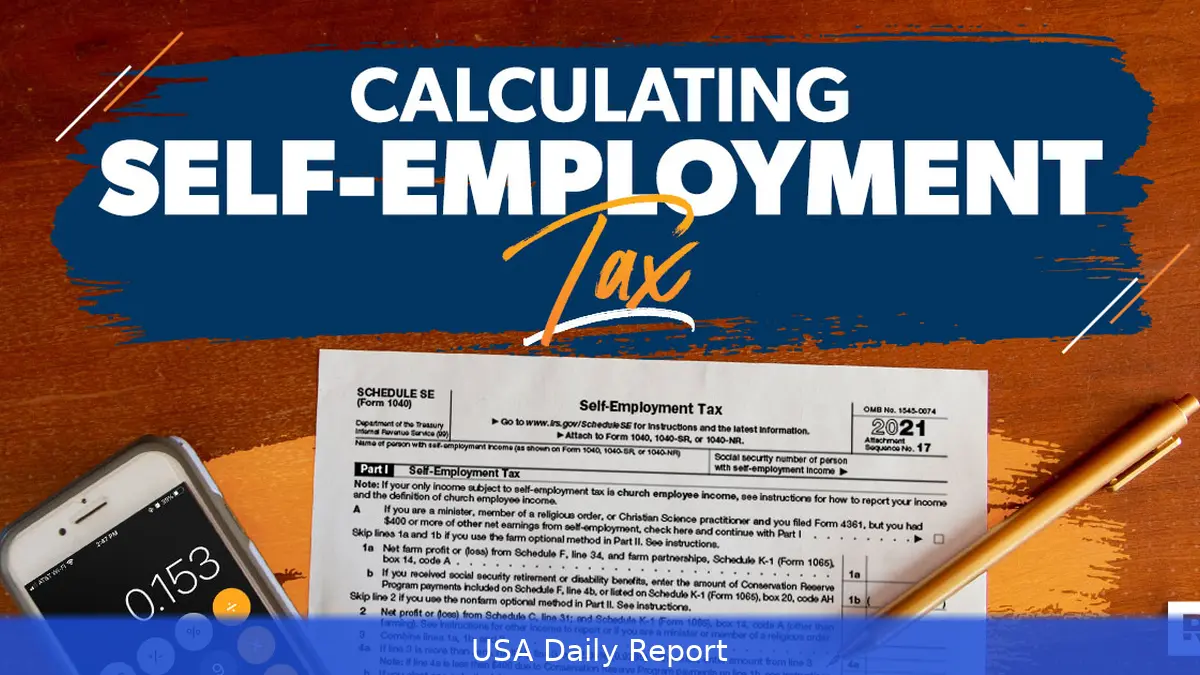
If you work for yourself, self-employment tax covers your Social Security and Medicare contributions. In 2026 the tax rate you pay stays familiar — but caps, thresholds, and filing details matter. Here’s a breakdown of the numbers, how to calculate your tax, common slip-ups, and some practical examples to help independent workers get a clear picture.
Key figures at a glance (quick reference)
- Self-employment (SE) tax rate: 15.3% (12.4% Social Security + 2.9% Medicare).
- Tax base for SE calculation: 92.35% of net self-employment earnings.
- Social Security wage base (most recent official): $176,100 for tax year 2025 (SSA sets 2026 figure; check SSA/IRS for the official 2026 cap). This cap limits the 12.4% Social Security portion.
- Medicare applies to all net earnings at 2.9%; additional Medicare tax of 0.9% applies above thresholds: $200,000 single, $250,000 married filing jointly, $125,000 married filing separately.
- SE tax only applies if net earnings from self-employment are $400 or more in the tax year.
- Employer-equivalent deduction: you may deduct 50% of your SE tax when calculating adjusted gross income.
- You’ll typically use Schedule SE with your Form 1040, Form 1040-ES for estimated payments, and get a 1099-NEC if you’re paid as a contractor.
How to calculate self-employment tax — step by step
1. Start with net profit from your business (Schedule C or other profit/loss statements). Example net incomes used below: $30,000, $50,000, $100,000, $200,000, $300,000, $500,000.
2. Multiply net earnings by 92.35% — that's the portion subject to SE tax. So for $100,000 net: $100,000 × 0.9235 = $92,350.
3. Apply Social Security tax (12.4%) on that adjusted amount up to the annual wage base. If the wage base is the 2025 figure $176,100, then the maximum Social Security portion of SE tax in 2025 is approximately $21,814 (that’s 12.4% of $176,100 × 0.9235).
4. Apply Medicare tax (2.9%) on the full adjusted amount — no cap. Add 0.9% Medicare surtax on any earnings above the filing-status thresholds.
5. Add the Social Security and Medicare portions to get total SE tax. Then remember you can deduct half of that SE tax as an adjustment to income on Form 1040.
Concrete examples (using 15.3% rate and 2025 Social Security wage base $176,100)
Honestly, note: the Social Security wage base for 2026 is set by SSA — official 2026 cap should be used when it’s published. Below uses the latest confirmed 2025 cap of $176,100 for comparison.

- $30,000 net: taxable SE base = $27,705. SE tax = 15.3% × $27,705 = $4,238. Estimated employer-equivalent deduction = $2,119.
- $50,000 net: taxable SE base = $46,175. SE tax = 15.3% × $46,175 = $7,067. Deductible half = $3,534.
- $100,000 net: taxable SE base = $92,350. SE tax = 15.3% × $92,350 = $14,124. Deductible half = $7,062.
- $200,000 net: taxable SE base = $184,700. But Social Security 12.4% only applies to the wage cap. Using 2025 cap $176,100: Social Security portion = 12.4% × ($176,100 × 0.9235) ≈ $20,181; Medicare portion = 2.9% × ($184,700) = $5,355; plus additional Medicare surtax 0.9% on amount over thresholds (for married filing jointly, $200,000 threshold rules vary). Total SE tax ≈ $25,536 plus 0.9% surtax where applicable.
- $300,000 net: taxable SE base = $277,050. Social Security capped as above; Medicare portion = 2.9% × $277,050 = $8,034; add 0.9% surtax on amounts above thresholds. Total SE tax will be roughly $28k–$30k depending on filing status.
- $500,000 net: SE tax dominated by uncapped Medicare and surtax. Medicare portion = 2.9% × $461,750 (92.35% of net) ≈ $13,390; plus Social Security capped portion; plus 0.9% on high-income amount. Total SE tax often exceeds $34k.
Required filings, deadlines, and minimums
- File Schedule SE with Form 1040 for the tax year.
- Make estimated quarterly tax payments with Form 1040-ES if you expect to owe $1,000 or more when you file. Typical due dates for 2026 estimated payments are April 15, June 15, September 15, 2026 and January 15, 2027 (watch IRS calendar for exact dates and weekend/holiday shifts).
- Safe-harbor rules to avoid underpayment penalties: pay at least 90% of the current year’s tax or 100% of the prior year’s tax. If your adjusted gross income was more than $150,000, the safe harbor to rely on prior-year tax is 110% instead of 100%.
Eligibility and thresholds to remember
- If you make $400 or more from self-employment in a year, you’ll owe SE tax.
- The employer-portion deduction (50% of SE tax) reduces your adjusted gross income — that lowers income tax, not your SE tax.
- Additional Medicare tax of 0.9% kicks in at $200,000 single, $250,000 married filing jointly, $125,000 married filing separately.
Common mistakes and how to avoid them
- Not calculating SE tax: people focus on income tax and forget SE tax — that can double the tax bill compared with expected withholding from a W-2 job. So plan for roughly 15.3% on the taxable SE base before income tax.
- Forgetting the 92.35% adjustment — the IRS doesn't tax the full net profit for SE tax.
- Missing the $400 threshold — even small gigs can trigger the requirement.
- Skipping quarterly payments — that leads to underpayment penalties. Use Form 1040-ES or electronic payment options.
- Misclassifying workers as independent contractors to avoid payroll taxes — state and federal rules require correct classification; penalties can be steep.
Alternatives and tax planning strategies
- Electing S corporation status: Some owners split profits into a reasonable salary (subject to payroll taxes) plus distributions (not subject to SE tax). That can reduce SE tax, but it brings payroll costs and IRS scrutiny over “reasonable salary” levels. Example: if a business nets $100,000, paying yourself a $60,000 salary vs. $100,000 salary can lower SE-equivalent payroll taxes — but you still pay employer payroll taxes and additional filing costs.
- Hiring payroll service: Payroll services charge from about $25 to $150+ per month plus per‑payroll fees; they handle Form 941, state payroll filings, and withholdings. Consider that overhead when comparing to SE tax savings.
- Retirement plans (SEP IRA, Solo 401(k)): Contributions reduce taxable income. For 2025 limits: SEP IRA allows employer contributions up to 25% of compensation or $66,000 (2023–2025 historical limits vary). Check current 2026 limits when planning big contributions.
Forecast and what to watch in 2026
- SE tax rate (15.3%) is unchanged for 2026. But the Social Security wage base is adjusted annually by SSA based on national average wages. The last confirmed cap is $176,100 for 2025. Expect an upward adjustment in 2026 — historically the cap rises by several thousand dollars each year.
- The additional 0.9% Medicare surtax thresholds ($200,000 single, $250,000 married filing jointly) haven't changed. Watch Congress and IRS guidance for any legislative changes that could affect payroll tax rules or the Medicare surtax.
- Plan cash flow for quarterly payments. With inflation and higher earnings, more freelancers hit the wage base and the additional Medicare surtax — so tax bills can jump even without rate changes.
Where to record and what forms to use
- Schedule SE for computing SE tax, attached to Form 1040.
- Form 1040-ES for estimated tax vouchers and electronic payment.
- 1099-NEC for reporting nonemployee compensation paid to others; Form W-2 applies if you have employees.
Related Articles
- Self employment tax meaning: What it is, how it’s calculated, and how to pay it in 2026
- How to apply for federal income tax (2026): step-by-step guide
- How to file for EITC on TurboTax in 2026
Self-employment tax is mostly predictable: 15.3% applied to 92.35% of your net self-employment earnings, with Social Security capped at an annually adjusted wage base and Medicare uncapped (plus a 0.9% surtax above income thresholds). Know the $400 filing trigger, plan quarterly payments, and weigh tax-saving options like retirement plans or S-corp payroll. Use the latest SSA wage-base number for 2026 when it’s published — that’s the single figure that changes year to year and affects how much of your income gets hit by the 12.4% Social Security portion.
This article was created with AI assistance.


