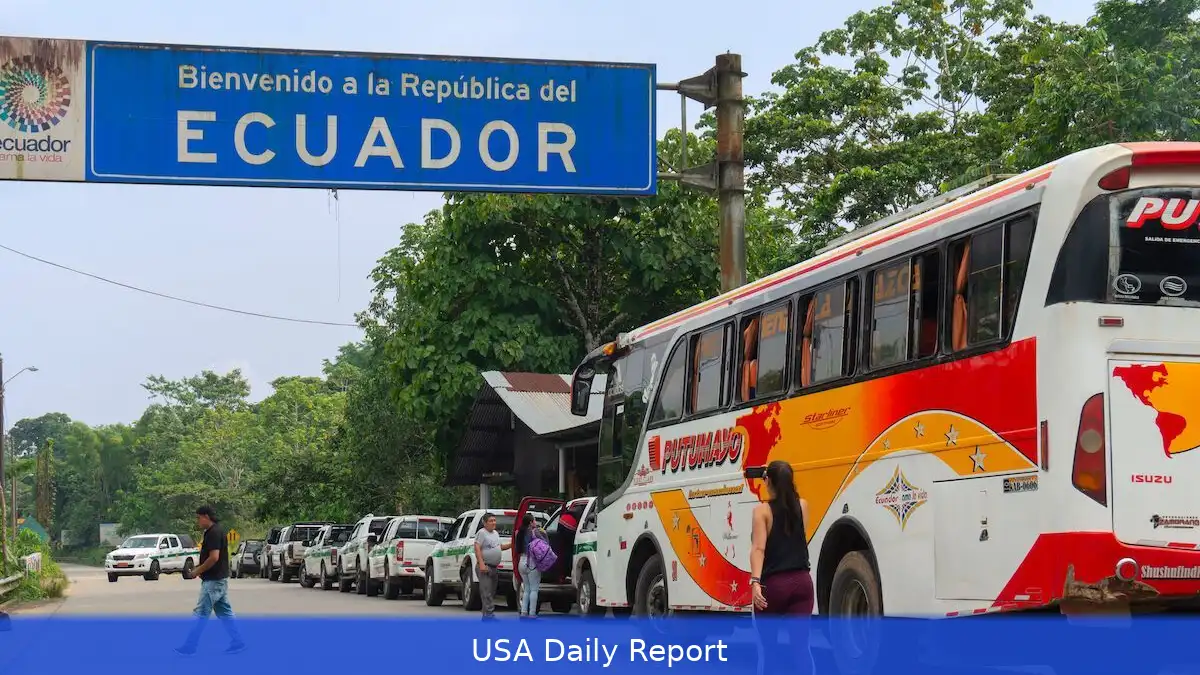
Tariffs on goods crossing the Colombia–Ecuador border rose sharply overnight after Colombia raised its rate from 30% to 100% to match Ecuador. Colombia announced on Friday it will raise import duties on Ecuadorian goods to 100 percent, up from 30 percent. Colombia's step matched a tariff hike Quito announced the day before, and it deepened an already worsening diplomatic rift between the two governments.
Immediate move and official reasoning
Colombia’s Ministry of Commerce, Industry and Tourism confirmed the decision on Friday, saying the new duties take effect immediately.
Bogotá said it was responding directly to Quito's action, not launching a broader trade offensive. The government said Ecuador had increased tariffs a day earlier, pushing its own duty rate to 100 percent, and that Colombia had little choice but to match the level.
Colombian Trade Minister Diana Morales said the government tried diplomacy first. "We have exhausted all diplomatic efforts and kept channels of dialogue open with the government of Ecuador, seeking a solution that benefits both countries, businesses, and above all, the communities on both sides of the border," Morales said, adding that Colombia "did not receive a positive response."
For now, both governments have set certain import duties at 100%, creating a mirror image in their tariff policies. That symmetry, however, is the product of a tit‑for‑tat escalation rather than a negotiated settlement.
What Quito said and what Bogotá replied
Ecuador’s government justified its recent tariff hikes by pointing to a persistent trade deficit with Colombia and alleging that Colombia wasn’t doing enough to stop illicit drugs crossing the border.
Colombia rejects that charge. Bogotá highlights its counter‑narcotics operations, including what it said was the single largest drug seizure in a decade last November, as proof it’s taking action against trafficking. The Colombian government says those operations demonstrate its commitment to stemming flows of illicit drugs — a central point of contention between the two capitals.
Political rancor has fed the dispute. Colombian President Gustavo Petro has repeatedly described former Ecuadorian Vice President Jorge Glas as a "political prisoner" and has pushed for Glas, convicted on corruption charges, to be transferred to Colombia. Ecuadorian President Daniel Noboa answered with harsh language, calling Petro’s comments an "assault on our sovereignty."
Sharp rhetoric and contested security incidents near the border, including Petro's claim of bombing, have eroded trust and made it harder to calm the dispute.
Economic and social fallout along the border
Small businesses and communities that straddle the Colombia‑Ecuador frontier stand to feel pain first. Many border traders run on tiny margins, so a sudden 100% duty can push the price of imported goods much higher and squeeze local livelihoods.
Morales explicitly referenced those local effects when she described the government’s failed diplomatic push as an effort to find a solution that "benefits both countries, businesses, and above all, the communities on both sides of the border."
Look, goods that commonly cross the border — foodstuffs, industrial inputs, parts for agriculture or informal market items — could become more expensive or harder to source if traders halt shipments to avoid crushing tariffs. That, in turn, risks higher consumer prices and squeezed livelihoods in towns where trade is a daily reality.
If both sides step up customs checks to enforce the new duties, trucks and shipments will likely face delays and higher logistics costs. For companies that rely on frequent cross‑border shipments, supply chains may need rapid adjustments.
Political signals and regional repercussions
The tariff spat is as much political as it's economic. Leaders on both sides have traded public accusations — on corruption, on sovereignty, and on whether military action near the border was coordinated — and those accusations now have a financial bite.
Colombia’s decision to mirror Quito’s tariff level sends a clear diplomatic message: economic pressure will be part of the mix until grievances are addressed. But using tariffs as leverage can backfire — the costs fall on firms and households, not just on foreign governments.
For neighboring countries and regional organizations that prefer stability on shared frontiers, the dispute complicates cooperation on issues like security and migration. Tension at one border often has a spillover effect across the region, affecting trade flows and political calculations.
What it could mean for the United States
U.S. Officials and companies watch developments in the Andes because Colombia and Ecuador play roles in hemispheric trade and security. The dispute touches on narcotics flows — an issue Washington has long prioritized — and on commercial links that include American investors and multinational supply chains.
American firms with sourcing or logistical ties across the two countries may face higher costs or interruptions if shipments slow or reroute. And U.S. Policymakers focused on regional stability will be monitoring whether the tariff conflict interrupts cooperative efforts on counternarcotics, trade, or migration.
For now, the change affects only Colombia and Ecuador directly. Neither Bogotá nor Quito has formally cut diplomatic ties, and both sides continue to use public channels to air grievances. The risk, though, is that economic pain at the border hardens political positions and makes a negotiated rollback harder to achieve.
Pathways out of the dispute
Trade experts and diplomats typically point to negotiation, arbitration or use of regional trade rules to resolve tariff disagreements — routes that avoid long bouts of economic harm. In this case, Colombia says it tried diplomacy first and will enact its countermeasure immediately.
Restoring lower duties would likely require a political compromise: Ecuador would need reassurance on its security concerns or on the trade imbalance, while Colombia would want guarantees about fair treatment for its exporters and an end to public attacks on Colombian officials.
For now, the two governments are trading measures instead of proposals. That pattern creates uncertainty for businesses, for border communities and for any external partners — including the United States — with an interest in steady trade and security cooperation.
Short timeline
In recent months: Quito raised tariffs, citing a trade deficit and security concerns. Bogotá denied the allegations and pointed to recent counter‑narcotics operations. On Thursday, Ecuador pushed its tariff rate to 100 percent. On Friday, Colombia matched that rate, announcing the change would take effect immediately.
Related Articles
- Wall Street Rewrites 2026 Playbook as Iran Conflict Raises Costs and Risks
- Can’t find the AP story on the Massachusetts wind dispute — here’s relevant tech context from AP reporting
- Prince Harry Sued for Defamation by Sentebale, Charity He Co-Founded
"We have exhausted all diplomatic efforts and kept channels of dialogue open with the government of Ecuador, seeking a solution that benefits both countries, businesses, and above all, the communities on both sides of the border," Diana Morales, Colombia's Trade Minister, said.


