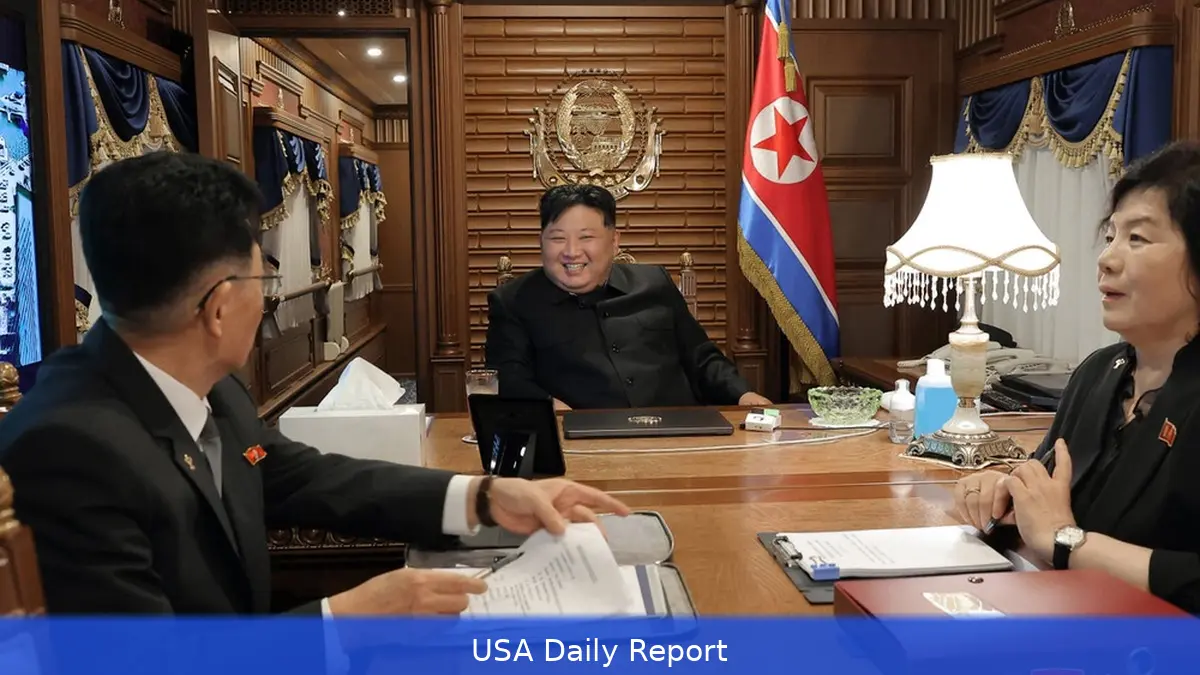
Kim Jong Un arrived in Beijing by armored train for a September parade.
Show of strength on Beijing's doorstep
Kim Jong Un's trip to China this year wasn't just ceremonial. He rolled into the capital by armored train for a military parade and brought a senior economic team with him, signaling a split focus on both weapons and trade.
The optics were just as important as the meetings.
On stage with other leaders, China's top officials and North Korea's ruler displayed a closer relationship. Chinese Premier Li Qiang later returned the visit in Pyongyang, and Beijing's ambassador called the exchanges a chance to "write a new chapter," according to Reuters reporting.
The parade and follow-up talks came after years of cool ties between Beijing and Pyongyang, and they arrived against a backdrop of rising trade between the two neighbors. Chinese exports to North Korea climbed to about $2.3 billion last year — a roughly 25% jump from the prior year — even as U.N. Sanctions on Pyongyang remain in force.
Trade flows, infrastructure and sanctions friction
That trade bump wasn't just a number on a spreadsheet. Satellite images and on-the-ground reporting show China and North Korea building new border infrastructure — roads and port work — that would make cross-border commerce easier if political constraints loosen.
Those projects increase Beijing's leverage. And they matter financially because they shape which markets, goods and cash flows get prioritized between the two countries.
China has started to soften some of its public language about North Korea. In November, Beijing removed a longstanding insistence on denuclearization from an official arms-control white paper. At a time when Washington has pushed for tighter enforcement of sanctions, Beijing's tone shift hints at a willingness to reframe its approach to Pyongyang.
Russia also plays a role here. Vladimir Putin's presence at regional summits alongside Chinese leaders showd Moscow's growing ties with both Beijing and Pyongyang. At a security summit in Tianjin, Chinese President Xi Jinping warned that "the world is experiencing changes not seen in a century, with significantly increasing instability and uncertainty," remarks delivered in front of numerous heads of state including President Vladimir Putin.
Military spectacle meets economic outreach
North Korea's leadership didn't just parade hardware. Kim brought economic officials to Beijing specifically to talk trade and investment, Reuters reported. By showing off weapons and opening economic channels at the same time, it makes it harder for markets and policy-makers to assess risk in the region.
Short-term market moves may be muted. Long-term plans are another story.
Big infrastructure projects on the border could ease freight flows and increase North Korea's ability to move commodities in and out, should political and sanctions conditions allow. That would affect commodity suppliers in China, logistics firms operating on the border, and any foreign firms that eventually consider investment in sanctioned-adjacent projects if restrictions shift.
Still, most Western firms and banks are limited by sanctions for now. And those rules still limit how much private capital can flow into North Korean projects without violating U.N. Or national measures.
Where Trump's China trip fits in
U.S. President Donald Trump has kept the question of direct engagement with Kim in play as he plans a visit to China. South Korean Prime Minister Kim Min-seok told Yonhap News Agency that his Oval Office meeting with Trump left him with the impression that Trump still favors restarting talks with Kim Jong Un — though timing remains flexible.
Trump himself told reporters he was "open to it, 100%" about meeting Kim, and said, "I got along very well with him, Kim Jong Un," remarks carried in media accounts of his comments. He also described North Korea as "sort of a nuclear power."
If Trump were to seek a meeting during or around a China trip, it would thread a sharp policy needle. Any U.S.-North Korea engagement risks colliding with the economic and diplomatic realities Beijing is shaping on the peninsula — and with the sanctions that underpin Western pressure on Pyongyang.
This intersection is as much financial as it is political because Washington controls many of the world's banking systems that settle trade in dollars. Beijing controls the bulk of North Korea's legitimate trade channels.
Implications for markets and policy
Investors and policy-makers need to keep an eye on a few key issues.
First: trade flows. If Beijing keeps expanding exports to North Korea and improves cross-border logistics, Chinese firms may find new opportunities — though those chances come with legal and reputational risk for foreign partners.
Second: sanctions language and enforcement. China's removal of explicit denuclearization language from an arms-control paper signals a recalibration. That kind of shift doesn't automatically change rules, but it can make enforcement less vigorous and create grey areas that traders might attempt to exploit.
Third: diplomatic sequencing. If the U.S. Pursues a high-profile meeting between President Trump and Kim, Beijing would be the gatekeeper for any meaningful economic follow-up. And Beijing has shown it can bind Pyongyang closer through purchases, infrastructure and political signaling — all levers that shape what Pyongyang will or won't do in negotiations.
What corporate treasuries should check
Corporate risk managers should rethink three areas: compliance, supply-chain routing, and planning for possible changes in sanctions.
Compliance units should verify counterparties and transport routes in Northeast Asia. That's basic, but it's also where many enforcement cases start. Global banks and trade-finance arms should ask tough questions about cargo, end users and ownership chains that intersect with the Korean peninsula.
Supply-chain teams need to map exposure to inputs that could reroute through China-North Korea channels if border infrastructure upgrades make that doable. And treasury teams should recalibrate contingency plans: what happens to pricing, insurance and financing if a diplomatic thaw allows more trade — or if tensions spike and push insurers away.
Politics will shape the math
Kim's diplomatic and military displays are political acts with financial spillovers. When Xi Jinping and Vladimir Putin stand shoulder to shoulder with Pyongyang — and when China quietly ramps up commerce — markets get a new set of parameters to price into risk models.
That said, any quick change to global capital flows is unlikely. Sanctions remain a strong brake. Still, the direction of Beijing's policy and whether Washington opens direct talks with Pyongyang will matter a lot for long-term investment calculations.
Frankly, it's a slow-moving story with sudden jolts. Watch the infra projects on the border, track the trade numbers, and keep an eye on any meeting calendars that put Trump and Kim in proximity — directly or via third parties.
Related Articles
- Gasoline surges 21% as Iran conflict sends March inflation to 3.3%
- Nvidia’s Jensen Huang Tells People to ‘Move to California’ as Proposed Billionaire Tax Looms
- European airports face jet-fuel squeeze within weeks as Strait of Hormuz disruption bites
North Korean state media reported that Kim Jong Un said cooperation "will become even closer in the future as we advance the common cause of socialism."


