
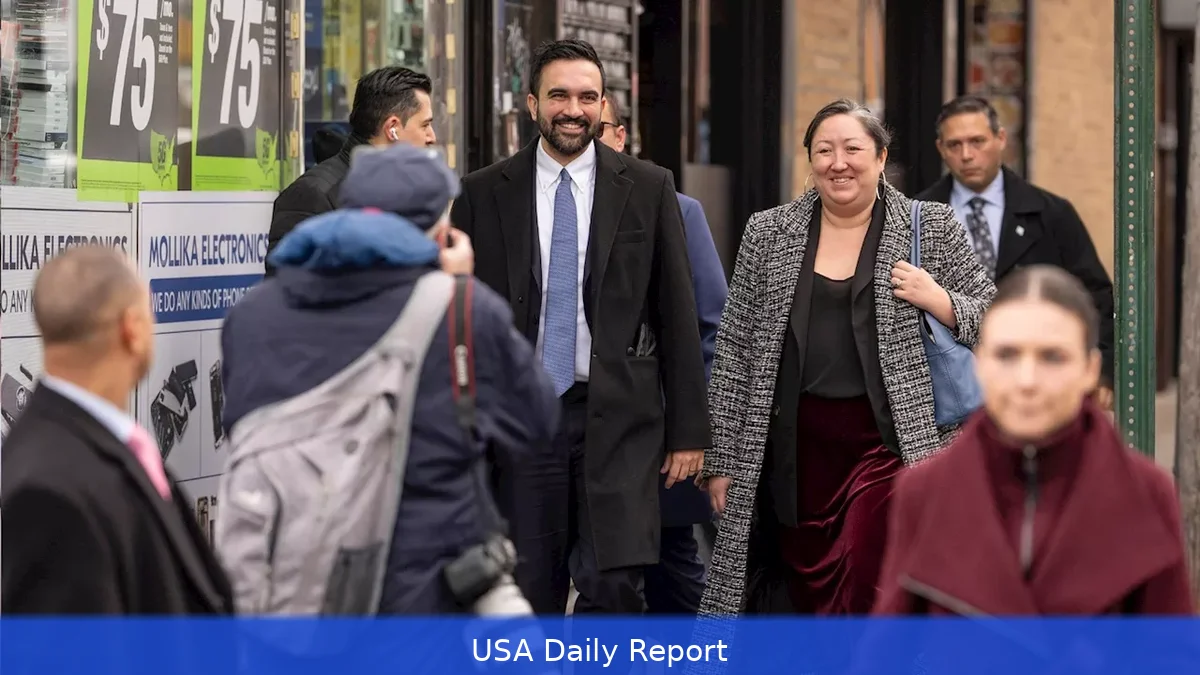
Thousands braved the cold at City Hall Park.
A symbolic inauguration, a practical agenda
Zohran Mamdani stood before a packed crowd at City Hall Park nearly 100 days ago and took office as New York City's mayor. He entered that role as the city's first Muslim mayor and as a self-described Democratic socialist who ran on affordability. His victory felt bigger than a city election — it tested whether a campaign built on cost-of-living promises could govern the nation's biggest financial center.
His message focused on everyday struggles. "The only real majority in this country and in this city is that of the working class," Mamdani told Al Jazeera in an interview at City Hall. He repeatedly tied his priorities to the pressures New Yorkers face, pointing to record rents, rising grocery bills and the high price of childcare.
That message helped bring thousands to the polls last year, and it sharpened the political scrutiny he'll face as mayor. Republicans nationwide labeled him with extreme rhetoric, some calling him a communist, while leaders within his own party offered cold responses: Congresswoman Laura Gillen called him too "extreme," and Senate Majority Leader Chuck Schumer and House Minority Leader Hakeem Jeffries withheld endorsements during the campaign.
Early wins: childcare and potholes
Mamdani's first 100 days have a clear short list of accomplishments that his team points to. Chief among them is a signature campaign pledge: expanded access to childcare. The administration announced a plan to add 2,000 daycare seats, targeting lower-income neighborhoods first.
For many families, it could mean spending less time looking for daycare and having a little more room in their monthly budgets.
The childcare rollout didn't rely on new taxes; state and city officials used existing revenue instead. Mamdani and Governor Kathy Hochul secured $1.2 billion from the state's existing revenue streams as part of the 2026 fiscal-year budget to fund the expansion. The city plans to open signup for two-year-old spots in June, with offers expected by August.
That timetable matters for working parents juggling jobs and costs. Mamdani has framed childcare as the second-largest cost burden after housing — and argued it's a major factor pushing New Yorkers out of the city. "After housing, it’s childcare costs that are pushing New Yorkers out of the city," he said, tying the policy directly to his broader affordability pledge.
On a cruder but highly visible front, the administration hit another milestone: crews filled 100,000 potholes by early April. For residents, that kind of hands-on municipal work can be as tangible as a new program. Officials framed the pothole drive as symptomatic of a city government that can handle routine tasks and deliver quick wins to daily life.

Political frictions and alliances
The childcare victory came with an obvious ally in the governor, whose support helped secure the funding without new taxes. That partnership gave Mamdani a rare bipartisan-feeling win in Albany for now — and it demonstrates how a mayor with an outsider label can still build working relationships with state leadership on shared priorities.
Still, Mamdani's position inside his own party remains complicated. His campaign's leftward tilt and some of his rhetoric drew skepticism from established Democrats. Laura Gillen publicly labeled him too extreme during the campaign, and high-profile national Democrats like Schumer and Jeffries didn't endorse him, even as he gained popular support at the ballot box.
Those intra-party tensions could affect upcoming budget talks in Albany, key appointments in City Hall, and how New York courts federal support. If party leaders stay distant, they may limit cooperative avenues that often smooth a mayor's first-term governance. If they come around, though, Mamdani could leverage early wins like childcare to press for broader changes on housing and cost relief.
Economic stakes for the city and country
New York isn't just a city government; it's a major engine for the U.S. Economy. That makes local policy shifts politically and economically consequential beyond municipal borders. Mamdani campaigned on affordability in a place where his office says one in four residents live in poverty. Those numbers framed his case for public intervention on basic costs.
Adding 2,000 childcare slots and using $1.2 billion in state funds won't solve housing affordability or curb inflation on its own; it's a targeted relief measure aimed at lower-income families. But targeted programs can blunt some pressures on low- and middle-income households. Families who find reliable, affordable childcare may stay in the city longer, keep working, and provide steadier consumer demand — small influences that ripple into the broader regional economy.
The pothole push works differently — quick repairs can cut vehicle damage, trim some insurance claims, and reduce delivery and commute delays. Those are small savings, but they add up in a dense, highly networked city where time and reliability matter to businesses and workers alike.
What New Yorkers—and Washington—are watching
Residents will judge Mamdani by whether these early initiatives actually translate into less financial strain. For parents, the June signups will be a test of whether promised slots materialize where they're needed. For drivers and riders, the pothole numbers will be judged by smoother streets, not publicity milestones.
Thing is, federal and national political observers are watching too. Republicans have seized on Mamdani's platform as an example of what they call socialism in urban governance. Meanwhile, the lukewarm response from prominent Democrats suggests internal debate over whether a progressive mayor in New York can be a unifying force for the national party heading into future contests.
Those dynamics could influence how federal resources and political endorsements flow to the city. If Mamdani narrows tensions with party leaders and delivers visible results — like a functioning childcare rollout — he could reshape skeptics' calculations. If he doesn't, his ability to scale programs and secure broader buy-in may be limited.
One-sentence paragraph used for emphasis.
Everyday politics, big questions
Mamdani's approach so far mixes policy detail and political symbolism. He champions working-class rhetoric and has pushed concrete measures that aim to ease living costs. He also walks a tightrope: delivering immediate, tangible wins while managing the expectations that come with being a historic first and an uncompromising campaigner.
Without strong backing from national party leaders, his administration may rely more on local coalitions and state partnerships. The early deal with Governor Hochul shows that's possible. But it also highlights the choices a mayor must make — balancing ideological commitments with pragmatic governance.
Point is, the next months will be about implementation. Signups in June, offers in August — those calendars will be milestones of both policy delivery and political credibility. New Yorkers will be watching closely, and so will politicians in Washington who see the city's experiment as a barometer for progressive governance on a national stage.
Related Articles
- Satellite firms and governments tried to create a digital fog over Iran — verification got harder
"The only real majority in this country and in this city is that of the working class," Mamdani said.
This article was created with AI assistance.


