
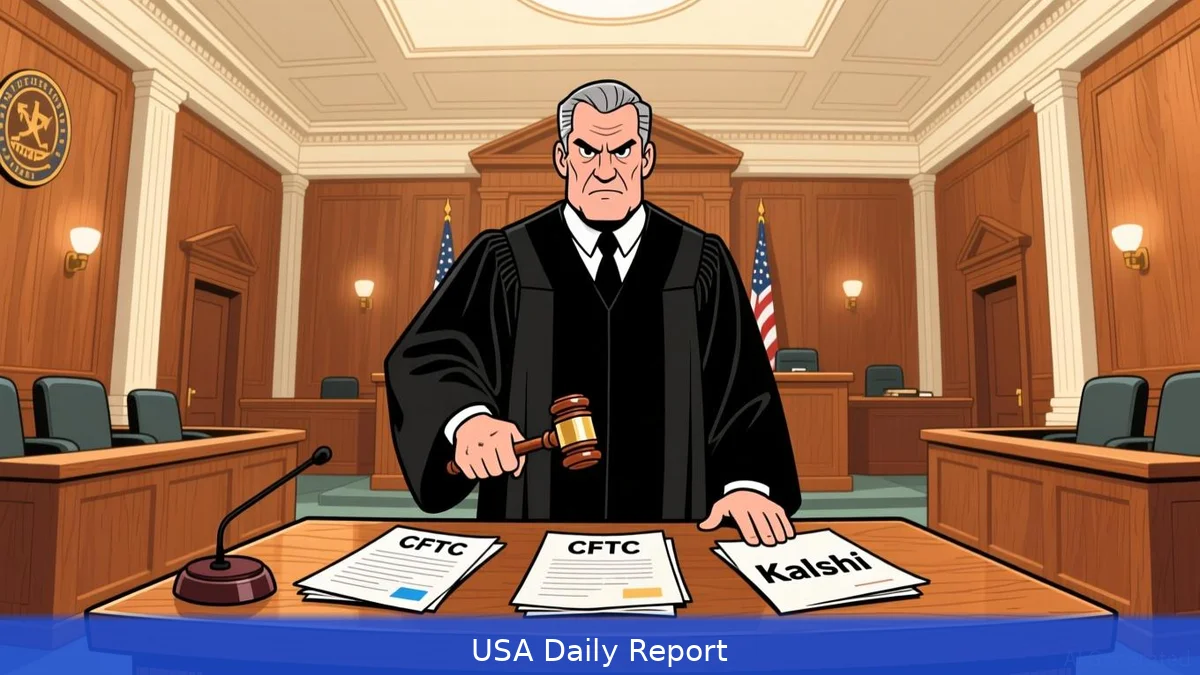
A federal judge on Friday halted Arizona’s effort to prosecute prediction market operator Kalshi. The order bars the state from enforcing its gambling laws against Kalshi while a federal regulator presses its case. The move came after the Commodity Futures Trading Commission said the contracts at issue are federal "swaps."
Arraignment on hold
The scheduled Monday arraignment in Arizona was called off after U.S. District Judge Michael Liburdi issued a temporary restraining order. Liburdi’s decision stops state prosecutors from while the federal case plays out. The judge said the CFTC had shown a reasonable chance of success in arguing federal law preempts Arizona’s gambling statutes.
Sure, kalshi lets customers buy and sell simple "Yes" or "No" contracts tied to outcomes — everything from elections to college sports and individual player performance. State prosecutors had charged Kalshi with 20 misdemeanor counts, accusing the company of running an unlicensed wagering business and accepting bets on elections, crimes that Arizona law forbids.
The core issue is clear: Arizona sees these sales as illegal bets. The CFTC calls them tradable financial instruments covered by the Commodity Exchange Act.
The regulator sued Arizona after state gambling regulators sent cease-and-desist letters and prosecutors filed criminal charges, arguing those state actions intrude on federal authority.
Federal regulator says contracts are "swaps"
In his order, Liburdi wrote that the CFTC had enoughly demonstrated that the platform’s "event contracts" fall within the Commodity Exchange Act’s definition of "swaps." The judge pointed to the statute’s language about federal control of swaps traded or executed on Designated Contract Markets.
"The Act grants the CFTC 'exclusive jurisdiction' over the regulation of 'swaps,'" the court document said. This CFTC had asked the court to block Arizona from with criminal prosecution while the federal suit is pending.
Michael Selig, chairman of the Commodity Futures Trading Commission, criticized Arizona’s action after the ruling. "Arizona's decision to weaponize state criminal law against companies that comply with federal law sets a dangerous precedent," Selig said. His office has pushed a message that the CFTC — not state gaming regulators or prosecutors — should decide which markets can trade event-based contracts.
Kalshi’s defense and reaction
Kalshi insists it's a regulated financial marketplace, not a gambling operation. Robert DeNault, head of enforcement at Kalshi, called the ruling "a step in the right direction" in a post on X, saying the decision protects firms that answer to federal law.
Kalshi is pushing for clear federal rules instead of a confusing mix of state laws. The company expanded into sports markets recently and hosted election-related contracts during the 2024 cycle; those offerings are central to Arizona’s case. Prosecutors argue those specific markets violate state law, while Kalshi and the CFTC say federal statutes cover them.

Arizona’s attorney general’s office pushed back. "The attorney general’s office disagrees with the court’s ruling and we will evaluate our next steps," Richie Taylor, a spokesperson for the Arizona Attorney General’s Office, said.
State officials have maintained that accepting wagers on certain events or running an unlicensed wagering business violates state criminal statutes.
What the CFTC argues — and why it matters
The CFTC’s lawsuit hinges on statutory interpretation: if event contracts are "swaps," then Congress assigned oversight to the federal regulator, and states can’t enforce conflicting rules. The agency argued that allowing individual states to police those markets would undercut federal uniformity and could fragment markets that operate nationwide.
That argument carries real-market implications. If federal control holds, national exchanges that list event-based contracts would be governed by uniform CFTC rules — not by 50 different state gambling regimes. That would let firms like Kalshi operate across state lines under a single regulatory regime.
There’s still debate over federal control. The Commodity Exchange Act bars some types of markets — including those tied to war or assassination and matters classed as "gaming" — and courts have long debated which event-based markets cross the line.
The CFTC’s stance is that many event contracts resemble traditional swaps and therefore belong under its authority.
Industry fallout and history
Prediction markets such as PredictIt, Polymarket and Kalshi have operated for years, but interest surged around the 2024 election cycle. Regulators tightened scrutiny during prior administrations; under the current CFTC leadership, the agency has taken a more assertive approach to staking a federal claim over the markets.
Kalshi’s expansion into sports betting-type markets during the past year drew extra attention. State prosecutors say that shift put Kalshi squarely into territory Arizona regulates as gambling. The company, though, says the contracts serve price-discovery and hedging functions familiar in commodities trading.
Federal litigation will test those competing views. Courts will have to decide whether the contracts in question are legally "swaps" when offered on exchanges that the CFTC treats as Designated Contract Markets.
This decision will affect how prediction markets create products and where they can operate legally.
What happens next
The temporary restraining order buys time for the federal case to proceed. Liburdi previously declined earlier requests from Kalshi to block state prosecutors, saying it was too soon to rule, but the court has now granted the CFTC a pause while it pursues its suit.
State prosecutors had agreed to appear in criminal court and ask that their case be paused. Meanwhile, the CFTC will press its argument that federal law preempts Arizona’s gambling statutes; Arizona officials must decide whether to appeal or challenge the federal court’s temporary order.
The outcome will probably reverberate beyond Kalshi. If the CFTC prevails, other prediction market operators would likely gain clearer federal protection for many event-based contracts. If Arizona or other states find ways to sustain enforcement, platforms might be forced to limit offerings by state or change product designs to avoid criminal exposure.
For now, Kalshi avoids an immediate arraignment, but the legal fight is far from over. The federal suit will probe statutory definitions and the limits of state power — and it will do so while traders and platforms watch closely.
Related Articles
"The Act grants the CFTC 'exclusive jurisdiction' over the regulation of 'swaps,' traded or executed on a Designated Contract Markets," the judge's order said.
This article was created with AI assistance.


