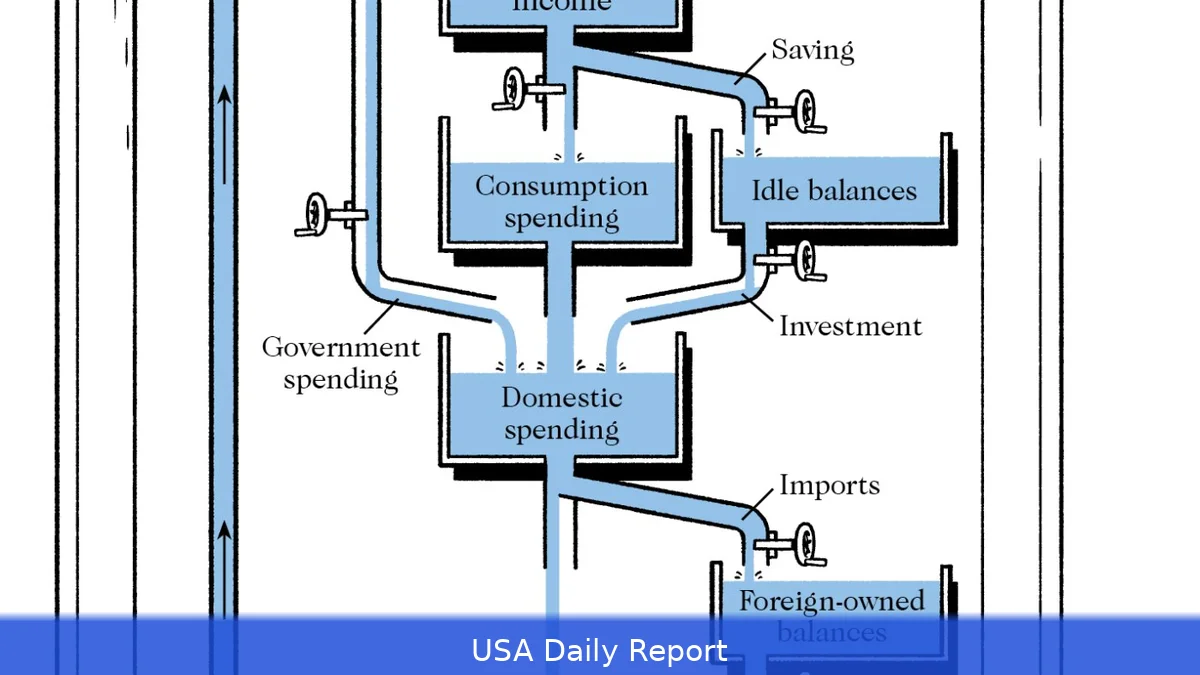
Back in 1949, Bill Phillips built a curious machine in his garage — tubs and chambers filled with flowing water that mimicked the British economy. Though it seemed like a quirky science experiment, Phillips' invention actually shifted economists' views on the inflation-unemployment relationship.
A Strange Machine That Spoke Volumes
Bill Phillips wasn’t your typical economist. Born in New Zealand, his early life involved hunting crocodiles and mining gold before he swapped fields to study economics in post-war London. But it wasn’t until he crafted a hydraulic model of the economy that his ideas really made waves.
Here's the thing — in his garage, Phillips rigged a system where water flowed between tanks labeled for government spending areas like health and education and a central Treasury tank. This setup showed how money moved through an economy, with the flow rate controlled by a lever that simulated tax rates. The faster the water flowed back to the Treasury, the different the economic balance.
He took his invention to the London School of Economics, expecting skepticism. And sure enough, the staff came out to mock what they thought was a bizarre stunt. But after just ten minutes, the water’s flow revealed insights Phillips had already grasped better than anyone else in the room. That demonstration landed him a job at LSE and a seat at the table with Britain’s leading economists.
From Hydraulic Model to Economic Theory
Sure, his machine wasn’t just a neat trick. It embodied a bigger question economists have wrestled with for centuries: why does the economy swing wildly between booms and busts? Before World War II, the world saw regular cycles of crashes and panics — from the Panic of 1873 to the crash of 1907 — roughly every two decades or so.
These cycles brought economic chaos that governments struggled to control.
Phillips focused intensely on controlling that economic chaos. His work connected to the ideas of John Maynard Keynes, who argued governments could smooth out the business cycle by adjusting spending and taxes. Keynes believed governments should act like a thermostat — cooling down an overheated economy or warming up a cooling one.
The hydraulic model was a physical representation of that principle. When the economy was booming — shown by rapid water flow — the government could tighten the lever, simulating higher taxes to slow things down. When it was sluggish, loosening the lever allowed more flow, mimicking stimulus through spending or tax cuts.
The Birth of the Phillips Curve
Phillips’ work went beyond the machine. He’s best known for the Phillips Curve, a relationship he identified between unemployment and inflation. Basically, when unemployment is low, inflation tends to rise. When unemployment is high, inflation drops.
His hydraulic model helped him understand this trade-off. It showed how the economy’s components interact dynamically — a tug on one lever affects the whole system. The Phillips Curve became a key tool for policymakers trying to balance growth and price stability.
Despite its long-lasting influence, the Phillips Curve has had its challenges. Economies don’t always behave predictably, especially with shocks like oil crises or financial meltdowns. Still, the curve remains a starting point for discussions about inflation and jobs.
Legacy of an Engineer Turned Economist
Phillips wasn’t just a thinker; he was a doer. His background as an electrical engineer helped him bring abstract economic ideas into a tangible form — something many economists had only imagined on paper. That hands-on approach won over skeptics and helped establish macroeconomics as a science focused on whole countries, not just individuals.
His story also shows how fresh perspectives can shake up established fields. Coming from outside traditional academic paths, Phillips proved that creativity and practical skills could advance economic theory.
His model anticipated today's economic tools that simulate and analyze policy impacts. Today’s central bankers and economists still wrestle with the same questions Phillips tackled decades ago: how to keep the economy stable without stifling growth.
Phillips’ water model might seem old-fashioned, but it left a lasting mark. It turned economic theory into something you could see and tweak, paving the way for modern policy tools. Sometimes, the best ideas come from a garage and a clever way of looking at the world.


