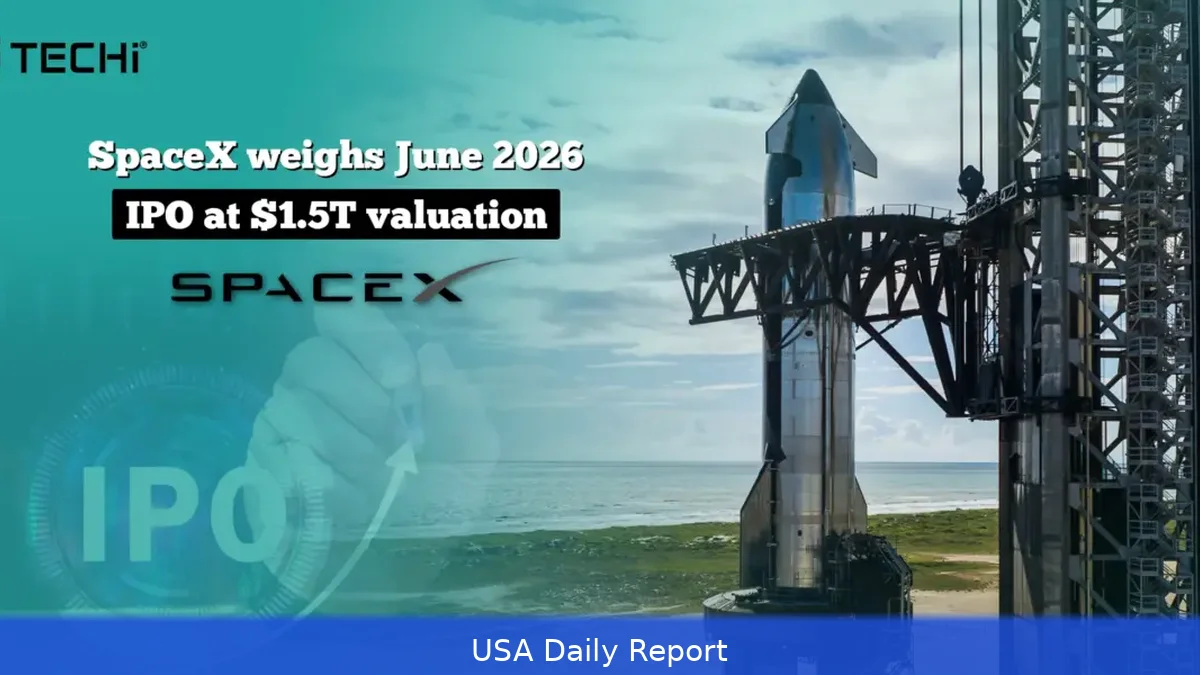
SpaceX is gearing up for what could be the largest initial public offering (IPO) ever, targeting a roadshow launch in early June. The rocket company's plan includes a hefty allocation of shares for retail investors—a move that breaks the mold for tech IPOs and highlights Elon Musk's loyal following.
IPO Roadshow and Retail Focus
SpaceX held a key meeting with its banking team recently, where it unveiled plans for its much-anticipated IPO. The company aims to kick off its roadshow in early June and plans to host an event shortly after, inviting around 1,500 retail investors. That’s a big deal, considering retail investors usually get a small slice of shares in tech IPOs.
Chief Financial Officer Bret Johnsen emphasized the importance of retail investors in this offering, calling them "a critical part of this and a bigger part than any IPO in history." Johnsen noted that many retail investors have been strong supporters of SpaceX and Elon Musk for years, and the company wants to reward that loyalty. The approach is a clear departure from typical IPOs, where institutional investors dominate the share distribution.
Reuters previously reported that SpaceX is aiming to rewrite the IPO playbook by putting more shares in the hands of everyday investors. The strategy could reshape how IPOs are conducted, especially for high-profile tech companies.
Valuation and Capital Raise Ambitions
SpaceX’s IPO will probably come with a staggering valuation, potentially reaching $1.75 trillion. If the company hits that mark, it would become one of the most valuable public companies in the world.
The offering could raise as much as $75 billion, dwarfing previous tech IPOs and making it a landmark event for capital markets.
To put that in perspective, the company reportedly earned around $8 billion in profit last year on revenue between $15 billion and $16 billion. That means SpaceX isn’t going public just to cover losses—it’s already making money. Instead, the fresh capital is aimed at fueling ambitious growth projects that have remained out of reach until now.
Among those projects: a plan to build AI data centers in orbit. SpaceX hopes to leverage its Starship rocket technology to deploy satellites capable of handling AI computing tasks in space. The goal is to create data centers that operate above Earth, potentially reducing costs and energy consumption associated with traditional, land-based centers.
Speculative Ventures and Future Plans
SpaceX’s vision doesn’t stop at AI data centers. The company is also eyeing a human colony on the Moon, dubbed Moonbase Alpha. While still in science fiction, this initiative aligns with Elon Musk’s long-term dreams of expanding humanity’s footprint beyond Earth.
Moonbase Alpha is largely speculative and not expected to generate immediate profits. Instead, it may serve as a research hub and stepping stone for future Mars missions. Johnsen’s team sees these projects as aspirational capital deployments, made possible by the massive infusion of IPO proceeds.
Orbital data centers, while speculative, have a more defined use case. Data centers worldwide face rising costs, especially from electricity, which can account for up to 30% of operating expenses. Running these facilities in space could ease some of those expenses and offer new capabilities for AI development and deployment.
Implications for Investors and the Market
The SpaceX IPO is shaping up to be a game-changer. By focusing heavily on retail investors, the company taps into a broad base of supporters who may have been shut out of previous offerings. That could fuel robust demand and make the IPO one of the most accessible ever.
But the sheer size of the raise and valuation also point to high expectations. Investors aren’t just betting on SpaceX’s current business—they’re buying into Musk’s far-reaching vision of space infrastructure and colonization. That means there’s a fair share of risk involved, given the speculative nature of some projects.
Basically, still, SpaceX’s profitability and revenue growth provide a solid foundation. The company already dominates several key markets, including satellite internet through its Starlink network and commercial rocket launches. Fresh capital from the IPO could accelerate innovation and expansion in these areas.
Sure, suppliers and partners in the space and AI industries could also benefit. The injection of billions into ambitious projects may prompt demand for components, services, and technology that support SpaceX’s initiatives, creating ripple effects across multiple sectors.
SpaceX’s IPO timing is notable, too. The company is moving forward despite broader market uncertainties and intense scrutiny of tech valuations. That suggests confidence in both its business model and investor appetite for high-growth space ventures.
With the IPO roadshow slated for early June and a unique retail-focused approach, SpaceX is rewriting the rules for public offerings. Whether it reaches that eye-popping $1.75 trillion valuation we'll have to wait and see—but there’s no doubt this event will be watched closely by investors worldwide.


