
Intel is replacing its older non‑Ultra Core parts with new silicon.
New silicon for mainstream laptops
Intel is replacing Raptor Lake silicon in its mainstream laptop CPUs with a new design called Wildcat Lake, a codename Intel uses for this non‑Ultra family. This is the first new silicon for Intel's non‑Ultra laptop CPUs since Core Ultra became the company's flagship line, ending years of reused Raptor Lake derivatives. For years, the less expensive Core offerings used revised versions of 2022 and 2023 designs. Now those midrange parts will share updated building blocks with higher‑tier chips, though in a simpler form.
Wildcat Lake isn't a clone of Intel's top-tier chips. The new parts borrow certain architectural elements from the Core Ultra Series 3 family — previously called Panther Lake — but they come in a scaled‑down package that prioritizes cost and power efficiency over peak performance. So laptop makers can add better integrated features to mainstream notebooks without the heat and cost of flagship chips, letting cheaper machines gain things like improved graphics and modern connectivity.
Intel's decision responds to a long period in which the company relied on Raptor Lake derivatives for non‑Ultra SKUs. Raptor Lake was the name used for the 13th‑generation Core family introduced in 2023, and many variants were essentially recycled from 2022's 12th‑generation designs.
Wildcat Lake brings midrange parts back in line with high‑end chips on key technologies, though the midrange versions are tuned down for efficiency.
Consumers will likely see faster integrated graphics, stronger on‑device AI, and newer wireless options in everyday laptops powered by Wildcat Lake. But the new chips still aim to live inside thin, light systems and affordable mainstream machines rather than high‑end performance notebooks.
Tile design and core mix
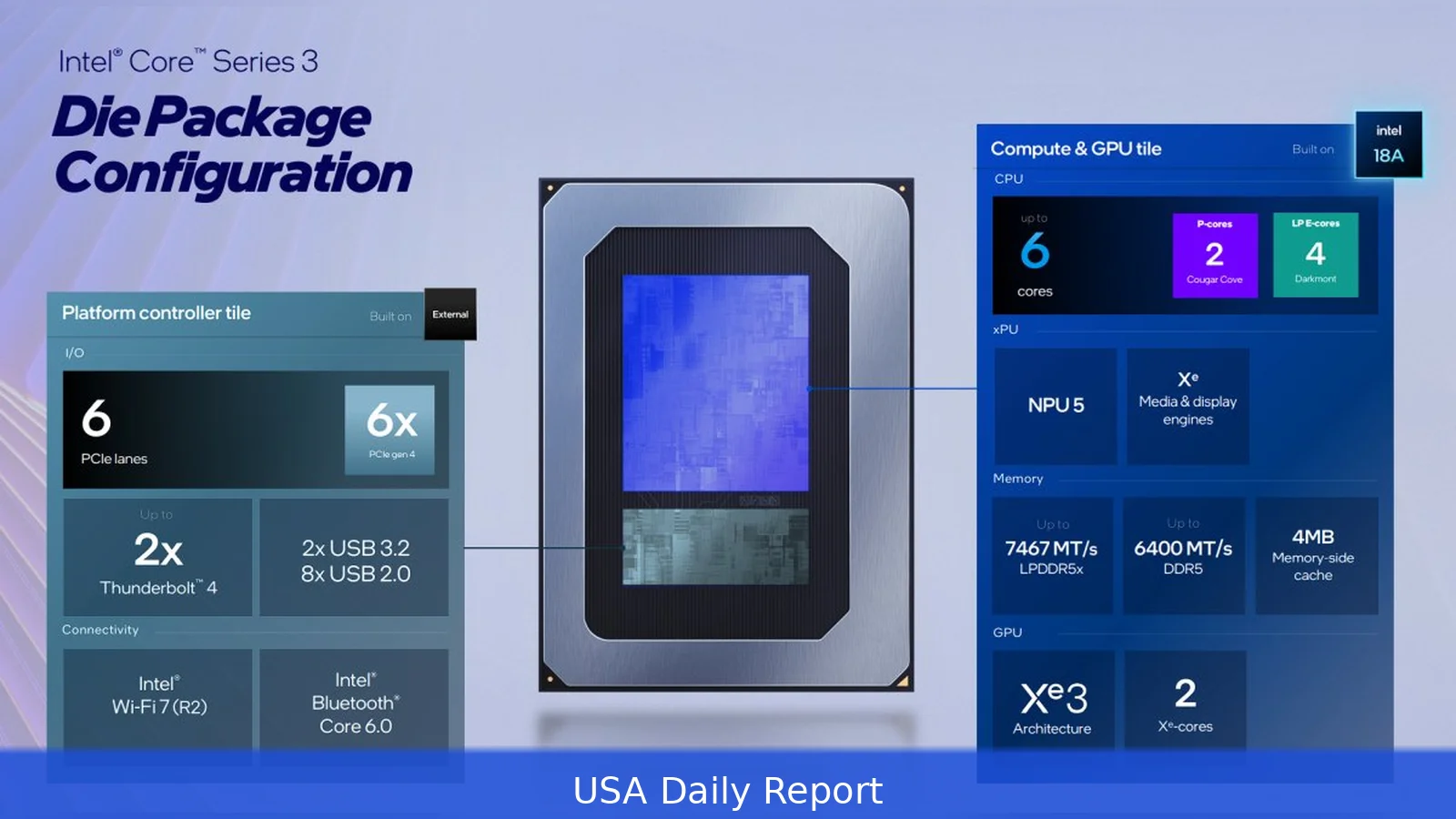
The Wildcat Lake processors use a two‑tile approach. One tile contains the compute elements: up to two high‑performance P‑cores based on the Cougar Cove microarchitecture alongside four efficiency E‑cores using Darkmont designs. That combination is less aggressive than many Core Ultra parts, which can cram more P‑cores and higher GPU counts into their compute tile.
Integrated graphics are based on Intel's latest Xe3 engine, but Wildcat Lake chips will ship with only one or two GPU cores enabled. That provides a noticeable uplift over older integrated graphics in the same power bracket, while keeping die area and power draw lower than flagship implementations. Most Wildcat Lake chips include an on‑chip NPU rated up to 17 TOPS; it handles camera processing, language features and other background AI tasks.
A second tile acts as a platform controller. Built on a non‑Intel foundry process, this companion die is responsible for I/O and connectivity. It provides up to two Thunderbolt 4 ports, Wi‑Fi 7 and Bluetooth 6.0 radios, and six PCIe 4.0 lanes for attaching storage or external devices. Offloading I/O to a separate tile keeps the compute die focused on CPU, GPU and NPU work while still supporting modern peripherals without increasing the main die size.

Memory, power, and OEM choices
Wildcat Lake supports both LPDDR5X and DDR5 memory. Systems can be configured with up to 48GB of LPDDR5X‑7467 or up to 64GB of DDR5‑6400. Those ceiling numbers match or exceed many current mainstream laptop designs, giving vendors flexibility in balancing capacity, battery life, and cost. The chips run at a base power level of 15 watts and can boost to a 35‑watt maximum, placing them squarely in the thin‑and‑light to mainstream performance category rather than the ultramobile or high‑performance brackets.
Because Wildcat Lake uses fewer GPU cores and a smaller complement of P‑cores, OEMs will likely tune devices for longer battery life and quieter operation. But the added modern I/O and the NPU could let vendors offer features previously reserved for pricier models — better camera processing, faster wireless, and lightweight AI features that run on the device instead of in the cloud.
The choice of a separate platform controller tile also gives manufacturers room to tailor designs without changing the compute die. If a laptop maker wants extra Thunderbolt ports or different wireless stacks, the companion tile can be the place to make those adjustments.
What this means for the laptop market
Wildcat Lake shrinks the feature gap between mainstream and flagship Intel laptops, so buyers get more modern capabilities in lower‑priced models. Midrange systems will get newer silicon building blocks and contemporary connectivity, reducing the old contrast between cutting‑edge features and affordable devices. For shoppers who upgrade every few years, machines powered by Wildcat Lake could feel more current for longer.
Manufacturers will have to decide how far to push the new parts. Some will aim for thin, fanless designs that favor battery life. Others will build slightly thicker systems that exploit the 35‑watt boost headroom for brief bursts of higher performance. Either path benefits from the modern I/O and the on‑device AI horsepower the NPU provides.
Competition in the laptop space is another factor. Chipmakers and device makers have been racing to add AI features and better wireless to mainstream products. Wildcat Lake gives Intel a clearer ticket to bring those capabilities to a broader set of notebooks without pushing every model into the higher thermal and cost brackets associated with flagship silicon.
At the same time, Wildcat Lake is explicitly a simpler design than Panther Lake. Buyers looking for the fastest integrated graphics, the greatest number of high‑performance cores, or the most robust NPUs will still find those options in Core Ultra Series 3 parts and other high‑end chips. Wildcat Lake is a trade‑off: modern features in a smaller, lower‑power package.
Transition and long‑term outlook
Intel's move also reflects a broader shift in how processor families are developed. Reusing older silicon for budget SKUs can save money Soon, but it leaves gaps in feature parity across price tiers. By investing in Wildcat Lake, Intel is signaling that midrange buyers matter enough to get newer architectures and connectivity standards.
For PC makers, the change could simplify product road maps. When midrange parts lag behind in important areas like wireless or AI acceleration, vendors must decide whether to add companion chips or accept a weaker feature set. Wildcat Lake's platform controller tile and integrated NPU reduce that dilemma.
From a user's point of view, the most visible changes will arrive in the next wave of laptops. Expect machines with longer battery life, snappier integrated graphics for everyday tasks and light gaming, and on‑device AI handling features such as camera enhancements, dictation, and background processing. Those improvements won't match flagship performance, but they'll be a major step up for many affordable systems.
Wildcat Lake also shows how Intel is positioning its product tiers. Flagship Core Ultra chips retain their role as the performance leaders, while the company brings modern features to the mainstream via a simpler, more power conscious design. That balance could make mainstream laptops feel less like compromises and more like practical daily drivers.
Related Articles
The Wildcat Lake chips use a two‑tile design and support up to 48GB LPDDR5X‑7467 or 64GB DDR5‑6400.
This article was created with AI assistance.


