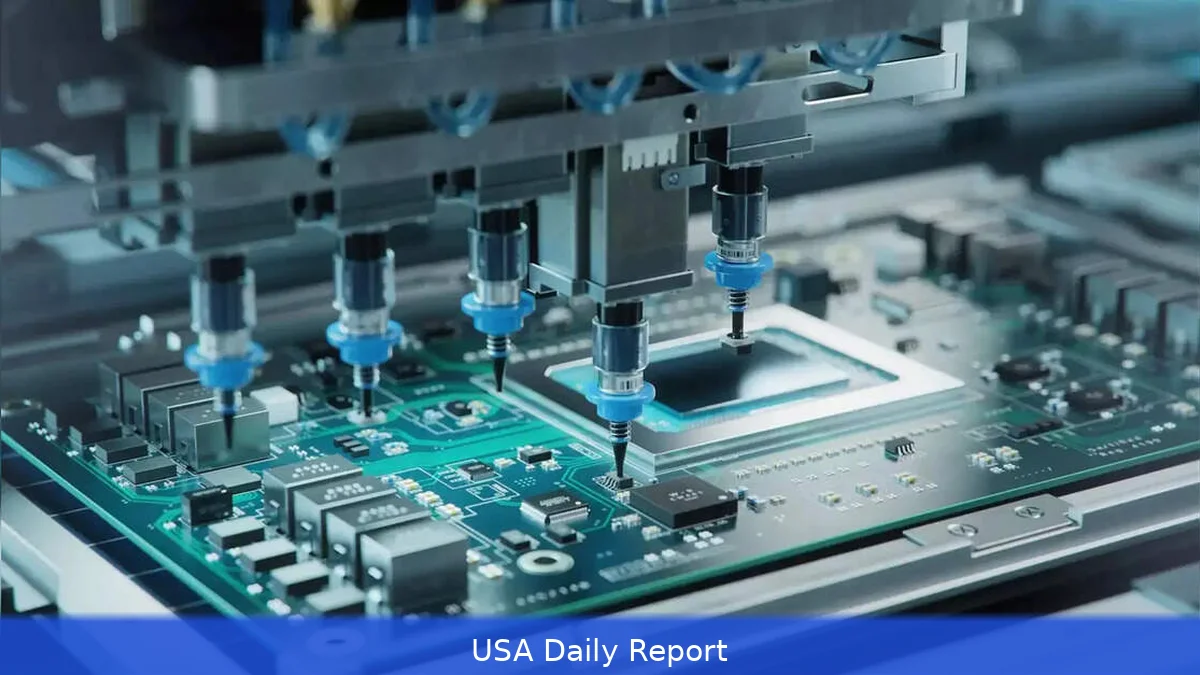
Taiwan is set to remain a top destination for chip-capacity investment through 2025.
AI demand still powering semiconductor spending
Taiwan's role in the global semiconductor chain looks set to stay central as industry spending shifts back toward capacity expansion tied to artificial intelligence workloads. World Semiconductor Trade Statistics data cited by industry analysts point to double-digit growth across core chip segments, driven in part by AI-related server demand and advances in memory and logic chips.
Honestly, the data are substantial and precise — WSTS projects a 12.3% rise in IC output this year. WSTS projects a strong rebound in integrated circuit output, with a projected 12.3% increase in IC growth and notable gains across logic, memory and microcontrollers. Those projections are already shaping orders for new tools and factory upgrades across Asia Pacific.
In short, companies are racing to add capacity for GPUs and high-bandwidth memory because those parts power data-center AI workloads, and that demand is driving WFE bookings. Gartner IT adds to the picture, estimating overall semiconductor revenue growth of 12.6% in 2025 and forecasting an explosive 66.3% rise for high-bandwidth memory that year.
These shifts are large enough to alter factory roadmaps and capital budgets for years, as new fab projects get prioritized.
Those shifts are already shaping where companies plan to buy tools and where governments and private investors are placing bets.
Equipment makers and demand hotspots: Taiwan in the mix
Global equipment suppliers face a more nuanced outlook than simple boom-or-bust. SEMI's Mid-Year Total Semiconductor Equipment Forecast sees wafer fabrication equipment (WFE) growing modestly this year — about 3.4% — before accelerating next year. The group expects sales to strengthen by roughly 17% in the following year, driven by capacity expansion and new fab projects. NAND and DRAM equipment, in particular, show steep swings in projected sales across 2024 and 2025.
But geography still matters: SEMI forecasts China, Taiwan and Korea will lead WFE spending through 2025. SEMI expects China, Taiwan and Korea to be the top destinations for WFE through 2025, with China as the single largest spender — about $35 billion in 2024. That puts Taiwan squarely in the path of sustained orders for tools, spares and services.
For Taiwan, the implication is twofold. First, homegrown foundries and chip packaging businesses are likely to stay active customers for equipment makers as they chase AI-tailored capacity. Second, spillover demand should help firms that supply materials, test and packaging equipment. The concentration of demand in the Asia Pacific region — Gartner expects about 10.4% regional growth while the Americas may grow faster on a percentage basis — keeps Taiwan strategically important for global supply chains.
Which companies and sectors stand to see the biggest lift
Equipment makers such as Applied Materials, Lam Research and ASML are front and center in discussions about the next leg of investment. Analysts praise long-term demand drivers — AI, IoT, electric vehicles and renewables — while warning investors to wait for suitable entry points because valuations have already climbed for some names.
Supply-side risks make the picture. Geopolitical friction and export controls have narrowed who can sell the very most advanced tools to certain customers. Still, demand at the trailing edge and for mature-node capacity is rising, especially in the region that includes Taiwan. That means both advanced and mid-tier equipment suppliers could see a pickup in order flow.
Memory makers and logic fabs are both part of the story. WSTS and Gartner data show memory's huge contribution to the recent upcycle — technology spending that fed an 18.1% jump in 2024 semiconductor revenue overall — and forecast further sizable gains into 2025. High-bandwidth memory, in particular, is likely to be a major growth driver as AI models keep expanding.
Market context and investor sentiment
Equity markets have been digesting all of this while also wrestling with macro and political variables. Quincy Krosby, chief global strategist at LPL Financial, warned that markets can flip quickly when sentiment turns. "The market had moved into overbought territory, making it vulnerable to anything it perceives as negative," Krosby said, noting investor worries about central bank messaging and election-season uncertainty.
Still, the semiconductor cycle often runs on hardware buildouts that take months or years to complete. That means capital spending plans announced now will juice equipment makers and foundries for a long time. Analysts argue that government funding programs and strategic investments tied to national security will keep pressure on capacity expansion even if consumer electronics demand softens.
Still, the cycle isn't risk-free: macro shocks or geopolitical moves can prompt buyers to delay equipment orders. The industry remains cyclical, and macro or geopolitical shocks can push buyers to defer purchases. Many analog and mixed-signal players have deliberately grown exposure to auto and industrial markets to smooth out seasonality, while foundries balance advanced-node demand with trailing-edge production to service a wider group of customers.
What it means for Taiwan's markets and corporate pipeline
Concentration of WFE spending in Taiwan means local suppliers are in a favorable spot if the forecasts hold. Foundries and packaging firms could accelerate investments to capture AI-related customers, and local suppliers of test and assembly gear may see stronger order books. The region's dense ecosystem — fabs, equipment vendors, materials suppliers and talent — helps speed up ramp cycles, compared with places that have to build new ecosystems from scratch.
Right now, the listed companies most tied to the cycle are those that make equipment, supply critical materials and run the fabs that produce logic and memory chips. Analysts advising investors on equity timing point out that while the long-term demand story looks solid, valuations and near-term macro risk still matter for when to buy stocks.
Bottom line: capacity plans tied to AI workloads are the key catalyst. If Gartner, WSTS and SEMI's projections play out, Taiwan will be among the core beneficiaries for tools and fab services through 2025. What that means for specific stock prices depends on timing, company execution and the wider market mood.
Related Articles
- Taiwan’s tech companies lean on convertibles as AI demand fuels record fundraising
- Goldman Traders Post Record Quarter as Bond Desk Falls Short
- Wave of $15 Billion U.S. IPOs Runs Headlong Into a New Phase of War
"The market had moved into overbought territory, making it vulnerable to anything it perceives as negative … It’s now worried that the Fed hasn't declared victory on inflation, and not to mention, the concerns post-election," said Quincy Krosby, chief global strategist at LPL Financial.


