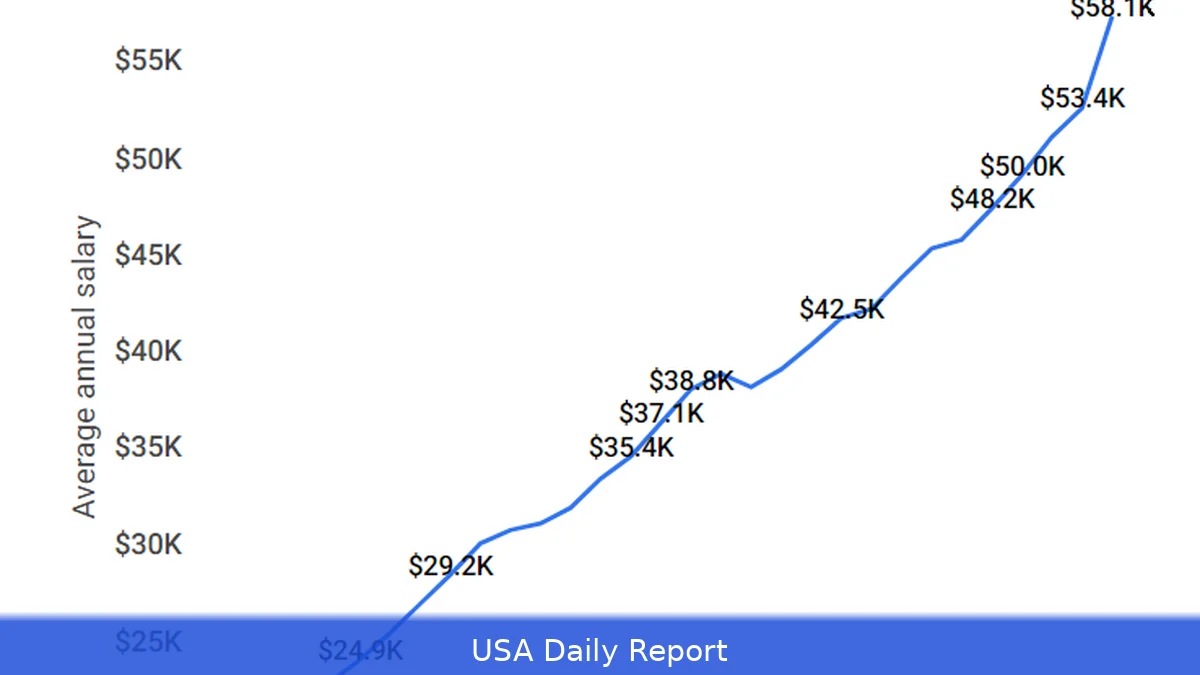
Wondering which industries will pay best in 2026? I walk through national average salaries, how they've changed since 2023, where pay varies across regions, and concrete steps you can take to boost your income. First, the headline numbers — then a deeper look by industry, city-by-city comparisons, and a brief outlook for the coming years.
Key figures — quick reference
Below are the headline U.S. industry averages for 2026 (annual, rounded). I list each 2026 figure with the comparable 2023 number and an approximate percent change so you can see recent movement at a glance.
- Information (tech/media): $142,000 (2023: $132,000) — +7.6%
- Management of companies: $145,000 (2023: $136,000) — +6.6%
- Finance & insurance: $128,000 (2023: $118,000) — +8.5%
- Professional, scientific & technical services: $115,000 (2023: $105,000) — +9.5%
- Health care & social assistance: $92,000 (2023: $85,000) — +8.2%
- Manufacturing: $75,000 (2023: $70,000) — +7.1%
- Construction: $72,000 (2023: $68,000) — +5.9%
- Transportation & warehousing: $58,000 (2023: $53,000) — +9.4%
- Retail trade: $37,000 (2023: $34,000) — +8.8%
- Accommodation & food services: $29,500 (2023: $26,500) — +11.3%
- Public administration (government): $73,000 (2023: $69,000) — +5.8%
- Median household income (U.S., 2024): $76,000 (2021: $70,784) — +7.4%
Detailed breakdown — who pays what in 2026
Pay differs sharply across sectors: data-heavy, high-skill fields generally top the list, while customer-facing and lower-skilled jobs tend to pay less. Below are typical averages and role-level numbers that explain the swings. All figures refer to base salary unless I note otherwise — where I mention total compensation, that includes bonuses and equity.
High-paying sectors
Information (software, data, media): $142,000. Software engineers range widely — entry-level in smaller markets often start around $85,000, mid-level sits near $135,000, and senior engineers or staff-level roles regularly hit $200,000 base in high-cost metros. Data scientists average $125,000; senior data scientists commonly earn $165,000. Cloud architects and SRE leads average $160,000 to $185,000. Equity changes total comp — median RSU value for mid-level tech in 2026 is roughly $30,000 to $80,000 annually at major firms.
Management of companies: $145,000. That category includes corporate executives, M&A specialists and holding-company staff. Mid-level corporate managers average $120,000 to $140,000, while C-suite roles at public firms usually report base salaries from $300,000 to $1,000,000 — with total pay dominated by equity and bonuses.
Finance & insurance: $128,000. Investment-banking associates average $140,000 base with bonuses that can push total comp to $220,000. Private equity and quant roles often start at $150,000 base for experienced hires — senior quants and portfolio managers commonly exceed $250,000 base plus incentives. Retail banking and insurance underwriting sit lower: branch managers average about $75,000, and underwriters average $82,000.
Professional and business services
Professional, scientific & technical services: $115,000. Management consultants average $105,000 at consultant level, $160,000 at manager level, and $220,000+ for partners in large firms. Legal services show large spreads: associate attorneys average $115,000 (varies by market), while partners often make $300,000 to multiple millions. R&D scientists in pharma average $120,000; senior researchers top $170,000.
Health care and social assistance
Health care & social assistance: $92,000. Nurses average $85,000 nationally; registered nurses in California or New York often earn $100,000 to $120,000. Primary care physicians average $220,000 to $240,000; specialists like cardiologists average $380,000 to $420,000. Physician assistants average $120,000. Home health aides and many social assistance roles still sit below $40,000.
Manufacturing, construction, transportation
Manufacturing: $75,000. Skilled trades like machinists and industrial electricians average $60,000 to $75,000; plant managers average $110,000. Construction: $72,000. Journeyman electricians average $65,000; project managers average $95,000. Transportation & warehousing: $58,000. CDL truck drivers average $55,000 to $70,000 depending on route; logistics managers average $85,000.
Low-paying sectors and hourly work
Retail trade: $37,000. Store managers average $47,000; hourly sales staff average $30,000. Accommodation & food services: $29,500. Restaurant managers average $45,000; cooks and servers often earn $18,000 to $28,000 base, supplemented by tips where applicable. Between 2024 and 2026, some low-wage industries showed larger-than-usual pay growth, often linked to minimum-wage increases and employer retention incentives.
Regional differences — where the money actually buys more
Where you live changes what those salaries actually buy — national averages are a start, but metro-level pay and local costs are what really matter. Below are typical 2026 metro averages for selected industries, shown as base salary (rounded).
- San Francisco Bay Area — Information: $185,000; Finance: $155,000; Median household income: $120,000.
- New York-Newark — Finance: $165,000; Information: $150,000; Median household income: $85,000.
- Seattle — Information: $155,000; Manufacturing (advanced): $85,000; Median household income: $95,000.
- Austin — Information: $125,000; Professional services: $100,000; Median household income: $78,000.
- Dallas-Fort Worth — Manufacturing: $78,000; Finance: $110,000; Median household income: $74,000.
- Chicago — Information: $125,000; Finance: $120,000; Median household income: $68,500.
- Miami — Hospitality: $38,000; Finance: $95,000; Median household income: $62,000.
- In many rural and nonmetro areas, typical pay levels run noticeably below national figures — often around 70% to 85% of the U.S. average across industries., depending on sector.
So salaries in San Francisco for the same tech job can be roughly 30% higher than the national average, while midwestern metros often pay 5% to 15% less. But cost-of-living pushes effective purchasing power down — housing costs in SF remain about 2.5 to 3 times the U.S. Median in 2026, while rents in Austin and Dallas are closer to 1.1 to 1.4 times median.
Compensation mix — benefits, bonuses and total pay
Right now, base salary isn't the whole story. Here are typical add-ons in 2026:
- Average annual cash bonus (finance): 20% of base; top performers: 50%+
- Average cash bonus (tech): 10% of base; senior ICs often get 15% to 30%
- Median annual RSU/stock value for mid-level tech: $45,000 at large public firms
- 401(k) employer match: common match is 3% to 6% of salary
- Health insurance premium share for employees: average employee contribution about $1,500 to $2,200 per year for single coverage
- Overtime pay (manufacturing/transport): time-and-a-half; average overtime premium adds roughly $4,000–$8,000 per year for many hourly workers
How much salary growth to expect — recent trends and short forecast
Year-over-year growth was uneven through 2023–2026. Tech and finance cooled in some hubs but still rose overall. Lower-wage sectors posted higher percentage gains because of wage-floor increases. Here are recent moves and a short forecast:
- Average annual industry wage growth 2023–2026: roughly 6% to 9% for most sectors (see key figures above).
- Forecast 2027: overall average wage growth ~4% to 6% as inflation eases and labor-market tightness normalizes.
- Forecast 2028–2030: tech and professional services expected to grow 3%–5% annually; health care expected to grow 4% annually due to aging population and staffing shortages.
- Manufacturing and construction forecast: 2%–4% annual growth, with local spikes where supply-chain investment occurs.
- Hospitality and retail: 2%–5% annual growth, driven by minimum-wage policies and automation effects.
So expect nominal wages to keep rising, but real gains will depend on inflation and local housing markets. Employers are shifting some pay into non-salary perks — student-loan repayment, childcare stipends, and flexible schedules — which shifts the take-home math.
Practical next steps to increase pay
Looking for a raise or job move? Here are evidence-based levers with numbers you can use in talks.
- Target industries with higher median pay — information, finance, professional services. Moving from a $75,000 manufacturing role to a mid-level tech role can boost base pay 40%–80% in many markets.
- Move metros selectively — a same-title move to SF or NYC can raise base pay 15%–35%, but housing and taxes cut into that.
- Ask for equity and bonuses — if base is constrained, negotiate a 10%–20% RSU grant or a 10% performance bonus target.
- Get certified — cloud certifications often add $10,000–$25,000 to pay for mid-career engineers; project management or professional licenses add $5,000–$15,000 in many fields.
- Consider shift to high-demand specializations — data engineering, cybersecurity, and advanced nursing specialties have above-average hiring premiums of 15%–30%.
Related Articles
- US Spring Cleaning Checklist 2026 — Room by Room Guide
- US Right to Repair Law 2026 — What It Means for Electronics
- Best E-Readers US 2026 — Kindle, Kobo and Alternatives Compared
Use these numbers as a starting map. Look at role-level pay, not just industry averages. Salary moves are part skills, part timing, and part geography — and small changes in role or city can mean tens of thousands of dollars a year.


