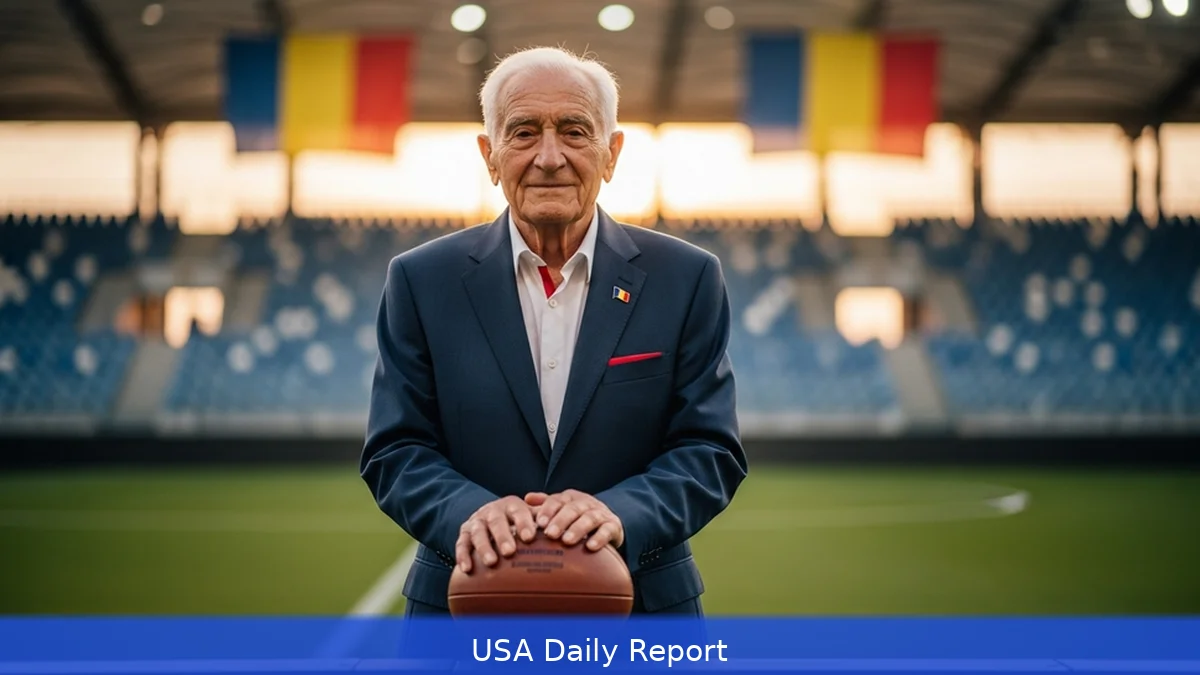
Mircea Lucescu, a towering figure in Romanian and European football, passed away at the age of 80 after suffering a heart attack. Mircea Lucescu's passing closes a significant chapter in football history, as he influenced the game in many countries over several decades.
A Career Spanning Decades and Borders
Mircea Lucescu was born in Bucharest on July 29, 1945, and went on to become one of the most influential figures in football, both as a player and a coach. Starting as a player in the late 1960s, Lucescu spent almost fifty years managing teams, navigating major political and economic changes in Eastern Europe.
He captained Romania at the 1970 World Cup, a milestone that helped raise the profile of Romanian football on the world stage. But it was his coaching career that truly defined his legacy. Lucescu was the first to lead Romania to a European Championship qualification in 1984, a breakthrough moment that energized football fans across the country.
Honestly, his coaching journey took him beyond Romania’s borders, including stints in Italy with clubs like Inter Milan, Pisa, Brescia, and Reggiana. At Brescia, he became a beloved figure, earning the nickname "Brescia Romeno" after bringing in several Romanian stars, including Gheorghe Hagi, one of Romania’s finest players.
Under his leadership, Romanian players made a noticeable impact on Italian football.
Shakhtar Donetsk and Eastern Europe’s Changing Football Landscape
Lucescu’s longest and arguably most impactful tenure came at Shakhtar Donetsk in Ukraine. For 12 years, from 2004 to 2016, he built a powerhouse team that combined local talent with a steady influx of Brazilian players, backed by billionaire Rinat Akhmetov.
The approach helped Shakhtar become a regular fixture in the UEFA Champions League and culminated in winning the UEFA Cup in 2009.
Lucescu coached Shakhtar during some of Eastern Europe's most turbulent years. The fall of communism transformed the region’s football and economics, opening new opportunities but also challenges. Later, the conflict in eastern Ukraine forced Shakhtar to relocate from Donetsk after Russian-backed separatists took control of the city. The political upheaval had a direct impact on the club and Lucescu’s legacy there.
After Shakhtar, Lucescu's decisions to coach Zenit St Petersburg and later Dynamo Kyiv sparked mixed feelings among fans. Some fans viewed these decisions as controversial given the regional tensions, especially with Russia’s ongoing war in Ukraine threatening sports in the area.
Return to Romania and Final Years
In 2024, Lucescu returned to coach the Romanian national team, nearly four decades after his first spell. His comeback was meant to revive the national side’s fortunes. However, Romania narrowly missed qualifying for the 2026 World Cup, losing in a playoff against Turkey. Just days after the heartbreak, Lucescu fell ill during training and stepped down. He was hospitalized with a heart attack and passed away shortly after.
Romanian President Nicusor Dan mourned Lucescu, describing him as a respected figure in Romanian and European football who inspired many.
Impact Beyond Football
Lucescu’s death resonates beyond the sports world. Eastern European football often reflects political and economic changes, and Lucescu's career shows that clearly. His ability to navigate complex environments—from communist Romania to post-Soviet Ukraine and Russia—showed sports as both a unifying force and a space fraught with geopolitical tensions.
In the U.S., Lucescu's story highlights how football is becoming more global and influential in American sports. Major League Soccer and the broader U.S. Soccer scene have increasingly looked to Europe and beyond for talent and inspiration. Coaches like Lucescu, who bridged cultures and eras, remind us of football’s power to connect people worldwide despite political divides.
His time at Shakhtar proved that smart investments, such as those by Akhmetov, can boost clubs from emerging markets internationally. Such models influence sports management thinking in the U.S., where ownership groups seek to build competitive teams while engaging diverse fan bases.
His passing raises questions about how football in Eastern Europe will fare amid current conflicts and economic challenges. The sport’s role as a cultural touchstone remains vital but vulnerable in times of crisis.
Related Articles
- Cooking Gas Shortages Push Indian Migrant Workers Out of Cities Amid Rising Costs
- US-Iran Ceasefire Sends Oil Prices Tumbling, But Fuel Costs for Americans May Not Drop Soon
- Pro-Regime Crowds Rally in Tehran Amid New US-Iran Ceasefire Deal
Mircea Lucescu’s passing closes a chapter on a career that defined Romanian football and left an indelible mark on European soccer. His legacy will live on in the players he inspired, the teams he transformed, and the fans who saw in him a symbol of resilience and passion.


