
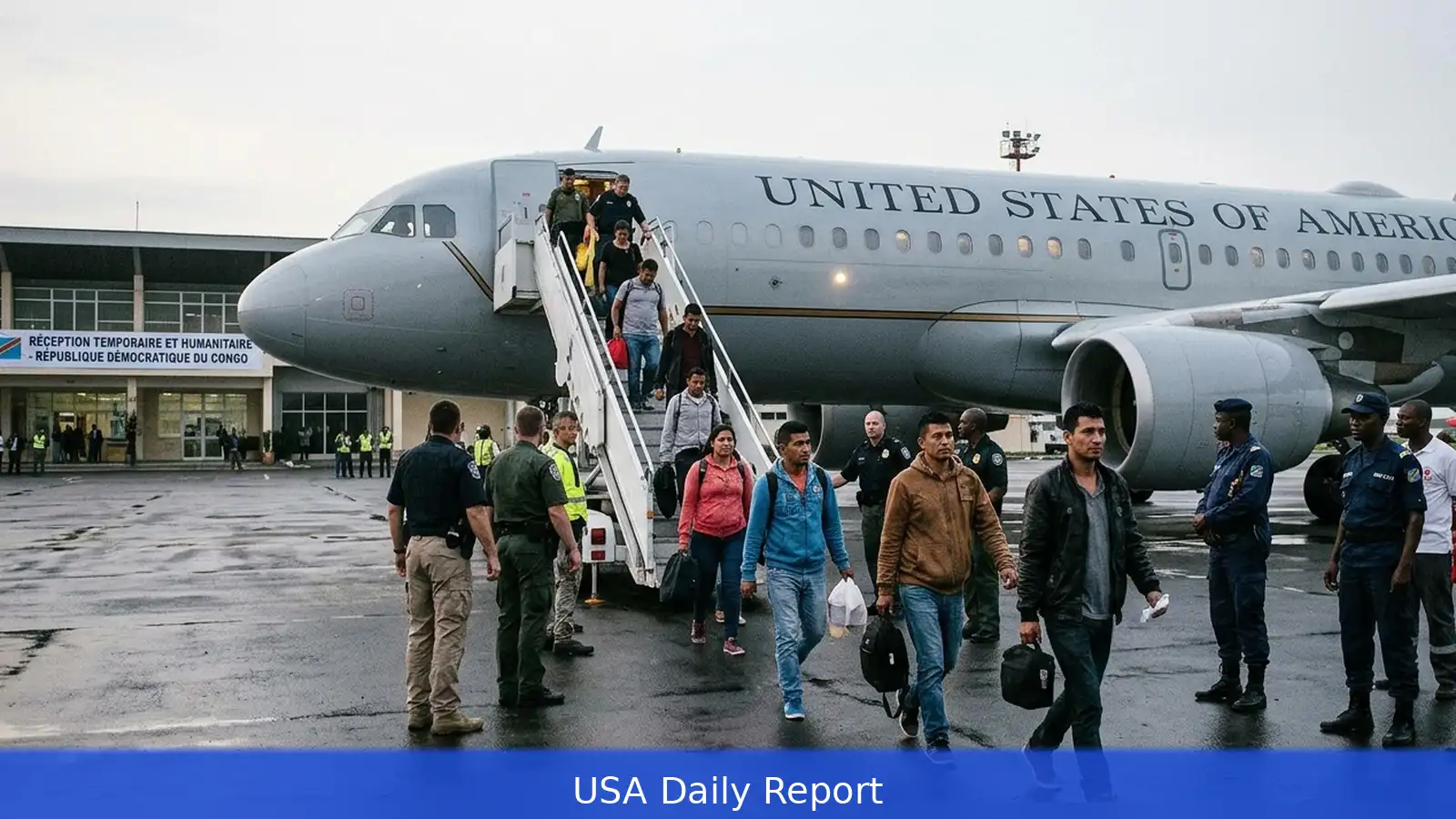
The Democratic Republic of Congo has taken in deportees flown from the United States. The move marks the first transfers under a deportation arrangement announced earlier this month.
What happened
Earlier this month, the US and DR Congo announced a deportation deal, but there's no confirmed report yet that the first group has arrived. Officials in Kinshasa framed the transfers as part of a newly implemented agreement to return so-called third-country migrants — people who are neither citizens of the sending country nor of the country where they were intercepted.
The Congolese government said it will accept these individuals on the grounds of human dignity and a commitment to migrants' rights. That rationale was offered when details of the deportation deal first emerged, and it accompanied the announcement that Kinshasa would cooperate in taking back third-country nationals relocated after interception or removal from US territory.
Officials haven't shared flight details, how many people were moved, or when exactly this happened. What Kinshasa did make clear was that it sees the decision as part of international cooperation on migration and as consistent with its stated obligations to protect migrants.
How Kinshasa describes the decision
The government in Kinshasa presented the acceptance as an expression of solidarity and respect for human dignity.
Officials said the move lines up with the country's stated policy on protecting the rights of migrants and with broader international obligations.
Those comments were offered at the moment the deal was first made public earlier this month. They served to justify the policy shift to domestic audiences and to international partners, emphasizing a humanitarian rationale rather than a purely administrative one.
Why the step matters for Washington
This deal could change how the US handles immigration enforcement, even if just a little.
It provides US authorities with an additional option to return people who don't have legal status in the United States and who don't hold nationality in the country where they were found. And it broadens the practical reach of removal operations by creating another pathway for people relocated from US soil.

Politically, the arrangement may be significant for the US government as well. Cooperating with foreign partners to repatriate people who lack clear legal status could be presented by US officials as part of efforts to manage migration flows and enforce immigration law. At the same time, arranging third-country returns touches on sensitive legal and diplomatic questions — from the rights of those being moved to how receiving countries handle reintegration and legal status once people arrive.
There are legal and logistical knots to untangle whenever a government accepts third-country migrants. The United States has at times sought cooperative arrangements with foreign governments to help removals. Those deals tend to involve negotiation over identity checks, documentation, and assurances about onward travel or local processing. The exact terms of the arrangement with Kinshasa were not detailed in the initial announcement.
Economic and social implications for DR Congo
When a country takes back people, it directly affects its resources and services. For many states, taking in people who have lived abroad means adding to the demand for public services, creating new pressures on housing, health care and social assistance systems. It also requires administrative capacity to register arrivals and determine their legal standing.
Kinshasa presented the decision as aligned with protecting migrant rights. But practical follow-through — registration, access to services, and support for people arriving with limited resources — will shape how the move plays out on the ground. That in turn affects public opinion inside DR Congo and the government's ability to portray the policy as consistent with both humanitarian principles and national interest.
Diplomatic ripple effects
This move creates a new diplomatic connection between Washington and Kinshasa focused on migration. Such links can open channels for broader cooperation, including on security, trade and development assistance. They can also be transactional: countries sometimes condition cooperation on concessions or future support in other policy areas.
For the United States, securing cooperation from partner governments on removal operations can ease short-term operational challenges. But those agreements can become points of political and legal scrutiny at home and abroad, particularly if the conditions of return or the treatment of returnees become subjects of public concern.
Broader context on third-country returns
Third-country returns — moving someone to a country other than the one from which they originally departed or to the country where they were intercepted — aren't the same as standard repatriation. They involve an extra layer of coordination because the receiving state must be willing to accept people who don't hold its nationality, or whose nationality is in question.
Governments frame such arrangements in different ways. Some emphasize orderly migration management and international responsibility-sharing. Others point to legal obligations or humanitarian reasons for taking action. Kinshasa chose to highlight dignity, rights and solidarity when announcing its decision earlier this month.
Possible domestic reactions
The decision to accept deportees could draw debate inside DR Congo. Citizens may focus on how the arrivals are processed and whether local communities receive support to integrate newcomers. Political opponents may question the costs and benefits of cooperating with the United States on removals, while civic groups may watch the treatment of returnees closely to ensure rights are respected.
In Washington, the arrangement can be framed as a tool in migration policy. But it's also likely to attract scrutiny from lawyers, advocates and lawmakers who monitor how removal programs operate and whether human-rights standards are upheld. The initial statements from Kinshasa emphasize humanitarian intent; whether practice matches rhetoric will be a key test.
At a minimum, accepting returns creates a set of practical tasks for both governments. Who pays for transportation? Who handles documentation? What mechanisms exist for people to contest or change their status? Answering those questions requires operational detail that was not included in the early announcement.
Related Articles
- Pope Leo Blasts Foreigners Exploiting Africa
- IMF warns against broad fuel subsidies
- Manhunt After Italy Bank Heist That Held 25 Hostages
The Congolese government said the decision to receive third-country migrants aligns with its commitment to human dignity, to protecting the rights of migrants and international solidarity.
This article was created with AI assistance.


