
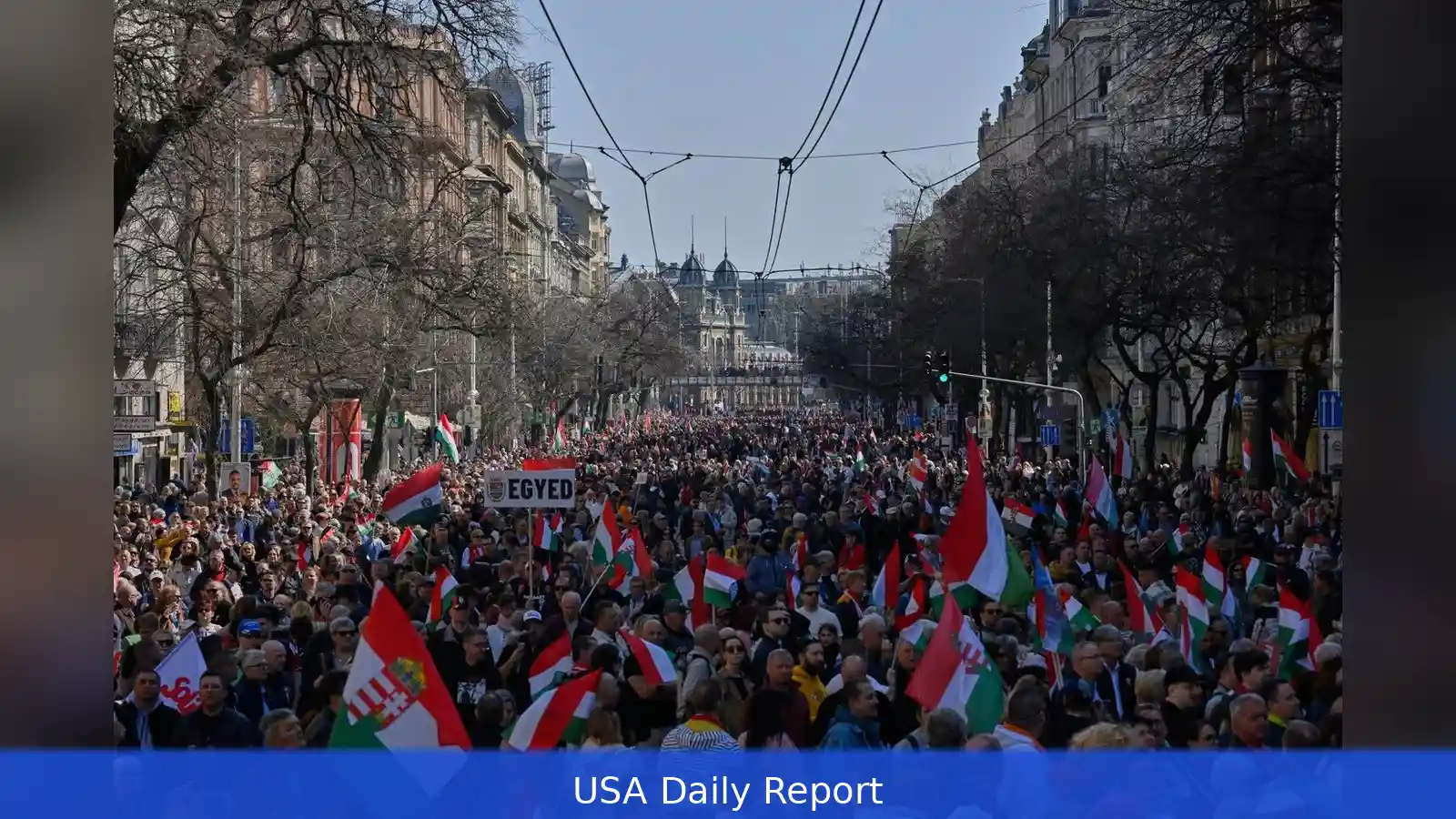
Magyar pressed for a rapid transfer of power after talks with Hungary's president.
Power shift demanded after tense talks
Magyar said he wants authority handed over fast following a meeting with Hungary's president. The intervention comes as Hungary's stance on European financial support for Ukraine has drawn fresh scrutiny. Look, the timing is delicate: last December, Hungary was one of three countries that opted out of a loan to Ukraine — and the question now is how that objection will be resolved.
The talks didn't settle the mechanics of lifting the objection. Magyar has made clear he doesn't Look at the veto to be relevant, while officials and political observers remain uncertain whether Prime Minister Viktor Orbán will play a direct role in any change of position.
What the veto means — and what it doesn't
This dispute has stirred up a lot of political uncertainty. Hungary’s decision to opt out of the loan raised questions across the European Union about cohesion on Ukraine policy. But the legal and procedural pathway for reversing or sidelining a country's veto is unclear from the conversations that took place, and that leaves governments and markets guessing.
The disagreement goes beyond just procedures. It touches on who will make decisions inside Hungary and how much control Orbán keeps over foreign-policy moves that have wider international consequence. That uncertainty is part of what makes diplomatic talks urgent.
Regional and European implications
Magyar's push for a quick handover comes at a delicate moment for European unity on support for Ukraine. Hungary's opt-out last December, along with two other EU countries, has already put the EU's unity under pressure. If the internal transfer of power proceeds quickly, Brussels could see a reopening of talks on financial packages. If it drags on, EU planning for medium-term aid might be complicated further.
One clear risk: when a member state signals it may block an EU measure, allies have to decide whether to reroute funds or redesign agreements to avoid a stalemate. That can slow disbursements and create policy drift. And when EU cohesion is in doubt, it changes how partners outside Europe — including the United States — assess prospects for sustained support to Kyiv.
How this touches the United States
U.S. Policymakers watch alliances closely. Washington has spent months coordinating military and economic assistance to Ukraine together with European capitals. A public dispute inside a key European state complicates those calculations. Officials in Washington will be weighing whether a change in Budapest's posture would make it easier to commit to longer-term plans for funding and reconstruction assistance.

For U.S. Lawmakers and the administration, the practical concern is predictability. American budget planning for foreign aid, sanctions enforcement and coordination of diplomatic initiatives assumes reliable partners. A drawn-out handover of power in Budapest could force the U.S. To delay decisions or to seek workarounds — for instance, increased bilateral aid or alternative financing channels — to keep support flowing to Ukraine.
Economic fallout and market signals
Markets don't like uncertainty. Even when disputes are political, investors look for concrete signs that cash flows or policy frameworks will be interrupted. European loans to Ukraine are part of a broader financial architecture that affects bond markets, currency stability and investor appetite for exposure to the region.
Short-term market reaction may be limited if the financial instruments involved are small relative to overall EU funding. But the bigger worry for traders is precedent: if one member can block a joint effort, others may reassess the risk of collective lending. That could raise borrowing costs for the EU as a whole and make some forms of pooled financing less attractive.
Domestic stakes inside Hungary
Inside Hungary, the move to press for a handover is also a political test. Whoever gains control of the relevant levers will shape the country’s foreign-policy posture — whether it remains closely aligned with Orbán’s approach or shifts toward a different path. That, in turn, matters for Hungary’s ties with both Brussels and Washington.
Magyar’s stance — that the veto isn't relevant — signals a desire to move past last December’s opt-out without sparking a protracted constitutional or parliamentary fight. But the source material makes clear the path forward is anything but spelled out. And that means Hungarian politics could remain unsettled for weeks or months.
Diplomacy on multiple fronts
Fixing this will take talks on multiple fronts. There are the internal Hungarian conversations about who controls the handover. There are EU-level discussions about how to treat an opt-out on a loan. And there are bilateral conversations between Hungary and key partners, including the United States, about the consequences of any change.
No single lever appears able to force a swift outcome; the parties will have to negotiate terms and sequencing. And if Orbán chooses to be personally involved, that will shape the calculus in Brussels and Washington alike. If he stays on the sidelines, other Hungarian officials may try to settle the issue more quickly.
What to watch next
Keep an eye out for two key signs. The first is any formal step inside Hungary that clarifies who now has the authority to act on the veto. The second is reaction from EU institutions — whether they interpret an opt-out as something that can be reversed administratively or whether a new political agreement will be required.
Both signals will influence whether plans for loans or other support to Ukraine move forward on an expected timeline — or whether Athens, Berlin, Paris and Washington need to explore contingency routes to keep assistance on track.
Magyar's call for speed makes the immediate future even more consequential. A fast handover could unblock discussions. A slow or contested transfer could lengthen the standoff and prompt allied capitals to rethink parts of their strategy.
Related Articles
- Sinai live-fire drills revive Oct. 7 fears
- Third Drone Strike Hits Tuapse Refinery, Prompts Evacuations
- Iran Offers to Reopen Strait of Hormuz if U.S. Lifts Blockade; Washington Skeptical
Magyar has made clear he doesn't Look at the veto to be relevant, as Hungary was one of three countries that opted out of the loan to Ukraine last December.
This article was created with AI assistance.


