
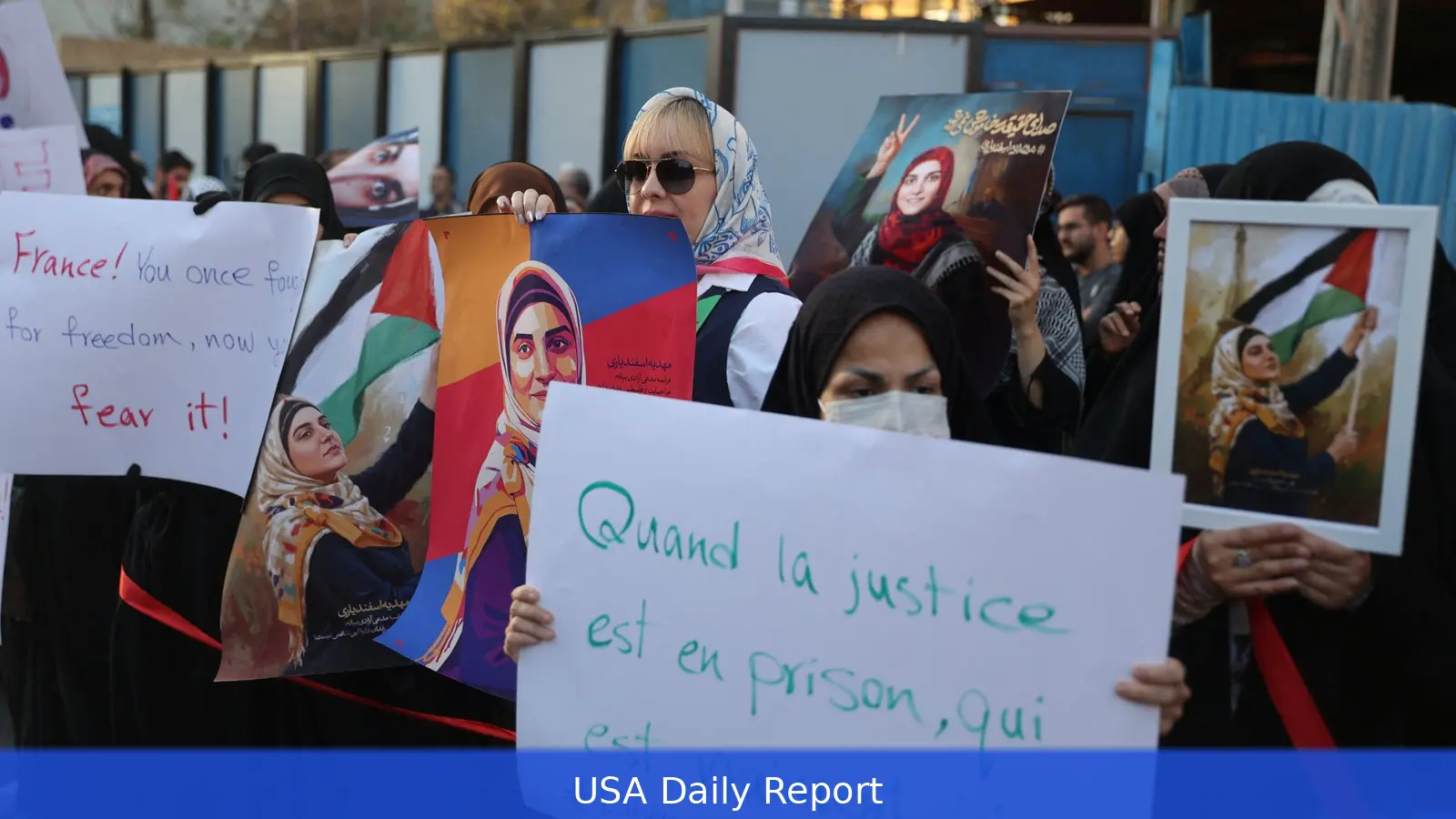
Mahdieh Esfandiari is back in Tehran. She landed after more than a year detained in France. The move came amid what Iranian officials and state media described as a detainee swap.
What happened
Mahdieh Esfandiari, an Iranian national who had been living in France since 2018, returned to Iran on Wednesday, Iranian state television said. Esfandiari, a University of Lyon graduate who worked as a translator, was arrested in France in February of last year on charges of promoting ‘‘terrorism’’ tied to online comments that expressed support for Palestine and the 2023 Hamas attack on Israel.
She was released on bail in October and later sentenced to one year in prison, according to state media in Iran. Her return follows the recent repatriation of two French citizens, Cecile Kohler, 41, and Jacques Paris, 72, who had been held in Iran since 2022 on espionage charges their families deny.
Paris and Kohler returned to France after their April 7 release. Iran’s IRNA says Tehran struck a deal with Paris to free Esfandiari in exchange for the two French nationals.
How the releases unfolded
Cecile Kohler and Jacques Paris were arrested by Iranian authorities in May 2022. They were freed in November but remained under de facto restrictions at France’s mission in Tehran until early April, the French presidency said. French diplomats then escorted them out of Iran; they were driven to neighbouring Azerbaijan before flying to Paris.
Emmanuel Macron’s office described the French citizens’ return as the result of a ‘‘long-term effort’’ by the government. The presidency added that negotiations sped up in recent weeks with increased regional pressures tied to confrontations between Iran and Israel, a dynamic Paris said gave talks fresh urgency.
IRNA publicly framed the outcome as an agreement between Tehran and Paris. France, while confirming the French citizens’ return, didn't explicitly call the moves a swap.
Domestic and diplomatic context
Esfandiari told Iranian state television that her legal case showed, in her words, that ‘‘there is no freedom of speech, at least not in France where I was. The court’s ruling was very unjust.’’ Her comments were broadcast after she arrived back in Iran.
These cases fall where criminal law meets foreign policy, and governments often treat them as diplomatic problems — Tehran has used detainees this way before. Western governments routinely say they oppose charges they view as politically motivated. Tehran, meanwhile, has long used detentions of foreigners as leverage in talks with European capitals.
For France, the episode presented a knotty dilemma: secure the safe return of two citizens while facing criticism at home for how such negotiations are conducted. For Iran, bringing Esfandiari home offered a domestic political win and a diplomatic bargaining chip.

Why Washington is watching
The United States has strategic ties with both France and Israel and keeps a close eye on Iran’s regional behavior. Although neither Washington nor Paris has framed the episode in public as altering broader policy, the case matters to U.S. Policymakers for a few reasons.
Hostage detentions and swaps become bargaining chips that can shape sanctions, nuclear negotiations and regional security talks. How Europe responds to detentions in Iran affects whether the U.S. aligns sanctions and diplomatic pressure with its allies. The case shows how claims of political speech can clash with national security laws, leaving courts and foreign ministries at odds.
Economic and regional fallout
These specific releases won't reshape trade immediately, but ongoing tensions raise insurance and risk costs for companies doing business related to Iran. Sanctions regimes, trade restrictions, and insurance costs for shipping in the Gulf all respond to changes in Tehran’s posture and in European-Iranian relations.
If diplomacy eases tensions, it could lower pressure for fresh sanctions on specific Iranian entities. Conversely, if Tehran’s tactic of detaining foreign nationals becomes more entrenched, European businesses and insurers may demand higher risk premiums for activity tied to Iran, pushing up costs for trade-related services.
And while Iran’s return of detainees to Europe might lower the immediate diplomatic temperature, underlying disputes — nuclear concerns, regional influence, and proxy conflicts — remain unresolved. Those tensions continue to be the backdrop for U.S. Policy in the Middle East.
Legal rights and free speech questions
Esfandiari’s case raised questions about the boundary between lawful expression and charges of promoting terrorism. French prosecutors brought charges after she posted online praise for the 2023 Hamas attack on Israel — an act French authorities described as promoting violence and supporting a designated terrorist group.
Supporters of Esfandiari and some rights groups argue that prosecuting political commentary risks curbing legitimate free speech, while governments cite public-order and anti-terror laws when they press charges. The tension is a legal and political fault line across Europe and beyond — one that now forms part of the public record in this case.
Political calculations
French leaders were dealing with competing pressures: secure the return of citizens abroad, uphold legal and security standards at home, and keep diplomatic channels open with Tehran. President Emmanuel Macron’s office framed the operation as careful diplomacy, crediting long-term efforts by French officials.
For Iran’s government, the optics of bringing Esfandiari home feed a domestic audience and serve regional messaging. Iranian state media labeled Esfandiari a ‘‘rights activist,’’ a term that signals to some domestic constituencies that Tehran views the return as a win for Iranian citizens abroad.
What to watch next
Expect diplomatic talks behind the scenes.
European capitals and Washington will likely reassess how they coordinate responses when nationals are detained overseas. The pattern of swapping detainees — whether framed as deals, negotiations, or unilateral releases — will be closely followed because it influences how states treat similar incidents later.
Meanwhile, legal proceedings in France that led to Esfandiari’s conviction remain a reference point for critics and defenders of the case. How French courts and prosecutors explain the legal rationale could shape public debate about where free speech ends and criminal responsibility begins.
At the very least, the returns underline a simple reality: when citizens are jailed abroad, diplomacy, law and public opinion collide quickly and often messily.
Related Articles
Mahdieh Esfandiari told Iran’s state television: "I think it’s clear for everyone that there's no freedom of speech, at least not in France where I was. The court’s ruling was very unjust."
This article was created with AI assistance.


