
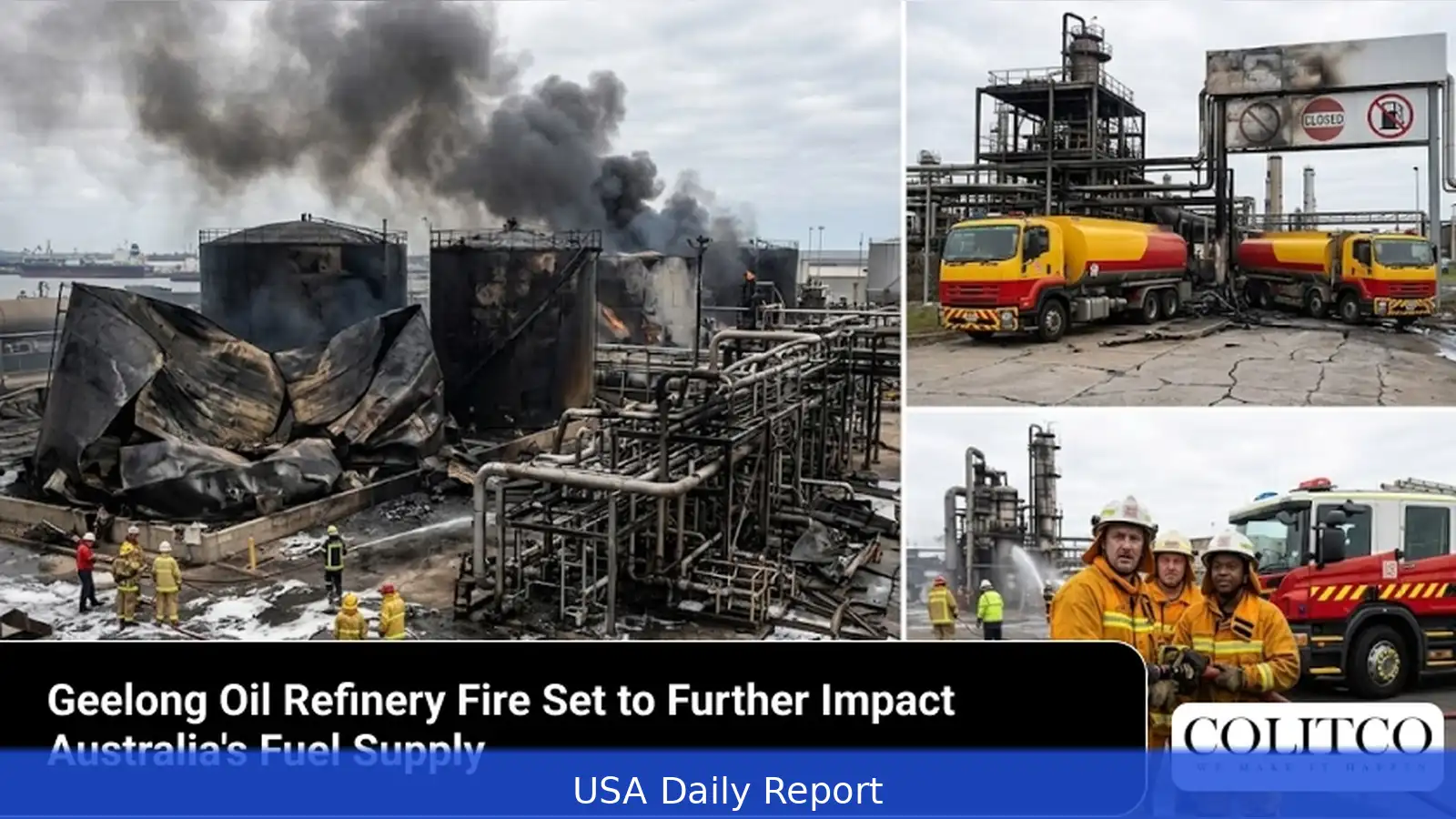
A major fire broke out at a refinery near Geelong on Thursday. Officials warn the blaze will squeeze petrol availability across Australia.
Immediate disruption and official response
Flames at a large Australian oil refinery sent alarm through government and industry on Thursday, forcing plant shutdowns and prompting officials to warn of near-term shortages of petrol. Chris Bowen, Treasurer of Australia, told Nine's Today show that "this isn't a positive development" and that he was working closely with the company involved to assess the damage and the likely ripple effects.
The incident triggered emergency responses at the site and set off contingency planning in state and federal agencies responsible for fuel supply and transport. Supply chain managers began rerouting deliveries and drawing on reserve stocks while the operator and authorities evaluated when refining operations might resume.
You can't fire up a refinery straightaway — crews must inspect equipment, fix damaged units and re-certify safety systems, and that can keep a plant offline for days.
It often takes days or even weeks to bring units back online; how long depends on the damage and how complicated the equipment is, and some repairs can last weeks.
Australian retailers and transport firms started to feel the impact immediately. Some service stations in the region reported reduced deliveries and tighter pump availability within hours of the blaze.
How this affects Australians — and why it matters abroad
For drivers and businesses in Australia the concern is obvious: less refined fuel at the pump and rising prices. Retailers face higher wholesale costs if local refining output is curtailed and imports need to be arranged to make up shortfalls.
Australia meets fuel needs with both local refining and imports, so a big outage usually forces extra shipments from overseas, and the country imports refined product when local output drops. When a major refinery goes offline, the gap must be filled either from other domestic facilities or by bringing in refined product from overseas — a logistics exercise that takes time and money.
Traders across the region will be watching closely — a sudden local squeeze can push up regional wholesale prices. Even though Australia's share of global refined fuel markets is small, a sudden local supply squeeze can push regional wholesale prices up. Traders factor any supply uncertainty into benchmark refined product and crude oil prices, and those moves show up in fuel futures and, eventually, wholesale costs around the world.
The US doesn't rely on Australian refined gasoline, so direct supply links are minor; US imports of Australian refined gasoline are negligible. Still, secondary effects matter. A spike in regional refined-product prices in Asia-Pacific can alter trade flows, change tanker demand and tweak freight rates. Bigger swings in global oil or refined-fuel markets can feed through to U.S. Gasoline prices and to costs for American firms that rely on global shipping and aviation fuel markets.
Economic implications and market signals
Energy analysts said disruptions at a refinery of this scale typically create short-term tightness in local markets and can accelerate trading in nearby hubs. Firms that buy fuel on short notice — shipping companies, airlines and trucking firms — often pay premiums to secure supplies quickly.

In Australia, tighter supply could push up pump prices at a time when consumers are already sensitive to fuel costs. That can feed into higher costs for goods that travel by road and raise operating expenses for transport-dependent businesses.
International investors and commodity traders price in such risks fast. If traders expect an extended outage, crude oil demand for refining may dip slightly in the region, while demand for spot refined products climbs. The net effect on global crude markets depends on how quickly replacement product can be sourced and whether other refineries can ramp up output.
Logistics are tricky: lining up tankers takes days, storage fills fast and port slots can be scarce — tankers often need several days' notice. If tankers have to be diverted from other markets to serve Australia, that changes delivery schedules elsewhere too.
Political fallout and government action
The federal government's immediate task is stabilizing supply and reassuring consumers. Chris Bowen said he was in contact with the company running the refinery and with other agencies involved in fuel security. Federal officials typically coordinate with state authorities to unlock emergency stocks or to prioritise key users — like hospitals, emergency services and public transport.
Local politicians are likely to press for clarity on what caused the blaze and whether regulatory oversight or maintenance lapses played a role. The incident will also revive questions about the resilience of Australia’s refining sector and the nation's reliance on imports when domestic capacity tightens.
After outages politicians usually call for bigger strategic reserves, subsidies to keep refineries running or more diverse import sources — all of which come with real costs to taxpayers and industry. Each option has trade-offs: reserves carry storage costs, subsidies for local refining raise long-term fiscal questions, and broader import sourcing can strain logistics and increase costs.
Business reaction and contingency planning
Firms that rely on steady fuel deliveries moved quickly. Logistics companies activated contingency plans, prioritizing essential freight lanes and consolidating deliveries to keep key services running. Retail chains began coordinating across regions to rebalance supplies, while some distributors started to source additional shipments from overseas suppliers where possible.
Insurance and risk managers will examine the incident closely. A major refinery outage can generate claims related to business interruption, damaged assets and environmental cleanup costs. Depending on the cause, investigations and insurance settlements can take months to resolve.
Suppliers of refinery parts and engineering services may see a surge in demand if the affected plant needs significant repair. That can create a short-term boost for specialist contractors but also puts pressure on the market for outage-related labor and equipment.
Wider energy-security questions
Energy security briefly becomes a political and economic priority after incidents like this. Industry players and policymakers often revisit where supply vulnerabilities lie — not just at a single plant, but across storage, transport and international sourcing networks.
Analysts note that refinery closures worldwide over the past decade left some regions with thinner margins for error. When a major facility unexpectedly goes offline, those thin margins show up fast.
That said, markets can and do adjust. Over time, supply gaps are usually filled through a mix of increased imports, temporary swaps and draws on commercial or government reserves. The speed and cost of that adjustment determine how painful the local impact is.
What to watch next
Officials will publish more detail on the cause of the fire and the estimated timeline for restarting operations. Observers will track tanker movements, regional wholesale fuel prices, and any emergency measures announced by state or federal authorities.
For consumers, the short-term marker will be pump prices and availability at service stations. For businesses and markets, the bigger markers will be how long refining capacity stays reduced and how much imported product is required to fill the gap.
Bottom line: the fire at the Geelong refinery is a clear, immediate supply shock for Australia and a test of both commercial and government contingency arrangements. It also offers a reminder that even isolated industrial incidents can have cross-border economic effects in a highly interconnected energy market.
Related Articles
“This isn't a positive development,” said Chris Bowen, Treasurer of Australia.
This article was created with AI assistance.


