
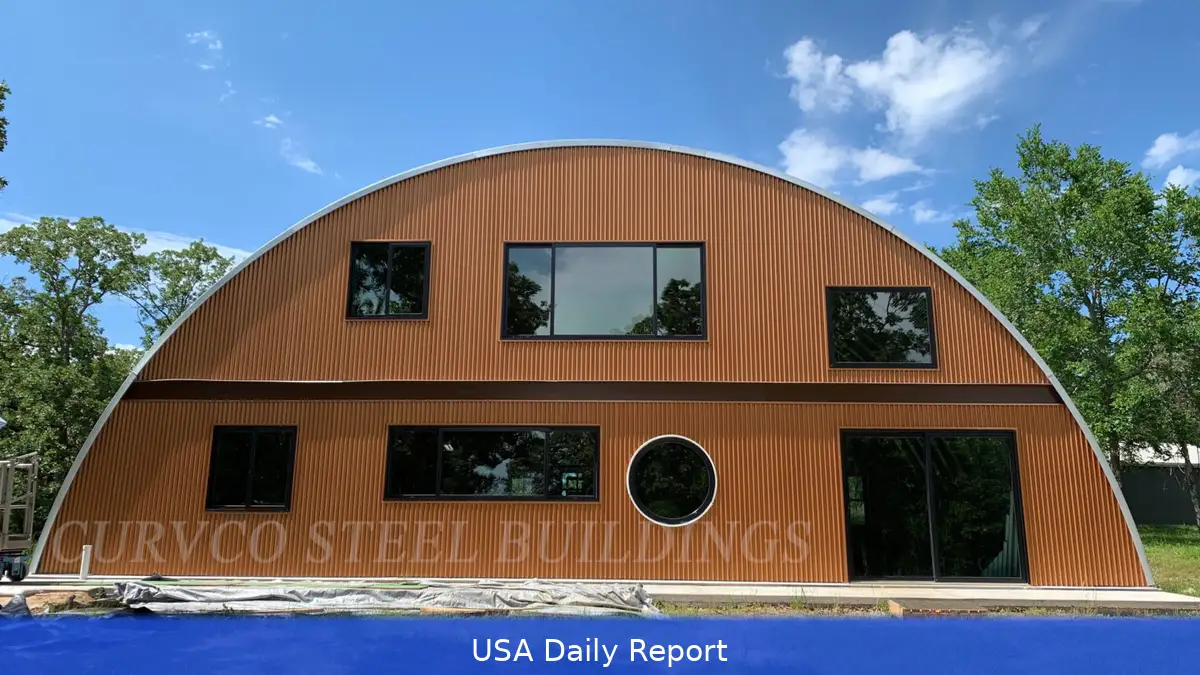
Think a metal-arch home under $300,000 sounds wild? Maybe not.
Why Quonset huts often start cheap
Quonset-style buildings began as military workhorses in World War II and they still carry that legacy: simple, curved steel shells built to last. Special Finds' guide on Quonset huts and steel homes notes they're cheap to erect, easy to move and need very little upkeep. That basic design — corrugated steel panels bent into an arch — is why builders can sell shells or kits for far less than a conventional stick-built house.
Don’t forget: the bare metal arch is just the shell, not a finished house. The shell itself can be a relatively small fraction of a finished home's cost. The appeal for many buyers is straightforward: pay relatively little for a durable envelope, then add the systems you want.
Line-item costs that buyers sometimes miss
Remember this: many 'unfinished' listings only include the shell and the land, so you still need to budget for the rest. BuildingsGuide's 2026 cost breakdown is useful because it lists typical add-ons that quickly add thousands to the bill.
Right now, permit fees vary a lot. BuildingsGuide reports that small towns might charge around $150, while larger cities can charge as much as $10,500 — and the average tends to sit between $550 and $2,000.
That's a modest cost for some, but for others it's an unexpected extra.
Site work and foundation also push numbers higher. Clearing and prepping a lot depends on soil, slope and local weather. The guide gives a rule of thumb by building size: for small buildings (under 1,500 sq. Ft.) expect roughly $0.50 to $1.50 per sq. Ft.; for medium buildings (1,500–3,000 sq. Ft.) $1 to $3 per sq. Ft.; and for large buildings more like $1.50 to $4 per sq. Ft. Foundation installation, meanwhile, is often estimated at $4 to $8 per sq. Ft., with perimeter foundations costing about 30% less than full slabs.
The reality is that a cheap shell can balloon in price once you add foundation work and interior framing — those line items add up fast.
Labor, shipping and customization: the hidden add-ons
Shipping tends to be relatively inexpensive since the arch panels stack tightly, which keeps delivery costs low. BuildingsGuide suggests shipping can run about 2% to 4% of the building cost. Many suppliers include delivery; others don't. So check the invoice.
Expect labor for erection and finishing to take a big chunk out of your budget; labor rates in the guide run several dollars per square foot. Professional teams tend to charge around $3 to $6 per sq. Ft. For basic construction. If you're converting a bare metal shell into livable space, interior framing and drywalling often run $9 to $19 per sq. Ft. Electrical and plumbing rough-ins each typically add another $4 to $7 per sq. Ft., according to BuildingsGuide's line-item list.

Doors, windows and end-wall packages add up too. Overhead garage doors can cost $1,000 to $2,000 apiece; standard access doors about $500. End walls purchased from the supplier can be $2,000 to $8,000 depending on size and options. Those aren't minor touches — they're the parts that turn an arch into a functioning home.
Crunching the math: is under $300K realistic?
To test whether a sub-$300,000 unfinished Quonset-style home makes sense, do a quick scenario: suppose you find a 1,200 sq. Ft. Shell for a low price. Add a modest foundation at $4 per sq. Ft. And you get $4,800. Interior framing and drywall at the low end — $9 per sq. Ft. — adds $10,800. Electrical and plumbing rough-ins at $4 per sq. Ft. Each add $9,600. Labor and site prep will vary, but they can tack on several thousand more.
A quick back-of-the-envelope shows a low-cost shell plus finishing trades and systems can push total spend toward the $300,000 neighborhood. But sellers and investors can and do find paths to stay under that threshold — by doing some work themselves, by choosing modest finishes or by buying in markets where land and labor are cheap.
Where Quonset homes give buyers an edge
Special Finds emphasizes the durability and low maintenance of steel homes. The curved shape helps regulate temperature, and the weatherproofing is an advantage in climates that see heat or heavy precipitation. For buyers willing to live in a raw or semi-finished building for a while, those savings on upkeep can matter a lot to the household balance sheet.
Also, Quonset kits are fast to assemble relative to conventional construction. That speed can cut carrying costs for builders and individual owners who are financing the conversion. Shipping being light and compact compared with rigid-frame kits is one reason erection can be quicker and less costly.
Financing, resale and appraisal realities
Getting a mortgage on an unfinished—or nontraditional—home can be tricky. Lenders and appraisers typically prefer comparables and predictability; an unfinished Quonset on raw land may lack nearby comps and could be classified as non-standard collateral. That means buyers often rely on construction loans, cash, or niche lenders who understand metal-arch homes.
Resale value also depends on finished quality and how the property fits its market. A well-executed conversion in a rural area can finish strong. But a half-finished shell with no utilities will scare mainstream buyers and could depress appraisals. One real advantage: steel shells don’t rot or get eaten by pests the way old wood frames do, so you’re less likely to discover major structural failures.
Buyer checklist before you bid
Know what you're buying. If the listing says "unfinished," find out exactly which items are incomplete: foundation? Utilities? Insulation? Windows and doors? Those details change the scope of additional spending.
Get line-item estimates. Use the BuildingsGuide cost ranges as starting points and get local contractors to price site prep, foundations and labor. Shipping and end-wall options should be clarified with the supplier.
Think about timeline. A Quonset shell can go up fast. But getting permits, hooking up utilities and finishing interiors still takes time. Build a schedule and budget for delays.
Lastly, check zoning and permits up front. Permit fees can run from under $200 to more than $10,000, depending on the jurisdiction and complexity of the project.
One-sentence paragraph to break the rhythm.
Who benefits most
Buyers who want low-maintenance exteriors, lower material costs and the ability to customize interiors are the natural audience. Investors who can manage a fast conversion and control labor costs can find margins. People who plan to do a lot of sweat equity may be able to turn a low list price into a finished home under $300,000.
But if you're expecting turnkey move-in without extra expense, you're likely to be disappointed. That's because the shell is only the start.
Related Articles
- Dubai home prices fall 5.9% in March
- Fed signals patience, projects one cut in 2026
- UAE Leaves OPEC — Saudi Arabia Picks Up the Slack
BuildingsGuide lists interior framing and drywalling at $9 to $19 per square foot.
This article was created with AI assistance.


