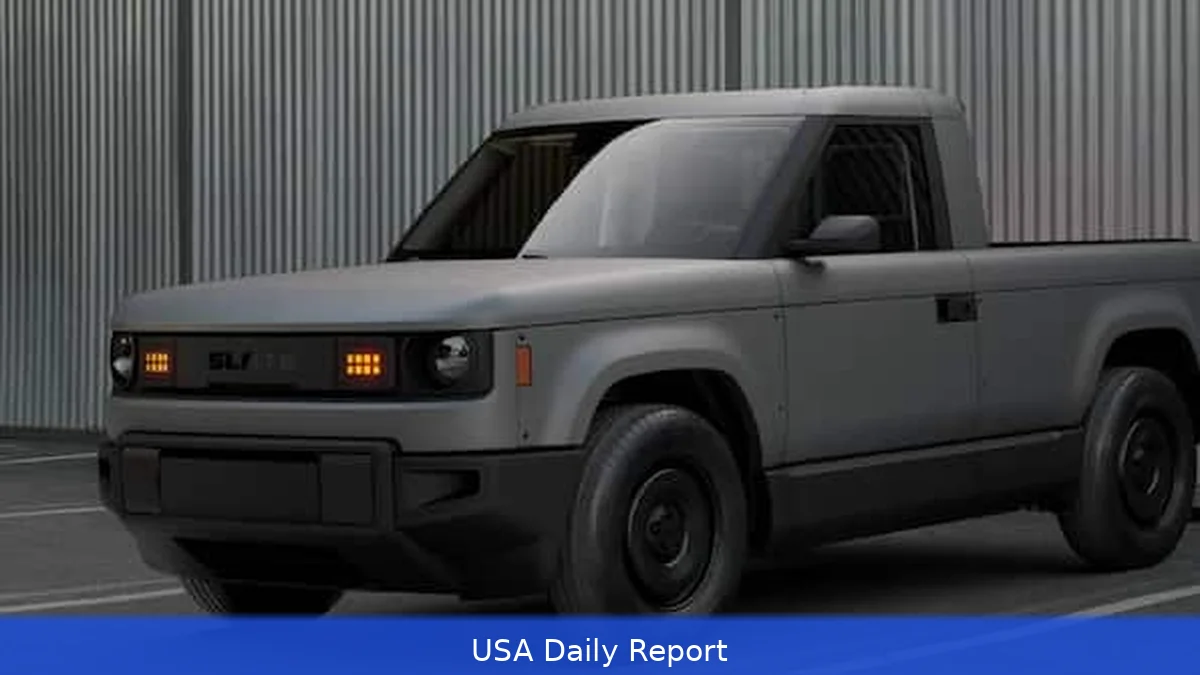
Slate Auto closed a $650 million Series C round. The cash tops its funding to about $1.4 billion.
Big raise, tight timeline
Slate Auto said Monday it has secured $650 million in new financing to accelerate production of its low-cost electric pickup. The Series C was led by TWG Global, the investment vehicle run by Mark Walter, CEO of Guggenheim Partners and owner of the Los Angeles Dodgers, alongside investor Thomas Tull. The company said the fresh capital brings its total raised to roughly $1.4 billion since it was founded in 2022.
Look, that’s a lot of money for a startup still building a factory.
The funds arrive as Slate targets a production start before the end of 2026 for what it calls a bare-bones electric truck aimed at the extreme low end of the market. The truck is meant to begin at a price in the mid-$20,000s before options, and buyers can add modular upgrades — including an SUV conversion kit that Slate has priced at about $5,000. Final pricing is due in June, the company said.
The pressure is real. Slate has to move from prototype and reservation books to assembly lines and supply contracts in a market that’s grown choosy about new EV entrants.
Who’s backing the bet
TWG Global led the round; Slate thanked what it called “visionary investors” in a statement but declined to name other new participants. Existing backers already include venture firms such as General Catalyst and Slauson & Co., Jeff Bezos’ family office, and former Amazon executive Diego Piacentini.
That said, Slate’s roster of executives reads a lot like Amazon’s org chart.
Co-founder Jeff Wilke, who once led Amazon’s consumer business, helped start the company. Peter Faricy, the former vice president of Amazon Marketplace, was installed recently as Slate’s chief executive to focus on converting interest into paid orders. Chris Barman, who previously led product work at Chrysler, moved into a new role as president of vehicles as Slate reset its executive lineup for scale.
Those hires give Slate institutional know-how on logistics, e-commerce and customer funnels. But manufacturing cars at scale is different from shipping boxes — and it tends to eat capital at a steady clip.
Factory, reservations and the cash runway
Slate is spending several hundred million dollars to retrofit a former printing plant in Indiana for vehicle production, the company said. The new cash will be used to continue that work and to support early production runs, tooling, and supply-chain build-out, according to Slate’s statement.
Point is, the dollars are earmarked for the hard stuff.
Slate has also been building demand off the drawing board; the startup says it has more than 160,000 refundable reservations for the truck. Converting those reservations into paid deposits and then into finished vehicles is the immediate commercial challenge facing the company. That conversion work was part of why the company tapped Peter Faricy as CEO.
Even with strong reservation numbers, Slate faces the classic hardware-company problem: reservations don’t equal revenue until cars roll out and buyers sign final contracts. And production hiccups, supplier delays or cost overruns could eat into the margin for a model priced at the low end.
Market backdrop: a tougher road for EV hopefuls
Electric vehicles haven’t been easy money lately. Automakers large and small have pulled back on some EV plans after the federal $7,500 tax credit expired in 2025, removing a price cushion many startups had counted on. Tesla’s overall sales have fallen for two straight years, according to industry figures. New entrants such as Rivian and Lucid have struggled to reach steady scale, even as each has pushed lower-priced models this year to try to broaden appeal.
Frankly, Slate’s low-price bet sets it apart. While many rivals chase premium buyers with higher margins, Slate aims to hit the smallest-ticket buyers with a stripped-down electric truck and low sticker shock. That could open a large market if the company can deliver a reliable vehicle at the promised price.
But there are trade-offs: low price points leave little room for errors on component costs and manufacturing efficiency. Suppliers often demand volume guarantees, and early-rate production tends to be slower and more costly per unit. Those dynamics make capital and supply-chain discipline crucial.
What the new leadership and capital mean
Slate’s investor mix and executive hires suggest the company is leaning hard on e-commerce and fleet sales playbooks — areas where Amazon veterans tend to be strongest. Jeff Wilke’s consumer background and Peter Faricy’s marketplace experience point to a strategy of using online funnels and direct-to-consumer sales to move inventory quickly.
But the company will still need to prove manufacturing chops. To date, Slate has shown concept vehicles and a clear price ambition. Now it must convert engineering promises into repeatable assembly-line output, and turn refundable reservations into nonrefundable orders.
Executives have said the company will reveal final pricing in June — a critical moment given the loss of federal support. Investors will be watching whether the number is realistic given current battery and parts costs, or whether Slate will rely on optional add-ons to push up average selling prices.
Investor perspective and risks
Mark Walter and Thomas Tull leading the round signals high-net-worth confidence in the idea that a low-cost EV truck can carve out a new segment. Slate’s previous capital raises showed similar investor faith: the company had already drawn backing from well-known venture outfits and Bezos’ family office before this round.
Still, there's a long list of risks: supply-chain shocks, slower-than-expected factory ramp, regulatory certification, and competition from incumbents who could cut prices or accelerate low-cost models. And while refundable reservations are a good marketing signal, they also cap how much capital the company can count on until buyers commit fully.
Why price matters
Slate’s aggressive price target — the startup had at one point suggested a starting price around $27,000 and later positioned pre-credit pricing as under $20,000 when the federal tax credit was in play — is the core of its pitch. If it hits that mark, Slate would widen EV access to buyers who have so far been priced out of the new-vehicle market.
But hitting low-cost thresholds depends on cell costs, supplier terms, and production yield. Those inputs have been improving industrywide, but not uniformly. So the path to a mid-$20,000 truck is narrow and full of variables.
Look, the idea of an affordable EV pickup is compelling. The execution is where the battle will be won or lost.
Related Articles
- Goldman Sachs Flags Iran War as Growing Drag After Solid Quarter
- Bill Ackman launches roadshow for dual Pershing Square IPO
- Goldman Traders Post Record Quarter as Bond Desk Falls Short
Slate Auto says it has more than 160,000 refundable reservations for its electric truck.


