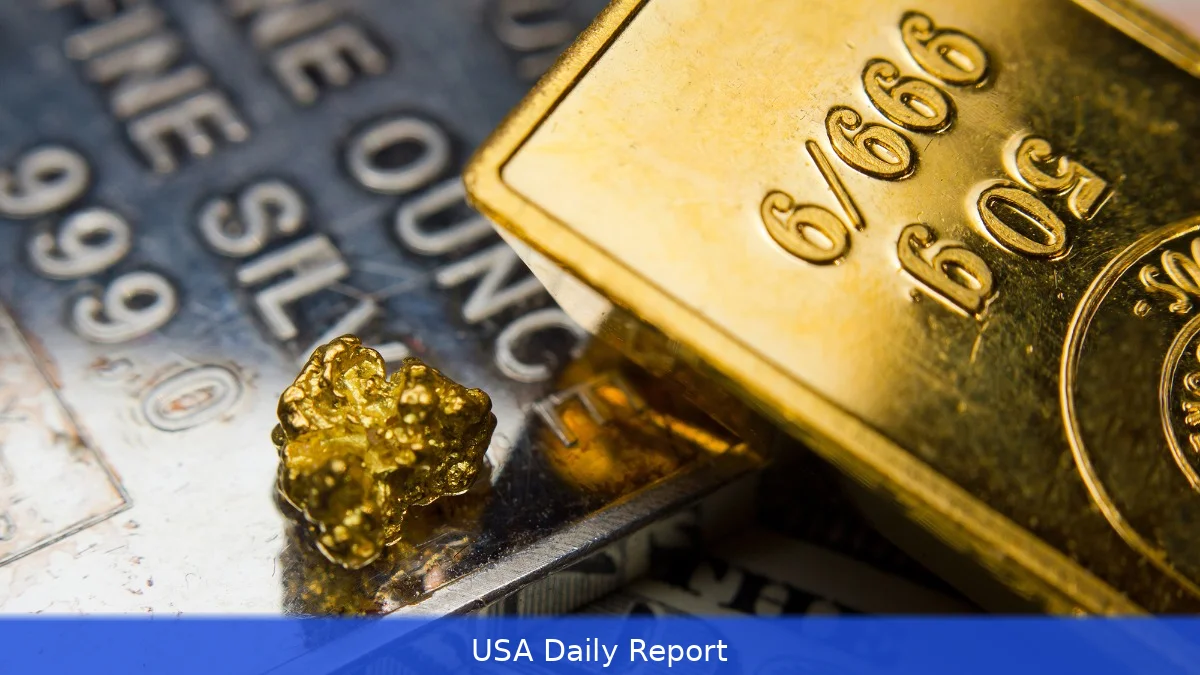
Gold jumped 65% in 2025. UBS now predicts even higher prices into next year. The bank pegs a mid‑2026 target of $6,200 an ounce and a $5,900 year‑end level.
How UBS arrived at a bullish call
UBS's outlook rests on three big pillars, according to the market note summarized by GoldSilver: looser U.S. Monetary policy, steady central‑bank purchases, and record investment demand. The bank models two quarter‑point cuts by the Federal Reserve through September 2026, which would shave real yields and make non‑yielding gold relatively more attractive. And those rate moves are central to UBS's case — lower rates reduce the opportunity cost of holding physical metal instead of bonds or cash.
Look, the math is straightforward. If real yields fall, investors tend to seek alternatives that hold value when money loses purchasing power. Gold ticks that box.
UBS also points to ongoing central‑bank accumulation. Emerging markets, in particular, are still trimming dollar exposure and adding bullion to reserves, the note said.
Poland recently raised its gold reserve target, a move UBS highlights as part of a broader, structural shift toward official buying.
That official demand matters because it's less price‑sensitive than retail flows. Central‑bank purchases tend to be steady and can absorb a lot of supply, which supports prices during pullbacks. And for exchange‑traded funds, investor inflows have pushed holdings to new highs — the GoldSilver summary notes global ETF stocks hit 4,171 tonnes in February 2026.
Price path and risk scenarios
UBS lays out a base case and two stress scenarios. The base case puts gold at $6,200 in mid‑2026, easing to $5,900 by year‑end after U.S. Midterm politics settle. In an extreme geopolitical shock — a sharp escalation in tensions — UBS's upside runs to $7,200 an ounce. The downside case, where the Fed re‑tightens more than expected, sits near $4,600 an ounce.
Thing is, gold has already flashed volatility. After the 65% leap last year, the metal pulled back toward roughly $4,400 an ounce before rebounding. That means UBS's downside isn't a fantasy; it's a level the market visited during the recent correction.
What the scenarios show is how sensitive bullion is to both policy moves and geopolitics. Small shifts in rate expectations can swing the implied return from bonds versus holding gold, and sudden geopolitical shocks can push a lot of capital into safe havens all at once.
What drove the 2025 surge
Global demand for gold last year reflected multiple threads. Retail and institutional buyers chased momentum, but central banks and ETF investors supplied a steadier bid, the GoldSilver coverage noted. China’s physical demand held up even at elevated prices, showing resilience in consumption markets that often get crowded out when prices climb.
Record ETF holdings underline that investment funds have become a structural source of demand. Rather than relying only on jewelry or industrial uses, the market now leans heavily on financial flows. That shift amplifies moves in price: inflows can be large and rapid, and they change the buyer mix toward investors who react to macro signals.
For producers, that’s a different market to plan for. Mines respond to long lead times, while investors can move in days. The result is a tighter supply‑demand balance once a momentum trade gets going.
Fed policy is the wildcard
UBS frames the Fed as the single largest swing factor for its forecast. The bank assumes two 25‑basis‑point cuts by September 2026. If that happens, the path toward lower real yields gives gold a clear tailwind. But if inflation surges again or data stay hotter than expected, the Fed could delay cuts or even tighten further — and that would tilt the market toward UBS's $4,600 downside scenario.
Right now, markets are pricing a delicate dance. Investors are parsing each inflation print, payrolls report and Fed speaker for hints. That makes gold especially reactive: it doesn't just trade on expectations for commodities, it trades on expectations for rates and for global risk.
How investors might think about positioning
Investors don't have a single correct move here — they have choices that reflect risk appetite and time horizon. One path is to buy on weakness, using pullbacks as entry points into a market UBS sees with mid‑teens upside from current levels. Another approach is to use smaller, staggered purchases to avoid mistiming a peak.
And for those who prefer liquid exposure, ETFs remain an option. Their recent record holdings show investors like the convenience and tradability. But physical buyers, including central banks, are a different beast; their buying tends to be measured and long dated.
Still, the possibility of a sharper Fed tightening or a sudden geopolitical thaw means hedges matter. Some traders use options to protect against downside while keeping upside potential. Others limit allocation sizes to avoid being overweight in a single macro bet.
Market takeaways and practical risks
Bottom line: UBS's call is bullish, but it's conditional. The bank builds a scenario around rate cuts and continued official buying — both plausible, but not guaranteed. The upside case hinges on an abrupt spike in geopolitical risk; the downside stems from a Fed that doesn't ease when markets expect it to.
Investors should be aware that gold's recent run was unusually sharp. Corrections can be swift. The metal's appeal as a hedge against inflation and turmoil remains intact, but timing matters. If you buy here, expect bumps.
Gold markets also carry structural quirks. Mining supply can't be dialed up overnight. Central‑bank buying is deliberate. ETF flows can swing. Those features mean price moves often look violent even when the fundamental story evolves slowly.
Finally, keep an eye on official demand trends. If more countries follow Poland in raising reserve targets, the steady, price‑insensitive nature of that demand could sustain higher prices even if speculative interest cools. GoldSilver's summary of UBS's note flags that as a key part of the thesis.
Related Articles
- Bowman signals early rate cut as Fed faces political squeeze
- Crude Tops $100 as Asian Stocks Slide on Blockade Risk
- Chinese Rare-Earth Stocks Rally as Markets Price in Tighter Supply and Higher Quotes
UBS's published targets: $6,200 per ounce in mid‑2026 and $5,900 per ounce by year‑end 2026.


