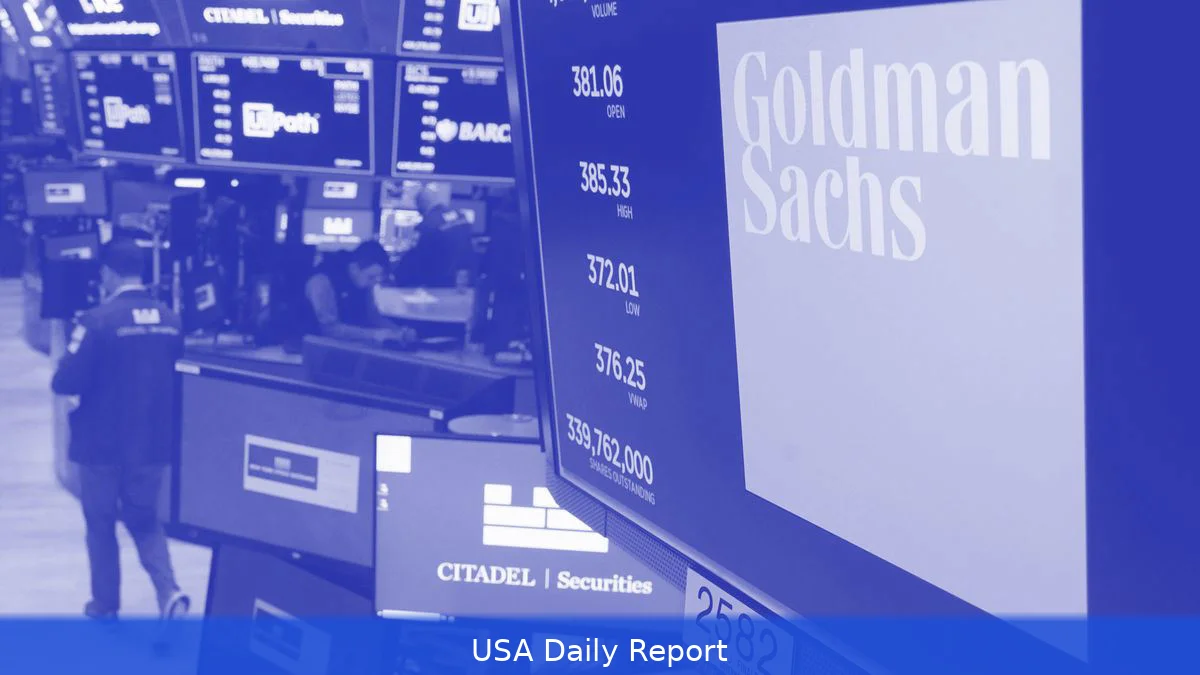
Goldman's equities traders pulled in $5.33 billion this quarter. But the bank's fixed-income unit stumbled, leaving investors surprised. Shares slipped after FICC revenue missed analyst forecasts by roughly $800 million.
Traders drove a historic haul
Goldman's equities unit produced one of the biggest quarters in banking history, recording $5.33 billion in revenue — more than $1 billion higher than its previous best. The bank said heightened market volatility tied to the conflict in Iran helped traders capture wide opportunities across stocks and derivatives. Look, that kind of trading quarter doesn't come along often; it's rare enough that the result dominated the headlines inside Wall Street.
Traders at Goldman delivered big revenue almost instantly, showing they still rake in fees whenever volatility spikes — equities pulled in $5.33 billion this quarter. Equities weren't the whole story, though.
FICC missed, and the market noticed
Fixed-income, currencies and commodities — FICC for short — delivered $4.01 billion, roughly $800 million below what analysts had expected and about 10% below the same quarter a year earlier. Investors reacted: Goldman shares fell about 3.4% and were the weakest performer in the KBW Bank Index on the day of the release. The shortfall in FICC erased some of the shine from the record equities quarter.
That gap between desks matters because it shows how lopsided modern big-bank revenue can be — a massive win in one area doesn't always offset weakness in another. Investors won't cheer a headline profit alone; they want more balanced results across divisions — the weak FICC quarter helped push the stock down 3.4%.
Banking fees and a rebound in deals
Investment banking provided a counterpoint to the trading confusion.
Goldman reported total fees of $2.84 billion, helped by advisory work that jumped 89% from a year earlier as M&A activity picked up. Deals that had been waiting in the wings finally started moving, and advisory bankers saw the benefit in their fee pool.
Advisory fees jumped 89% year-over-year, a performance management highlighted on the earnings call. But even with deal fees and record equities trading, the mixed message from FICC cooled investor enthusiasm.
Private credit: a bet with soft edges
Goldman is ramping up in private credit, putting big amounts of capital to work in a market where valuations have drawn scrutiny. Lloyd Blankfein, Goldman's former CEO, warned earlier this year that private markets could be at risk of a "fire" if valuations were frothy.
The bank disclosed that one private credit fund experienced nearly 5% of investors attempting to redeem in the first quarter — a sign that even sophisticated clients can twitch when markets wobble.
David Solomon, Goldman's chief executive officer, called private credit "very, very attractive." He repeated the phrase twice on the earnings call, underscoring how management is leaning into the business despite the frictions. Management sounded confident on the call, but FICC's $4.01 billion in revenue lagged expectations.
Management on the call
Solomon addressed the FICC miss directly. "A lot of this has to do with expectations that are set in the research community," David Solomon, chief executive officer of Goldman Sachs, told analysts. He also framed the quarter differently: "It was the 10th-best FICC quarter ever," he said, a line that tries to soften the blow by putting the result in historical context.
His comments underscored that expectations — not just raw figures — shaped analysts' reactions, because FICC fell short of what the Street had penciled in. Investors who had priced in a blowout were disappointed by a quarter that, on some measures, was solid but short of the sky-high bar set for it.
What the mix means for Goldman
The split between an all-time equities record and a weaker FICC quarter exposes a familiar modern bank dynamic: revenue can be highly concentrated in a few businesses and move fast with market swings.
A single strong trading quarter can mask other problems; if FICC stays weak, Goldman's results will look vulnerable once equities calm — equities were $5.33 billion vs. FICC at $4.01 billion.
Goldman is expanding in private credit, betting those loans will lift future returns and fees — one private credit fund saw nearly 5% of investors try to redeem in Q1. The near-5% redemption pressure in one fund is a concrete reminder that private strategies carry liquidity and sentiment risks that can surface quickly.
Investor reaction and the road ahead
Markets punished the stock after the numbers landed. A drop of 3.4% isn't catastrophic for a bank the size of Goldman, but it signals investor frustration that the headline results didn't match the loftiest hopes. Traders and bankers did their parts, but the bond desk's soft show undercut the mood.
Analysts will spend the coming days parsing how much of the FICC shortfall was temporary — tied to specific market moves — and how much signals a slower cycle for fixed-income trading. Management pushed back, arguing expectations were a key part of the story and pointing to the quarter's place within a longer history of FICC results.
Balance: risk and reward
Goldman faces the practical task of balancing volatile trading payouts with steadier fee businesses and an expanding private-credit arm. The bank's results make clear why executives prize diversified revenue streams. When one area surges, another can drag the whole story down if it's out of step.
Executives emphasized record equities, higher advisory fees and a push into private credit as evidence of strength, even as the market reacted to the FICC miss. Investors wanted to see FICC rebound before handing the stock a rally; the shares fell about 3.4% on the report.
Related Articles
- Wave of $15 Billion U.S. IPOs Runs Headlong Into a New Phase of War
- Chinese Rare-Earth Stocks Rally as Markets Price in Tighter Supply and Higher Quotes
- Creditors Seek Roughly 90% Stake in Raizen Debt-for-Equity Deal
"It was the 10th-best FICC quarter ever," said David Solomon, chief executive officer of Goldman Sachs.


