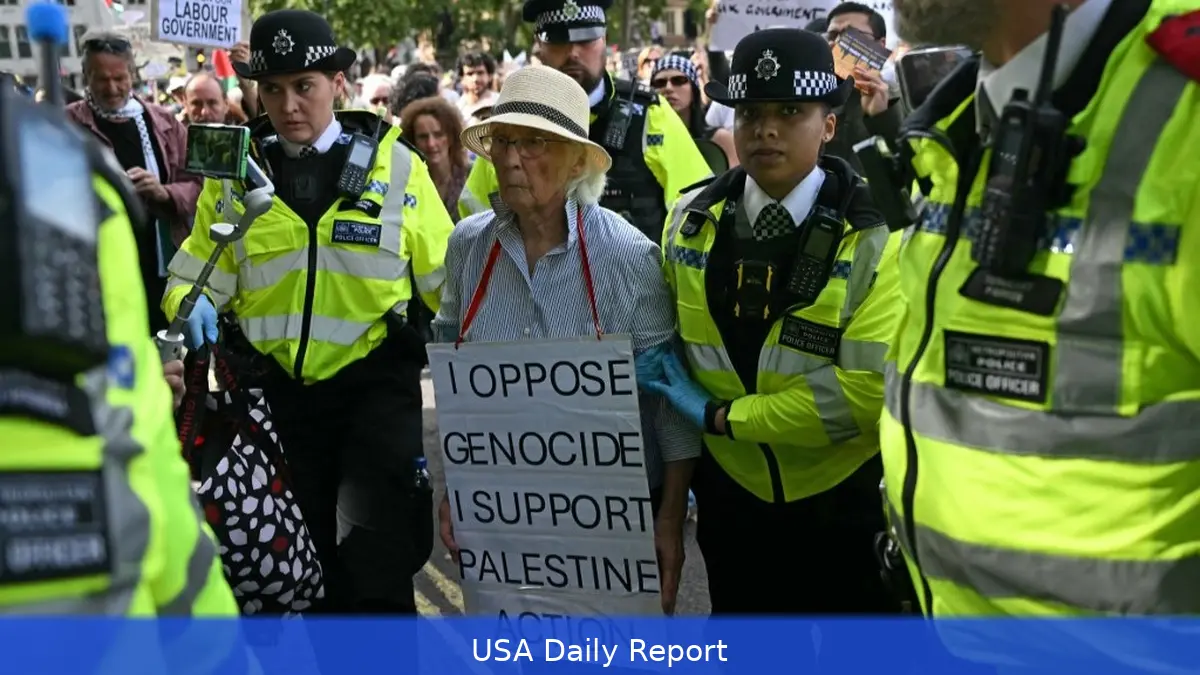
Police began arresting demonstrators in Trafalgar Square on Saturday.
Mass vigil, quick arrests
Police moved into Trafalgar Square after hundreds gathered for a vigil opposing the UK government’s decision to ban Palestine Action. Organisers said roughly 1,500 people attended, many carrying placards and chanting against the proscription. Officers carried several people from the square and escorted an elderly woman using walking sticks away from the crowd.
Tension rose in the square as officers moved into the crowd and people were carried away.
Defend Our Juries (DOJ), a U.K.-based activist group that organised the demonstration, called on the government to lift the ban on Palestine Action and to drop charges and investigations brought under the Terrorism Act. The group also criticised what it described as a change of course by the Metropolitan Police over arrests for showing support for the group.
One protester told reporters they were there because they feared a shrinking space for free speech in Britain. Organisers said the action was meant to push back against both the proscription and renewed police enforcement.
What led to the crackdown
Palestine Action stages direct actions against firms and sites it accuses of supporting Israel's military, including a break-in at an RAF base and an attack on a London business linked to weapons suppliers. The group has claimed responsibility for a range of disruptive actions, including a break-in at a Royal Air Force base where aircraft were painted and an incident at a London business said to have ties to weapons suppliers.
The government moved to proscribe Palestine Action as a terrorist organisation in July 2025, placing it alongside groups such as al-Qaeda and Hezbollah under U.K. Law. That designation makes membership or public support for the group a criminal offence carrying sentences of up to 14 years.
But the High Court dealt a setback to the government in February. On Feb.
13, the court ruled the proscription unlawful, calling the ban disproportionate and in breach of freedom of expression. Following that ruling, the Metropolitan Police initially signalled it was unlikely to arrest people displaying support for Palestine Action.
Then, on March 25, the force said it would resume arrests for expressions of support. That reversal has angered campaigners and helped bring people onto the streets in London.
Voices from the demonstration
Qesser Zuhrah, who has been on hunger strike while held on remand in connection with Palestine Action activity, told the crowd that the police didn't protect ordinary people. She said the force appeared to be enforcing government policy rather than serving communities.
Defend Our Juries framed the vigil as a defence of civil liberties. The group demanded the government rescind the proscription and drop investigations into those accused of backing Palestine Action. Organisers said the event was meant to highlight both the legal fight and the human consequences for people charged under the Terrorism Act.
Look, many people there shared a broader fear: that criminalising a campaign of property-focused direct action could chill protest across Britain. Some speakers warned about the reach of terrorism laws into political debate; others stressed solidarity with Palestinians amid a broader international conflict.
Legal and political stakes
The High Court’s judgment underlined a key legal tension: how to balance public order and national security against protected political expression. The Feb. 13 ruling said the ban went too far. The government, however, has maintained its stance that the group’s tactics and alleged links justify proscription.
The dispute has become a test of how far ministers and police can act before judges reassert legal limits. And for opposition politicians and civil liberties groups, the episode has become evidence in a wider critique about limits on dissent.
This isn't only about Palestine Action; it's a wider fight over how terrorism laws are applied to political protest. It’s about how terrorism laws get used in a modern democracy — whether the state will answer to judges when limits are set, or whether enforcement decisions by police and ministers will dominate.
International implications and U.S. Connections
At first glance the confrontation is a British matter. But the effects ripple outward. Palestine Action has targeted firms and sites it says are part of an international web of defence suppliers and support for Israel. Many of those commercial and military ties cross the Atlantic.
There's a second issue: whether U.K. court decisions will set a legal precedent for how democracies handle protests aimed at arms suppliers and foreign-policy matters. Civil liberties groups and rights defenders in the United States monitor cases like this because they can shape discourse about protest, policing and the use of counterterrorism powers.
Right now, U.S. Lawmakers and legal advocates aren't party to the U.K. Court fight. But courts in one major democracy can influence arguments in another — especially when judges parse where free expression ends and criminal conduct begins. Corporate reputations and investor risk assessments also get a look-in: companies linked to contentious foreign policy issues can face protests that affect their share prices and business ties.
Economic angles
Direct actions that target defence-linked firms are meant to raise the cost — reputational and operational — of doing certain kinds of business. Investors watch these disputes because repeated disruptions can lead to higher security costs and legal exposure for firms, or to contract cancellations.
For U.S. Companies with international operations or suppliers that deal with defense or dual-use technologies, a tougher regulatory or enforcement environment in a major market like the U.K. Adds complexity. Banks and insurers may re-evaluate risk. That can make projects more expensive to insure or finance.
So far, reporters have not found clear evidence of major economic fallout tied to the proscription or the demonstrations. The protest was large and visible, yet it didn’t target trading floors, ports or infrastructure in ways that would trigger major market moves. Still, the optics — arrests in a central London square and a contested legal backdrop — are the sort of headlines that analysts factor into long-term reputational risk assessments.
What protesters and officials say next
Organisers plan to keep up pressure through legal channels and public events. Defend Our Juries has demanded the government remove the proscription and end prosecutions tied to the group. Supporters of the ban argue it’s needed to deter what they call criminal and dangerous activity.
The Metropolitan Police’s decision to resume arrests marks a shift back toward enforcement. For campaigners who’d hoped the High Court decision would reduce arrest risk, that reversal felt like a warning.
Frankly, the scene in Trafalgar Square shows how court rulings, policing decisions and political choices interact — and how those interactions can play out on the streets.
Related Articles
- Bournemouth shock Arsenal 2-1 at Emirates, handing Man City a Premier League lifeline
- Irish police use force to clear fuel protesters at refinery as shortages spread
- Trump administration unveils 250-foot 'Triumphal Arch' plan for Washington
The High Court ruled on Feb. 13 that the proscription was "disproportionate" and breached freedom of expression.


