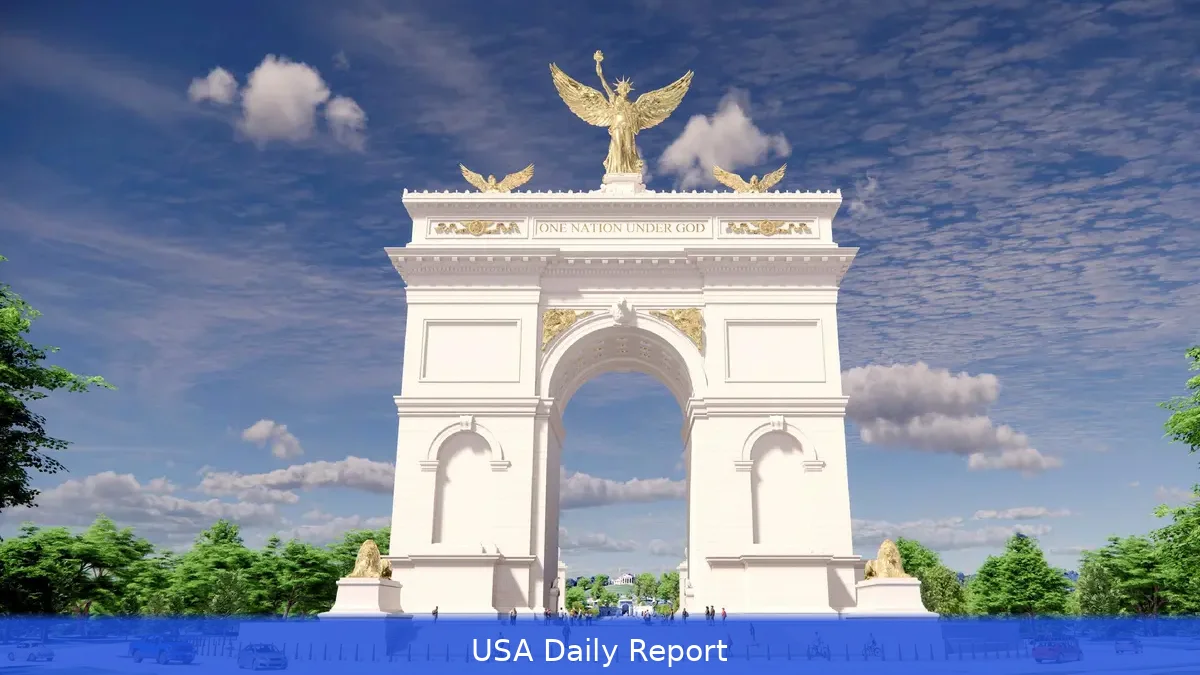
A 250-foot arch is coming to the nation's capital. Look, the White House says it's modeled on Paris's Arc de Triomphe. The administration says the structure will greet people crossing Memorial Bridge from Arlington into Washington.
What was revealed
The White House unveiled designs this week for a 250-foot structure being billed as a "Triumphal Arch" for Washington. The plan, announced by the administration after an earlier pledge, shows an arch meant to sit on the approach to the capital as people cross the Memorial Bridge from Arlington National Cemetery into the city.
The president already said he wanted the arch to be inspired by Paris's Arc de Triomphe, which he linked to the Memorial Bridge approach. He said he wanted the new monument to echo that famous Parisian gateway — a clear choice of reference that signals the scale and style Washington officials are aiming for.
It isn't clear who would own the site, but any proposal on federal land near Memorial Bridge would need to go through federal review. That means the project will involve federal design approvals, coordination with agencies such as the National Park Service and changes to a heavily trafficked ceremonial approach into the capital.
Political symbolism and timing
Honestly, the design arrives into a charged political environment. An architecturally bold statement at the city's entrance can be read as a symbolic move.
It can also become a political flashpoint — despite the administration's stated goal of creating a welcoming physical gateway, public monuments tend to spark debate over whose history is being celebrated.
There are also straightforward political questions about funding, oversight and local impact. Any major federal construction project invites scrutiny from lawmakers overseeing budgets, from local officials worried about traffic and sightlines, and from preservationists worried about impacts on the capital's historic vistas.
Those tensions are likely to show up as the plan moves from drawing boards into approvals. The National Park Service manages much of the public land in the area and will have a role in permitting and environmental review. Arlington National Cemetery — a neighboring institution with its own traditions and protocols — will also watch changes to the bridge approaches closely.
Economic and fiscal considerations
Monuments like this require large budgets, and deciding who pays is a political fight. The administration has presented the arch design as a civic project tied to national identity and tourism appeal. Construction of a 250-foot stone-and-steel gateway will require materials, labor and months — likely years — of construction work, which means federal spending and local economic activity during the build.
That said, the White House hasn't laid out a full funding timetable in the material released with the design. Whether the project will be financed through federal appropriations, public-private partnerships, or another mechanism is a question that Congress and agencies will need to address if the plan advances.
Local businesses and contractors could see opportunities if the project proceeds. But costs can rise during long projects, and decisions about where to source materials and labor could shape who benefits. The federal procurement process, prevailing wage rules for public works, and the review timeline will all affect the final price tag and schedule.
Urban design and heritage debates
Planners and preservationists closely guard Washington's sightlines, and any big new structure usually draws their scrutiny. The National Mall, the vista down Pennsylvania Avenue, and views to the Capitol and Lincoln Memorial are all protected by decades of planning and law. Any new monument in a prominent approach corridor touches on those rules.
Memorial Bridge already frames a solemn passage between Arlington National Cemetery and the capital. Adding a towering arch alters that experience — physically and symbolically. Some will argue the arch provides a dramatic formal gateway. Others will say it intrudes on existing memorial landscapes.
Design critics will likely scrutinize scale and placement. Preservation groups have, historically, pushed back against large interventions that change established views.
And because the proposed arch explicitly references a foreign monument, comparisons to the Arc de Triomphe in Paris will shape aesthetic debate in the U.S., even as planners stress local meanings and context.
Security, access and logistics
Security considerations are also on the table. The area near Arlington and the Memorial Bridge is a high-profile location that sees ceremonial traffic, tourists, and regular commuters. Introducing a monumental construction site makes people wonder about how to maintain safe access to Arlington National Cemetery, keep traffic moving, and protect ceremonial routes.
Building at the Memorial Bridge approach would likely require long staging periods, frequent deliveries and lane changes that could disrupt visitors and commuters. Coordination among federal agencies, local authorities in Washington and Arlington County, and law enforcement will be necessary to minimize disruption.
There are also ceremonial implications. The path between Arlington and the capital is used for national events and funerals. The introduction of a new structure along that path could change how those moments are staged, or require new protocols to preserve ritual flows.
Public reaction and next steps
You can expect split reactions — some people will praise a bold gateway, while preservationists and others will question adding a massive new monument. Public comment periods and agency reviews typically follow any major design unveiling, giving community groups, preservationists and elected officials an opportunity to weigh in.
If this moves ahead, it will go through formal reviews and public comment; unveiling designs is only the first public step. After that, the plan would normally need environmental reviews, permitting sign-offs and funding approvals — a process that involves both technical studies and political negotiation.
While the White House framed the arch as a welcoming gateway, any project that reshapes a nation's capital carries complex trade-offs. The design's Parisian model will be part of the discussion, but so will budget constraints, planning rules and the interests of nearby institutions like Arlington National Cemetery and the National Park Service.
Related Articles
- Israel Rejects Hezbollah Ceasefire Demand Ahead of Washington Talks with Lebanon
- Viktor Orbán Seeks Fifth Term After 16 Years — Backed by Trump, Aligned with Putin
- Drone strikes hit Odesa ahead of Orthodox Easter ceasefire; 175 prisoners returned in swap
When he announced the project last year, the president said he wanted the arch to be based on the Arc de Triomphe in France.


