
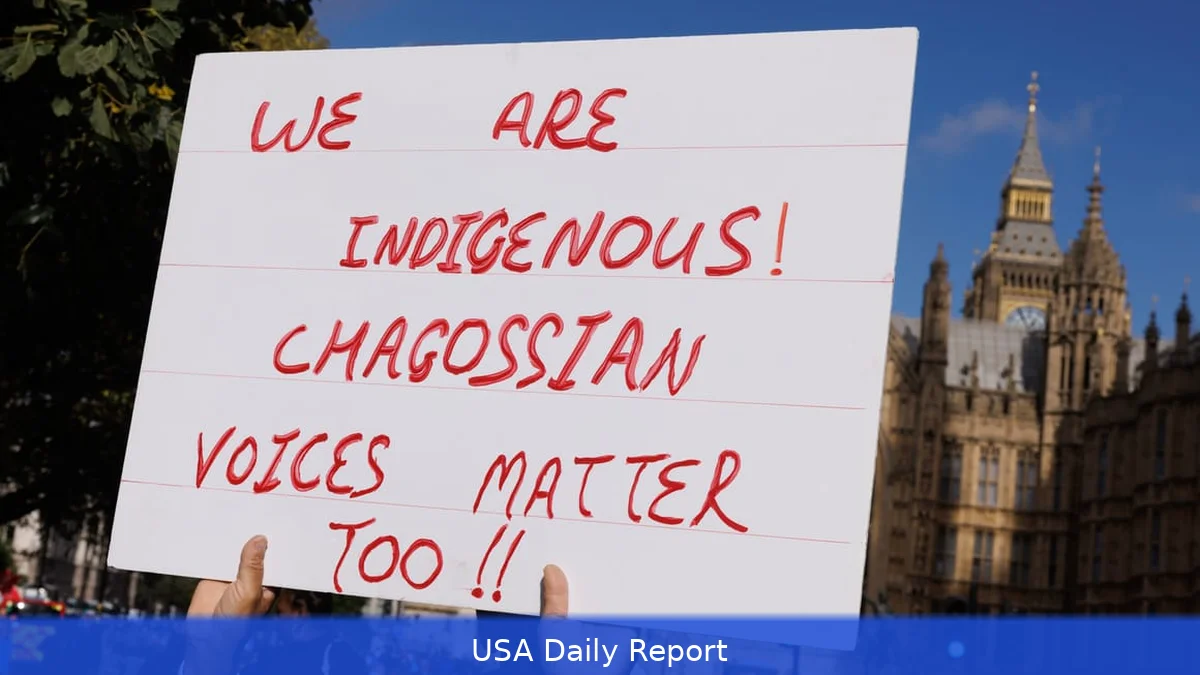
UK ministers have paused a bill to transfer sovereignty of the Chagos Islands. The move follows clear resistance from U.S. President Donald Trump. London says it won't press ahead without Washington’s backing.
Bill dropped from parliamentary agenda
Parliament won't see the planned legislation to hand the Indian Ocean archipelago back to Mauritius, at least for now.
Why the U.S. Objected
The White House has been outspoken. Donald Trump, US President, called the proposal an "act of great stupidity" in January and later warned it would be "a blight on our Great Ally."
Washington's main concern is clear: Diego Garcia, the largest island, hosts a key Anglo-American military base that has supported U.S. operations from Vietnam to Iraq and Afghanistan. The UK had proposed returning sovereignty to Mauritius while preserving the base through a 99-year lease — with Britain footing the bill to guarantee continued U.S. Access.
But the UK will only proceed if the United States signs off, the British government said, according to reporting by Reuters and Agence France-Presse. Officials in London framed the arrangement as a way to protect the base’s long-term operational security while addressing a legal and diplomatic dispute dating back decades.
Diplomatic strings and frayed ties
Relations between Prime Minister Keir Starmer and President Trump are now strained. After a phone call in February Trump said Starmer had "made the best deal he could make," but he later resumed criticism on his social platform, Truth Social.
The disagreement comes at a politically sensitive time for both governments. Britain is leading a 30-plus nation effort to protect shipping in the Strait of Hormuz without initial U.S. Participation. That divergence on maritime security and now on the Chagos deal shows a gap at the heart of the alliance.
Legal and moral backstory
Britain has administered the Chagos Islands since the early 19th century, maintaining control after Mauritius gained independence in the 1960s. The UK removed islanders — known as Chagossians — to make way for the military facility on Diego Garcia, a move that sparked decades of legal and political challenges.
Those challenges reached an international audience in 2019, when the International Court of Justice produced an advisory opinion recommending that the archipelago be returned to Mauritius. British courts and administrations have since faced pressure to resolve claims by displaced Chagossians and by Mauritius itself.

Strategic geography and military value
Diego Garcia sits roughly midway between Africa and Southeast Asia. The island's deep-water port and runway let the United States project airpower and sustain logistics in a wide swath of the Indian Ocean and beyond.
For the U.S. Military, the base provides a secure staging area for operations and logistics. For Britain, its presence has long been tied to shared security commitments with Washington. The proposed 99-year lease was meant as a compromise: political sovereignty would shift to Mauritius while operational control of the base would remain effectively intact.
Economic and contractual implications
Under the UK plan announced with Mauritius last year, Britain would pay to lease Diego Garcia to keep U.S. operations running. That arrangement would have meant a substantial but unspecified fiscal commitment from the UK, according to the announcement at the time.
Such an arrangement raises a host of contract and budget issues. Who signs the operating agreements? How are base upgrades funded? Who bears liability for environmental or social claims tied to the base? London would have to answer those questions before any transfer of sovereignty could be implemented.
What the pause means politically
The decision to hold the bill back is a clear nod to the power of U.S. Objections in British defense planning. It signals that London won't unilaterally alter arrangements governing a facility the United States calls "key" to its global posture.
But it also leaves an unresolved diplomatic knot. Mauritius has insisted on full sovereignty for years and views the return of the islands as part of correcting a colonial-era injustice. Chagossians continue to press Britain for compensation and a right of return. Suspending the bill delays any final settlement for those communities.
Regional and alliance fallout
Analysts say the spat could ripple across Indian Ocean diplomacy. Countries in the region watch whether Western powers can reconcile security ties with decolonisation-era legal rulings.
The dispute quickly turned into a test of U.S.-UK relations. If London defers to Washington, it preserves military continuity but risks angering Mauritius and chilling international support for Britain’s handling of colonial legacies. If London pushes ahead without U.S. Consent, it could jeopardize operational arrangements on an island that the Pentagon values.
Next steps and likely scenarios
Officials in London say they will keep engaging both the United States and Mauritius. That leaves a narrow room for negotiation: Washington could accept the lease model, but only if guarantees meet U.S. Security requirements; Mauritius could accept a staged transfer, but only if sovereignty is clear and accompanied by reparations or compensation for displaced islanders.
So far, public information points to a diplomatic deadlock. Trump’s public statements have shaped the politics in Washington, and the UK’s willingness to wait shows how central U.S. Military needs remain to alliance decision-making. Reuters and AFP reported the bill’s removal from the parliamentary agenda on Saturday, citing a UK government statement that the deal would only proceed with U.S. Backing.
The issue ties together history, international law, defense logistics and domestic politics in three capitals. It won’t be solved by procedure alone; it will need a political bargain that satisfies security planners, Mauritius’s sovereignty claim and demands from the Chagossian community. That's a tall order.
Hang on though — the clock on the base’s role isn’t just political. Upgrades and maintenance decisions will have to continue while sovereignty remains unresolved, and funding lines may be strained if Britain must underwrite the lease while also trying to close legal claims at home and abroad.
Ultimately the decision shows how a single island chain can force larger alliance choices into the spotlight.
Related Articles
He is making a big mistake," wrote Donald Trump, US President, on Truth Social.
This article was created with AI assistance.


