
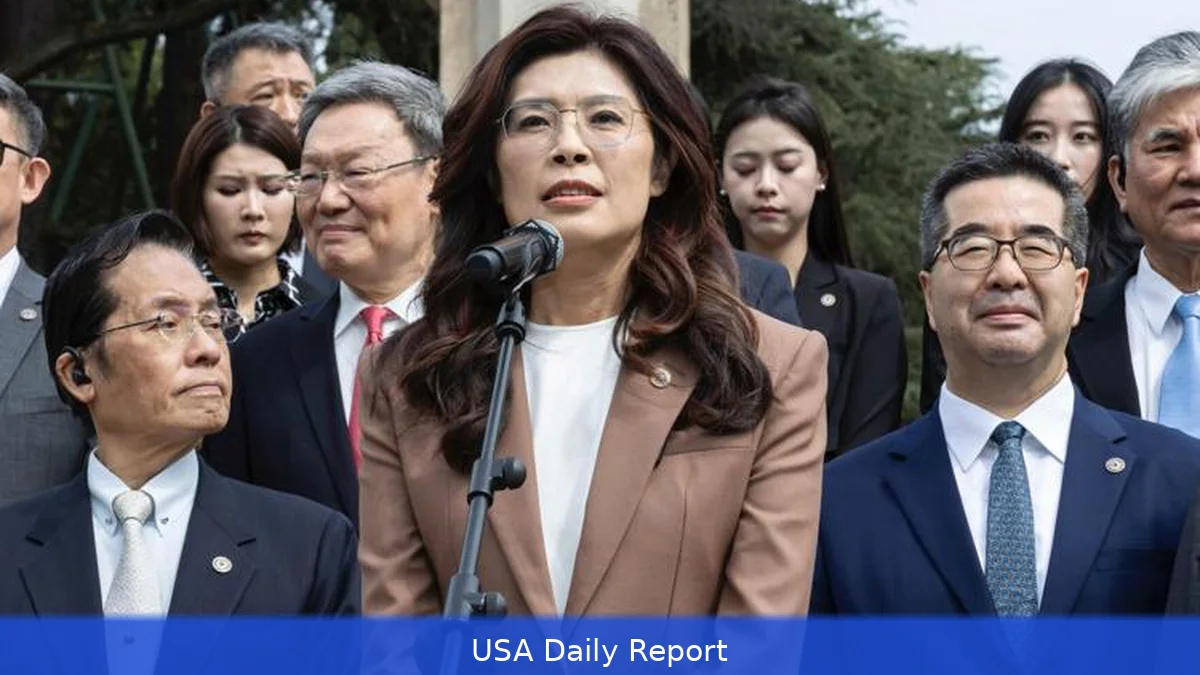
Xi Jinping met Taiwan’s opposition chairwoman in Beijing. The handshake came amid stepped-up Chinese military pressure.
High-profile meeting in the Great Hall
Chinese leader Xi Jinping received Cheng Li-wun, chairwoman of Taiwan’s Nationalist Party, inside the ornate East Hall at the Great Hall of the People on Friday. Xi told Cheng that reunifying Taiwan with the mainland is a “historical inevitability,” a line he used at the meeting. Cheng stopped short of endorsing that goal outright, saying instead she wants a steady, step-by-step approach to avoid conflict.
The meeting was unusual. The East Hall normally hosts foreign heads of state, not political visitors from Taiwan, and the setting showd the message Beijing wanted to send.
What each side said
Cheng Li-wun, who leads the Kuomintang or KMT, told reporters after the talks that she and Xi were “very pragmatic” and that they hope to “consolidate a stable relationship.” Those comments track with her public pivot from earlier politics; she was once a student activist who favored independence, and she has since shifted toward closer ties with the mainland.
Xi Jinping, General Secretary of the Chinese Communist Party, framed the meeting in broader historical terms. His declaration that unification is inevitable came at a moment of rising tension in the Taiwan Strait, where Beijing has been conducting more frequent military drills.
Timing and signals ahead of a U.S.-China diplomatic moment
The visit came just weeks before President Donald Trump will probably travel to Beijing, a timing that diplomats and analysts say was likely deliberate. The timing of inviting a senior Taiwanese political figure to the Great Hall just before a U.S.-China meeting clearly signals Beijing’s influence and strategic patience.
Chinese officials have also been publicly scornful of American arms sales to the island. Beijing’s stepped-up drills and vocal opposition to U.S. Arms deliveries frame the meeting as part of a two-track approach: coax political allies while building military pressure.
How Cheng’s stance shook Taiwan politics
Cheng’s trip and her embrace of closer ties with Beijing have split public opinion in Taiwan. She told reporters she wants to prevent war and act as a peacemaker. "We must do everything in our power to prevent a war in the Taiwan Strait," Cheng told NBC News in an earlier interview, language she reiterated during the visit.
Her appearance in Nanjing earlier in the trip showd historical ties. Nanjing was the Kuomintang capital before the party fled to Taiwan after its defeat by the Communist Party in 1949. Cheng’s itinerary invoked that shared history — and the painful rupture that followed.

Military pressure and the wider security picture
Recent weeks have seen more Chinese military activity near Taiwan, a trend that has spooked residents and leaders on the island. Beijing’s drills are part of what mainland officials call measures to assert sovereignty, while many in Taiwan see them as coercive and destabilizing.
That military pressure gives Xi leverage when he sits down with Taiwanese politicians willing to talk. At the same time, the displays of force underline Beijing’s capacity to intimidate — and to complicate any peaceful dialogue.
Political implications for Washington
The U.S. Has steadily backed Taiwan’s self-defense with arms sales, a point Beijing has repeatedly criticized. American weapon transfers are one of the friction points mentioned during and around the meeting. Thing is, Washington now faces a delicate balancing act: keep supplying defense capabilities to Taipei while avoiding an escalation with Beijing.
The meeting also lands at a diplomatic hinge point. With President Donald Trump expected in Beijing soon, Chinese leaders appear to be showing they can influence Taiwanese politics directly — and also remind Washington that the island remains a core interest for Beijing.
Economic stakes and market risks
While the visit was political, the backdrop is economic too. Tensions in the Taiwan Strait can have ripple effects for global supply chains. Taiwan produces critical technology components and is a major player in semiconductor manufacturing, and any sustained rise in instability would create uncertainty for multinational firms.
Beijing’s mix of political outreach and military posturing could make investors jittery. Companies that rely on Taiwanese suppliers will be watching political developments closely.
Still, the meeting aimed to ease tensions by opening a dialogue channel between Beijing and certain Taiwanese politicians.
Where Taipei’s government fits in
Taiwan’s President Lai Ching-te was not part of the talks and is publicly shunned by Beijing, which has labeled him a dangerous "separatist" for rejecting the mainland's claim over the island. Lai has taken a firmer stance on preserving Taiwan’s self-governance, and Beijing’s outreach to Cheng can be read as an attempt to undercut Lai’s domestic standing.
For Taipei, the visit poses a domestic test. The government must show it can defend Taiwan’s democratic choices while coping with mainland attempts to woo or pressure opposition figures. That dynamic will shape local politics and cross-strait relations in the months ahead.
Diplomacy without guarantee
The meeting didn’t result in any formal agreement, policy change, or peace deal. Instead, it offered gestures like handshakes and public remarks in a staged setting to push Beijing’s political message and gauge how far a Taiwanese opposition figure might go toward reconciliation.
Xi’s insistence on eventual reunification and Cheng’s call for pragmatic, step-by-step engagement together lay out two very different endgames. One leans on a grand historical claim. The other emphasizes preventing war and keeping channels open.
What comes next
Expect more diplomatic signaling. Expect more saber-rattling too. The meeting won't settle anything on its own. But it will be part of the record when diplomats and capitals assess whether Beijing is using charm and force at the same time to shape Taiwan’s future.
For Washington, the challenge will be to respond in ways that protect Taiwan’s security without escalating the standoff into a crisis — a task easier said than done.
Related Articles
- Ichiro statue unveiled in Seattle — and the bat snapped on reveal
- Hezbollah Supporters Rally Outside Lebanese PM's Office as Talks with Israel Loom
- Israel Rejects Hezbollah Ceasefire Demand Ahead of Washington Talks with Lebanon
"We must do everything in our power to prevent a war in the Taiwan Strait," Cheng Li-wun, chairwoman of the Kuomintang, said on the trip.
This article was created with AI assistance.


