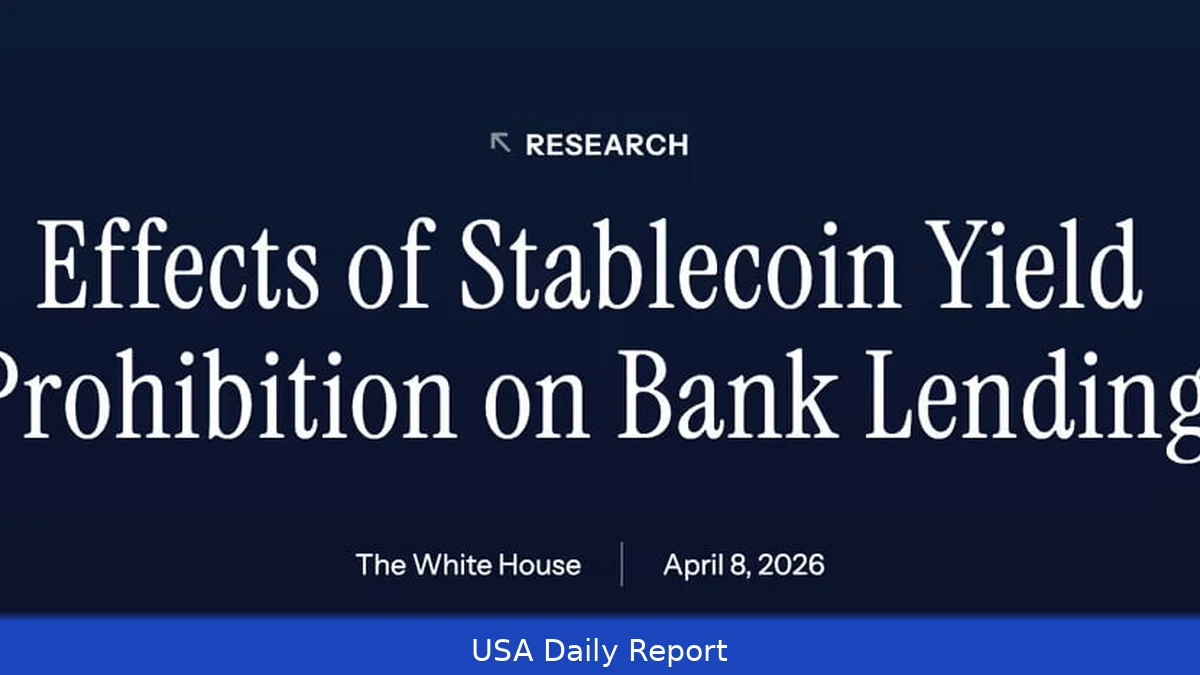
The White House jumped into the heated stablecoin yield debate with a report challenging banks' claims that crypto rewards drain deposits and harm small business lending.
Stablecoin Yields and Bank Deposits: The Controversy
Last week, the White House Council of Economic Advisers (CEA) published a 21-page report that shakes up the ongoing tug-of-war between traditional banks and the crypto sector. At the heart of the dispute is whether allowing stablecoins to pay yield rewards siphons off deposits from banks, potentially choking off loans to households and small businesses.
Bankers argue that competitive yields on stablecoins could trigger massive withdrawals—estimated at around $6 trillion—from bank accounts. The American Bankers Association (ABA) and community bank groups say this would especially harm smaller banks that rely heavily on deposits to fund local lending.
But the White House economists push back hard. Their findings suggest that banning stablecoin yields would barely boost bank lending at all. In fact, the report estimates that eliminating these rewards would increase total lending by just $2.1 billion, a mere 0.02% uptick.
Community banks, representing institutions with under $10 billion in assets, would see only about $500 million more in loans, or 0.026% growth.
And those gains would come at a steep price. Consumers stand to lose roughly $800 million in welfare benefits by forfeiting competitive returns from stablecoin holdings.
How Stablecoins Interact with the Financial System
But the banking lobby misses how stablecoins really operate behind the scenes. When someone converts dollars into a stablecoin, the cash doesn't just disappear from the financial system. Instead, stablecoin issuers often invest those funds in highly liquid assets like U.S. Treasury bills. The money flows through dealers who then redeposit it into banks, keeping deposits stable overall.
Major stablecoin issuers, such as Circle, hold only about 12% of their reserves in cash deposits. The rest goes into Treasuries or other securities, which don’t directly reduce bank lending capacity. That’s a key reason why banning stablecoin yield rewards barely moves the needle on credit creation.
Some stablecoin reserves do sit in bank deposits, which regulators require to be backed by central bank reserves. This “siloing” of funds could limit the credit multiplier effect banks rely on. But even under extreme assumptions—like the stablecoin market growing sixfold and all worst-case scenarios playing out—the report forecasts only a 4.4% increase in aggregate lending, mostly concentrated among big banks.
Political Stakes and Legislative Gridlock
The White House report comes as talks over the Clarity Act, which Congress has debated since last year, remain stalled. The legislation would either ban third-party stablecoin yield rewards or set clear rules for how they can be offered. Crypto firms like Coinbase, which currently offers up to 3.5% APY on USDC balances for some customers, want legal certainty to keep these products alive.
Meanwhile, banking trade groups push for strict limits or outright bans, fearing stablecoins will pull deposits away from traditional institutions, especially community banks that serve rural and underserved areas. Senators from both parties, including Thom Tillis (R-N.C.) and Angela Alsobrooks (D-Md.), have taken an interest in protecting Main Street banks while trying to avoid crushing innovation.
The White House has actively brokered discussions between crypto advocates, bankers, and legislators, aiming to break the deadlock. President Donald Trump’s administration has identified the Clarity Act as a priority, pushing negotiators to find common ground. The latest economic analysis may tip the scales by undercutting the banking lobby’s core claims.
What’s Next for Stablecoin Regulation?
So, where does this leave the future of stablecoin yields? The report suggests that prohibiting these rewards is a blunt instrument that won’t meaningfully help bank lending but will definitely hurt consumers who benefit from competitive returns.
Crypto firms are likely to seize on these findings to argue for more lenient regulations. At the same time, banks may double down on lobbying efforts, emphasizing risks to financial stability and community lending.
Lawmakers face a tough balancing act: encourage innovation and consumer choice in digital assets without undermining the traditional banking system that millions rely on. The Clarity Act vote expected in April could be a turning point, but the battle over stablecoin yields is far from over.
This debate shows the bigger challenge of fitting new financial tech into old regulatory systems. Stablecoins blur lines between banking and crypto, challenging regulators and industry players to rethink old assumptions.
Related Articles
- India’s Biggest Currency Clampdown in a Decade Could Backfire
- Bissell Recalls 1.7 Million Steam Cleaners Over Serious Burn Risk
- Bank of America Projects $1.1 Trillion Market for US Sports Event Betting
The White House report makes it clear that banning stablecoin yields won’t rescue community banks or unlock lots of new loans. Instead, it risks cutting off consumer benefits for almost no gain in credit. That’s a big deal as Congress wrestles with how to regulate a fast-changing financial landscape.


