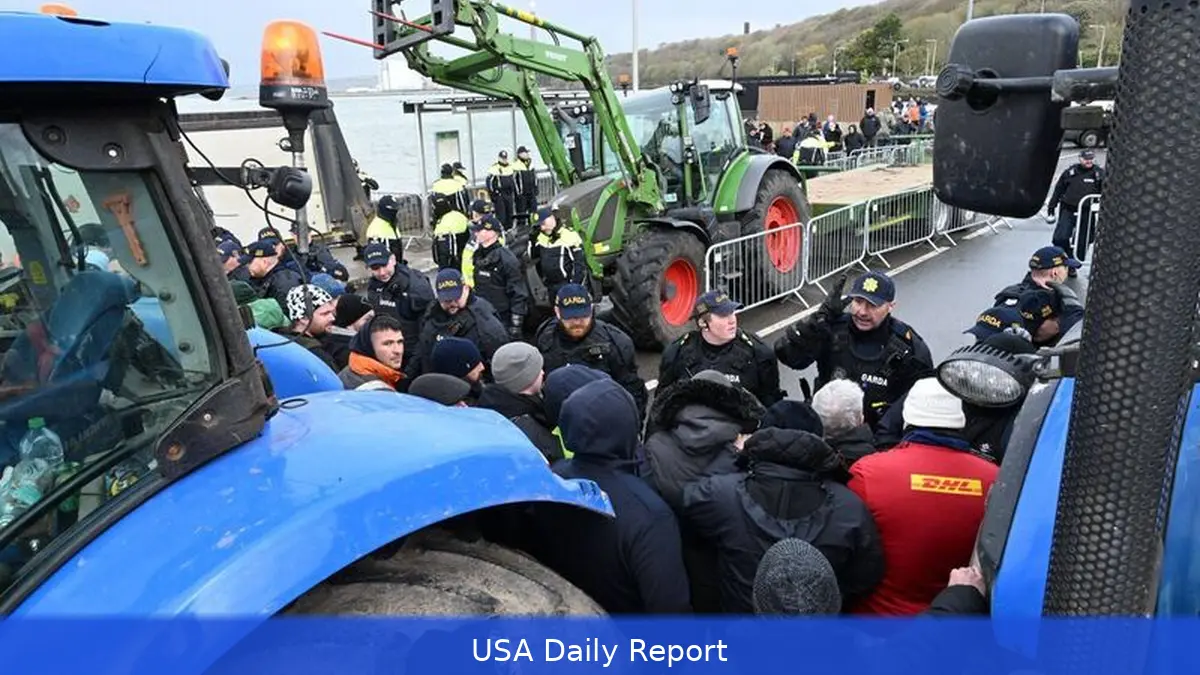
Gardaí moved tractors and reopened the gates at Whitegate refinery on Saturday. The hour-long operation allowed dozens of fuel trucks to enter and leave the site. The move came after days of nationwide blockades that had driven many forecourts toward empty tanks.
Force deployed to restore fuel access
Look, the scene at the County Cork refinery was tense but tightly controlled. Scores of members of An Garda Síochána, including Public Order Units, pushed through lines of tractors and slow-moving vehicles that had been erected by protesters. The police operation took roughly an hour and included the use of pepper spray in several confrontations, and members of the Irish Defence Forces were on hand to provide heavy-lift support if needed.
Gardaí posted on their official Twitter account that the action was intended to keep “critical supplies of fuel to maintain critical emergency public services, including Ambulance and Fire Services.” The tweets showed police escorting tankers into and out of the Whitegate facility after access was restored.
Authorities had declared the situation an "exceptional event," which allowed the force to mobilize additional personnel and require members to be available for weekend duty. The availability of a military heavy-lift recovery truck was requested by gardai in case any of the large tractors blocking the entrance needed towing.
Fuels for Ireland, the trade body representing companies that import and sell petrol and diesel, said it hoped to get more than 20 oil trucks into Whitegate on Saturday, including seven that had managed access earlier in the day. That push was aimed at easing pressure on a retail network already reporting shortages.
Wider disruption across the country
The blockades were not limited to Cork. Protesters had established stoppages at fuel depots in Limerick and Galway, and slow-moving convoys and roadblocks affected key routes around Dublin and beyond. O’Connell Street in Dublin remained blocked in parts, and sections of the M50, M7, M8 and other national roads were reported disrupted.
Hundreds of petrol stations across Ireland had already run dry by Friday and Saturday, with Fuels for Ireland warning that two-thirds of forecourts could be out of stock if blockades at storage facilities continued. Rosslare Europort in County Wexford faced capacity risks after nearby protests set up a blockade at Kilrane, about a mile from the port, raising the possibility ships might be turned away.
Public transport also took a hit. Bus Éireann said it would seek to prioritise services for Dublin Airport passengers where possible while some other services were suspended or rerouted. Irish Rail’s operator warned the situation could worsen late Sunday night or early Monday morning if distribution remained constrained.
Protesters’ demand and government response
The demonstrations were mounted by hauliers, farmers and agricultural contractors fed up with soaring fuel costs. Protesters say fuel prices are unsustainable and threaten livelihoods in transport and farming. The actions included slow convoys and targeted blockades at strategic points in the distribution chain.
Government ministers returned to talks with established representative groups for the transport and agricultural sectors to try to defuse the disruption. Officials were working on a temporary Fuel Support Scheme aimed at the haulage, agri-business and contractor sectors, and ministers described discussions with industry representatives as "constructive" as they finalised details of a support package.
That package, while not yet signed off in public statements released on Saturday, is intended to reduce operating costs for the sectors leading the protests. Fuels for Ireland and recognised trade bodies are involved in the negotiation process, though the groups organising the separate blockades are distinct from those participating in the talks.
Economic fallout and international ripples
Thing is, the immediate economic hit inside Ireland is clear: empty pumps, business travel delays and the added costs of rerouting freight and passengers. For industries that rely on tight delivery schedules — construction, food distribution and emergency services among them — even brief interruptions push up costs and complicate planning.
On top of that, ports like Rosslare serve as nodes for cross-border and international freight. If ships are turned away or loading is delayed, exporters and importers face slower turnaround and higher shipping bills. That can ripple into supply chains across Europe, particularly for time-sensitive goods.
For the United States, the impact is indirect but real. Ireland isn't a major crude oil supplier to the U.S., but global fuel markets are interconnected.
Short-term physical disruptions in any trading hub can feed into prompt-market volatility and add a little extra pressure on refined-product shipping and insurance costs. Traders watching European supply points factor such disruptions into short-term fuel assessments, and that shows up in futures markets and shipping schedules.
Right now, the scale of the Irish disruption isn't large enough to move global crude benchmarks. But the episode is a reminder that distribution problems — not just production — can tighten local markets and affect businesses relying on timely diesel and petrol deliveries. Diesel in particular matters to heavy trucks and agricultural machinery; shortages here hit economic activity more sharply than shortages of premium petrol might.
Politics, optics and what protesters are betting on
Protest tactics hinged on choke points: depots, refineries and key arterial roads. That approach aims to cause visible pain fast — empty pumps, disrupted commuting and slowed commerce — to force ministers back to the table. The government’s decision to accelerate talks over a support package shows the tactic is working in part.
Still, the use of police force to clear blockades risks political fallout. Law-and-order voters will expect authorities to protect critical infrastructure. At the same time, rural and supply-sector constituencies will note whether the government’s financial aid is timely and enough. That political balancing act could shape policy choices in the coming days.
Frankly, ministers are under pressure to deliver both practical help and a clear timeline for relief. If they don't, organisers might repeat disruptions in other forms. If they do, the government will need to show it can move quickly and fairly so that hauliers and farmers see a direct benefit.
For businesses and individuals coping with immediate shortages, the central questions are simple: when will deliveries normalise, and will the cost relief promised be meaningful? The answers depend on logistics teams getting tankers back into depots and on ministers finalising the support scheme soon enough to prevent more forecourts from running dry.
Bottom line: restoring access at Whitegate eases immediate pressure, but the protests and the state's response are likely to stay part of the story until the new fuel measures are agreed and tankers keep rolling.
Related Articles
- Police make arrests at London vigil as debate over Palestine Action proscription intensifies
- Irish police use force to clear fuel protesters at refinery as shortages spread
- Delhi’s paratha vendors face a gas squeeze as Gulf conflict chokes supplies
An Garda Síochána said on Twitter: "A Garda Operation is ongoing at Whitegate Refinery to ensure critical supplies of fuel to maintain critical emergency public services, including Ambulance and Fire Services. Garda Public Order Units have been deployed. Blockaders must comply with Garda directions."


