
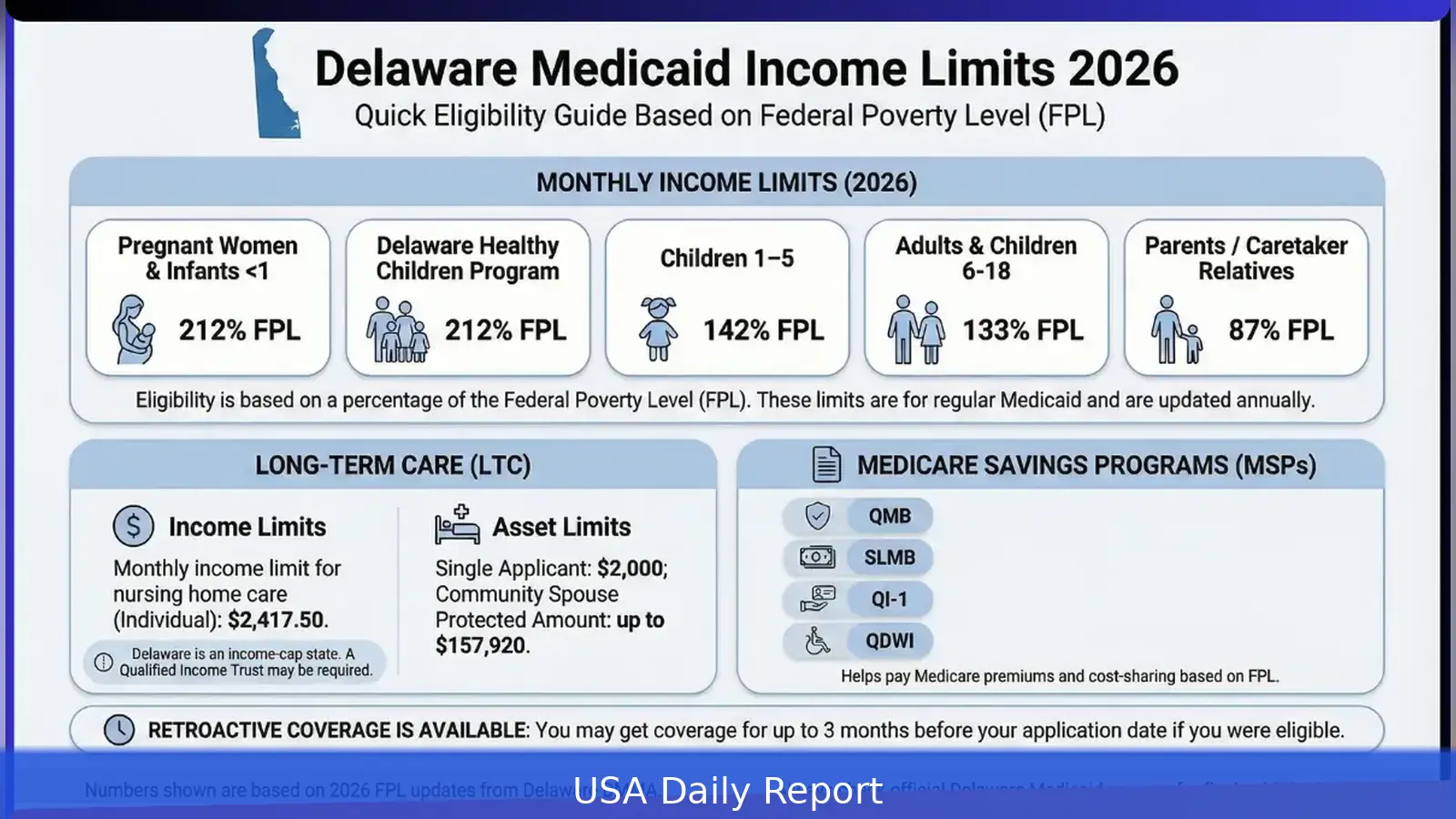
Medicaid rules can be confusing, and there are important changes coming in 2026. This guide explains the income limits you should check, how to determine your eligibility, the federal rules that apply nationwide, and the next steps to take. It's a practical, step-by-step guide designed for people who want clear answers quickly.
Quick-reference summary
Short list of the most-used figures and rules for 2026:
- Medicaid expansion adults: 138% of the Federal Poverty Level (FPL).
- Non‑MAGI groups (seniors, people with disabilities): common asset limits — $2,000 individual / $3,000 couple — and state income tests or spend‑down rules apply.
- Pregnant people and children: higher state-specific thresholds — often 138% to 300%+ of FPL depending on state and program.
- Noncitizen federal match change: beginning Oct. 1, 2026, federal matching funds for full Medicaid/CHIP benefits are limited to specific noncitizen categories; states may change coverage.
- Where to check numbers: HHS poverty guidelines (aspe.hhs.gov/poverty-guidelines), Medicaid information (medicaid.gov) and your state Medicaid office (use usa.gov/medicaid to find state contacts).
Prerequisites
Thing is, before you start calculating eligibility, gather these items:
- Proof of gross income for everyone in the household for the last 30 days (pay stubs, benefit letters, statement of unemployment, self‑employment records).
- Household size — usually you, your spouse if filing jointly, and tax dependents counted on the same tax return.
- Social Security numbers or immigration documentation for everyone applying (U.S. Citizens, lawful permanent residents, and certain noncitizen categories).
- Bank statements and asset lists if you’re applying as an older adult or someone with a disability (non‑MAGI groups have asset limits).
- State agency contact info and an online account for your state Medicaid agency or HealthCare.gov if your state uses the federal marketplace.
Step-by-step: How to determine your Medicaid 2026 income limits
Follow these steps carefully, and be sure to verify information on the official sites provided.
- Decide which eligibility category you’re in. There are two big buckets: MAGI-based groups (Modified Adjusted Gross Income) and non‑MAGI groups. MAGI covers most adults, pregnant people, and children. Non‑MAGI covers seniors (65+), people who get Supplemental Security Income (SSI), and many people with disabilities. The rules differ — so pick the right bucket first.
- Find the official 2026 Federal Poverty Guidelines (FPL). Use the HHS poverty guideline page at https://aspe.hhs.gov/poverty-guidelines. The FPL is the baseline used to compute income limits (for example, 138% of FPL). Most Medicaid thresholds are expressed as a percentage of FPL.
- Calculate your household size and MAGI (if applicable). Household size typically equals the number of tax filers and dependents. For MAGI, start with your adjusted gross income (AGI) on your federal tax return and add certain tax-exempt foreign income, tax-exempt interest, and non-taxable Social Security benefits. If you don’t file taxes, state agencies have rules to estimate MAGI — ask the state Medicaid office or use Healthcare.gov’s calculator at https://www.healthcare.gov/medicaid-chip/getting-medicaid-chip/.
- Compare your income to the percentage thresholds. In expansion states, adults age 19–64 qualify at up to 138% of FPL. Children and pregnant people often qualify at higher percentages — some state rules go to 200%, 250%, or more of FPL. For example, if the FPL for a one-person household is $X in 2026, multiply X by 1.38 to get the expansion cutoff.
- If you’re non‑MAGI (elderly or disabled), check asset and income rules. Most states use an asset limit around $2,000 for an individual and $3,000 for a couple for full institutional Medicaid eligibility, though states may apply different treatment or allow spend‑down. Also look for Medicaid Long‑Term Services and Supports (LTSS) waivers in your state if you need home or assisted living services; those waive room-and-board but cover many care services.
- Account for state differences and special programs. Medicaid is state-administered. Search your state Medicaid site through https://www.medicaid.gov/about-us/contact-us/contact-state-page.html or go to USA.gov’s Medicaid page at https://www.usa.gov/medicaid to find links. Many states have medically needy programs, spend‑down eligibility, or higher pregnancy/child thresholds — check the state chart or call the state office.
- Consider citizenship and immigration status rules. Federal law change effective Oct. 1, 2026 limits federal matching funds for full Medicaid and CHIP benefits to lawful permanent residents, certain Cuban and Haitian entrants, and Compact of Free Association migrants lawfully residing in the U.S. Other lawfully present noncitizens (refugees, asylees, parolees, trafficking victims) may lose federally matched full benefits depending on state choices. States may offer state‑only coverage or emergency Medicaid instead — confirm with your state.
- Apply or renew through the right channel. You can apply online at your state Medicaid website, use HealthCare.gov if your state relies on the federal marketplace, or apply in person at your local Medicaid office. Use document uploads where possible. For renewals, states are required to review eligibility — expect notices and a deadline.
Costs, fees and financial rules to expect in 2026
Medicaid typically has no or very low premiums for full-benefit enrollees. Some states charge nominal premiums or copayments for certain groups — often a few dollars per service. For long-term care, you’ll usually have to contribute most of your monthly income toward room and board, with Medicaid picking up the care costs after a spend‑down or qualification.
Look, asset limits for non‑MAGI programs remain a core rule: $2,000 for individuals and $3,000 for couples is the common federal baseline used by many states for institutional Medicaid planning. Countable assets exclude a primary home (up to state equity limits), a vehicle used for work, certain burial funds, and exempt benefits — but rules vary, so confirm with your state Medicaid office.
Tips
- Use the HHS poverty guidelines page and your state Medicaid site — they give the official 2026 numbers you need. HHS: https://aspe.hhs.gov/poverty-guidelines. Medicaid: https://www.medicaid.gov/.
- If you’re near the cutoff, include every deduction and allowable exclusion — child care costs, certain medical expenses for spend‑down, and dependent care can change eligibility.
- For elderly couples, look into spouse‑income rules and spousal impoverishment protections — they let the community spouse keep a portion of income and assets.
- Keep a digital folder of pay stubs, bank statements, and ID. Uploading clean, dated documents speeds approval.
- Ask about waivers: 1915(c) HCBS waivers can cover home‑based services even if room and board aren’t covered. Each state runs different waivers — request the state waiver waitlist if there’s one.
Common mistakes to avoid
- Assuming federal rules are identical in your state — Medicaid varies widely by state.
- Counting net income instead of MAGI for MAGI-based eligibility — MAGI uses AGI and specific add‑backs.
- Ignoring asset tests for non‑MAGI groups — many people fail to apply because they think only income matters.
- Missing renewal deadlines — losing coverage is often avoidable by returning forms or calling the state office before the deadline.
- Not checking immigration-status changes — the Oct. 1, 2026 federal matching rule may change what benefits are federally funded for some noncitizens; states can make coverage decisions that affect eligibility.
Where to find official help and apply
Key federal pages:
- Medicaid main site: https://www.medicaid.gov/
- Find state Medicaid contacts: https://www.medicaid.gov/about-us/contact-us/contact-state-page.html
- Healthcare.gov Medicaid/CHIP info and applications: https://www.healthcare.gov/medicaid-chip/getting-medicaid-chip/
- HHS poverty guidelines (for FPL): https://aspe.hhs.gov/poverty-guidelines
- USA.gov Medicaid overview and state links: https://www.usa.gov/medicaid
If you need one-on-one help, call your state Medicaid office. Most states also let you apply at county health and human services offices or via local legal aid and community health centers that offer free enrollment assistance.
Related Articles
- Medicaid 2026 Fee Schedule — Rates & Where to Find
- Dental Plans 2026 for Seniors: A Step-by-Step Guide
Check the 2026 FPL at HHS and your state Medicaid site, match your household MAGI or non‑MAGI category to the right percentage and asset rules, and apply through your state office or HealthCare.gov. Watch for the Oct. 1, 2026 noncitizen federal matching change and for state-specific spend‑down and waiver options.
This article was created with AI assistance.


