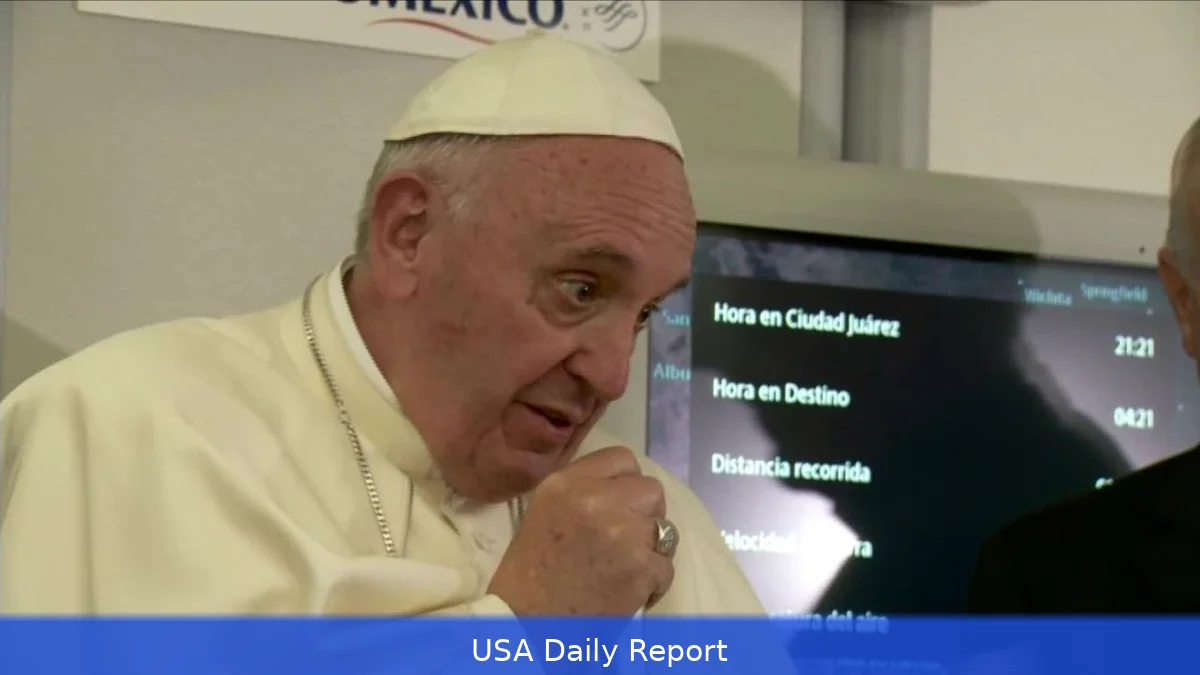
Pope Francis said he has "no fear" of President Donald Trump. The comment followed a sharp social media attack by the president.
What was said
Pope Francis responded publicly after President Donald Trump posted a critical message on Sunday. The pontiff told reporters he had "no fear" of Mr. Trump, a brief, direct reply that closed a short chapter of public sparring between the two leaders.
In his social media post, Mr. Trump wrote that the Pope "should get his act together" and called him "weak on nuclear weapons." The president's message apparently referenced concerns about Iran's efforts to develop nuclear capacity — a point Mr. Still trump cited as among the reasons for military pressure and confrontation with Tehran.
It was a short exchange, but it immediately grabbed attention from newsrooms and diplomats. These two figures rarely spar publicly, so their back-and-forth jumped into headlines across international media and diplomatic channels.
Why the clash matters
Words matter here: both the pope and the US president have outsized moral and political influence worldwide.
Pope Francis is head of the Roman Catholic Church, a moral authority for more than a billion people worldwide. Donald Trump leads the United States government, with control over vast military, diplomatic and economic tools.
What each says colors how millions — voters, diplomats and markets — see global affairs. A terse comment from the Pope can shift conversations about refugees, climate or diplomacy.
A blunt post from the US president can reorder policy debate and influence allies' calculations.
More importantly, Trump's post focused on nuclear policy, apparently pointing to Iran's drive for nuclear capability. That ties directly into a fraught and highly sensitive regional security issue: Tehran's nuclear ambitions. Even brief public spats over nuclear issues can complicate quiet diplomacy, particularly among Washington and European capitals that coordinate sanctions and arms-control measures.
Political implications in the United States
At home, both supporters and critics can spin the episode — allies stress toughness, opponents warn about damaging rhetoric. Supporters of Mr. Trump can point to his tough rhetoric on Iran and national security. Opponents of the president — and those who follow the Pope's calls for diplomacy and humanitarian priorities — can portray the president's tone as undiplomatic and divisive.
The episode will likely play out differently across political constituencies. Conservative voters who prioritize security and who backed the president's previous stances on Tehran may welcome his bluntness. Catholic voters, meanwhile, aren't monolithic; some will view the Pope's posture as moral leadership, while others — particularly those aligned with conservative political views — may side with Mr. Trump.
And for lawmakers in Washington, the public clash is a reminder that international messaging can have domestic repercussions. Congressional leaders who must weigh sanctions, defense budgets and foreign aid may feel pressure as public opinion shifts in response to high-profile exchanges between powerful figures.
Diplomatic and economic fallout
Short-term diplomatic effects are often about signals. When the US president frames a foreign power as a nuclear threat, allies tune in and sometimes tighten coordination. Conversely, a moral leader like the Pope urging restraint or highlighting humanitarian concerns can encourage softer, multilateral approaches.
Markets pay attention to sudden geopolitical rhetoric; traders often factor in added risk when leaders trade blows publicly. Investors watch geopolitical risk closely.
Sharp escalations in rhetoric about nuclear proliferation or war can move oil prices, defense stocks and currencies as traders price in potential disruptions and policy shifts. But one post alone rarely drives a lasting market shift; broader developments and follow-up actions determine whether prices stay moved.
Still, the timing and framing of such comments can amplify uncertainty. If the exchange coincides with other tensions in the Middle East, or with sanctions announcements, businesses with exposure to energy or regional supply chains may reassess risk and hedge accordingly.
Vatican–Washington relations and wider context
The Vatican and the White House have a long, complex relationship that mixes moral advocacy with political negotiation. Pope Francis has used his platform to press on migration, poverty and climate change — issues that sometimes clash with US policy priorities depending on the administration.
Mr. Trump has routinely used social media to voice policy grievances and personal criticisms.
The president's post described the Pope as "weak on nuclear weapons," language that shows a focus on hard security rather than moral suasion. The Vatican, by contrast, generally favors diplomacy and humanitarian frames.
That tension — between moral and security-first approaches — isn't new. What's notable is the publicness of the exchange and the brevity of the Pope's reply. Pope Francis didn't escalate. He answered plainly: he had "no fear" of the president. That tone likely reflects a choice to avoid prolonged public confrontation.
Reactions to watch
There are several threads to follow in the coming days. Will the White House amplify its critique or shift to quiet diplomacy? Will Vatican officials attempt to smooth relations through back-channel contacts? And will allied governments use the moment to push for a coordinated line on Iran or on other contested issues?
Those questions matter because they affect decision-making in capitals and boardrooms. Policy officials in Washington and European capitals routinely take cues from public exchanges among leaders. If rhetoric hardens, diplomatic space for negotiation can shrink. If one side steps back, channels for quiet talks can remain open.
Frankly, the public dispute also feeds media cycles and campaign narratives. Political strategists on both sides will try to frame the episode to their advantage, and the story will get picked up by domestic and international outlets that monitor both religious and political leadership.
Where this sits in recent history
High-level clashes between religious leaders and heads of state have happened before — sometimes over policy, sometimes over personality. What sets this episode apart is the two leaders' profiles and the nuclear angle in Mr. Trump's criticism. Nuclear questions are high-stakes by default, and even short exchanges can have oversized symbolic weight.
The Pope's succinct reply — "no fear" — removes drama while sending a clear signal: he isn't intimidated. Whether that changes any policies is another matter. But it does give both leaders a public bookmark they can reference: the president on security, the Pope on moral authority.
Related Articles
- How Washington Could Turn a Fragile Ceasefire Into a Lasting Peace
- Gulf States Rethink Security After US–Israel War with Iran; Strait of Hormuz Emerges as Flashpoint
- Ukraine’s drone tech finds new buyers as Middle East war shifts attention
Pope Francis said he had "no fear" of President Donald Trump after the president's Sunday post calling the Pope to "get his act together" and labeling him "weak on nuclear weapons."


