Colombia has launched a new bond buyback plan that aims to retire costly dollar‑denominated debt. The goal: retire expensive external debt and ease refinancing risks. Javier Cuellar, Colombia’s public credit chief, laid out the offer’s scope and timing.
What Bogotá is offering
Colombia has launched an offer to repurchase a package of its external bonds, aiming to buy back more than $4 billion of dollar‑denominated notes that carry coupons above 7%. The operation covers bonds maturing between 2026 and 2054 and also includes two non‑USD issues — a euro note and a global peso‑linked instrument.
Look, the deadlines are tight: the bid for dollar bonds closes on November 19 and the window for the two non‑USD notes ends on November 21. Javier Cuellar, public credit chief, described the move as a targeted step to cut debt service costs and to shore up liquidity on the sovereign’s balance sheet.
Colombia has already carried out active liability management this year. In August the government completed an earlier buyback that took roughly $2.9 billion of its dollar bonds out of circulation. The new offer is framed as a continuation of that push.
Why the government is doing it
Some of Colombia’s external bonds carry steep coupons, so buying them back can reduce interest payments. Retiring those notes reduces the coupon burden on the debt stock.
Cuellar said the plan intends to retire notes with coupons north of 7%, a move that could lower average funding costs if the government later refinances at cheaper rates.
The buyback also responds to pressure on public finances after the government widened its deficit forecasts. The economy is facing a wider budget gap that prompted the government to suspend certain borrowing limits and to raise its forecast for the 2026 primary deficit. So the operation doubles as both a cost‑cutting exercise and a tool to manage short‑term refinancing risk.
Officials have been active this year with swaps and other liability‑management moves, including a $9.3bn Swiss‑franc total return swap. Colombia’s program included a $9.3 billion total return swap denominated in Swiss francs and several other bond operations designed to smooth cash‑flow and currency exposure, according to the sovereign’s debt plan.
How markets reacted
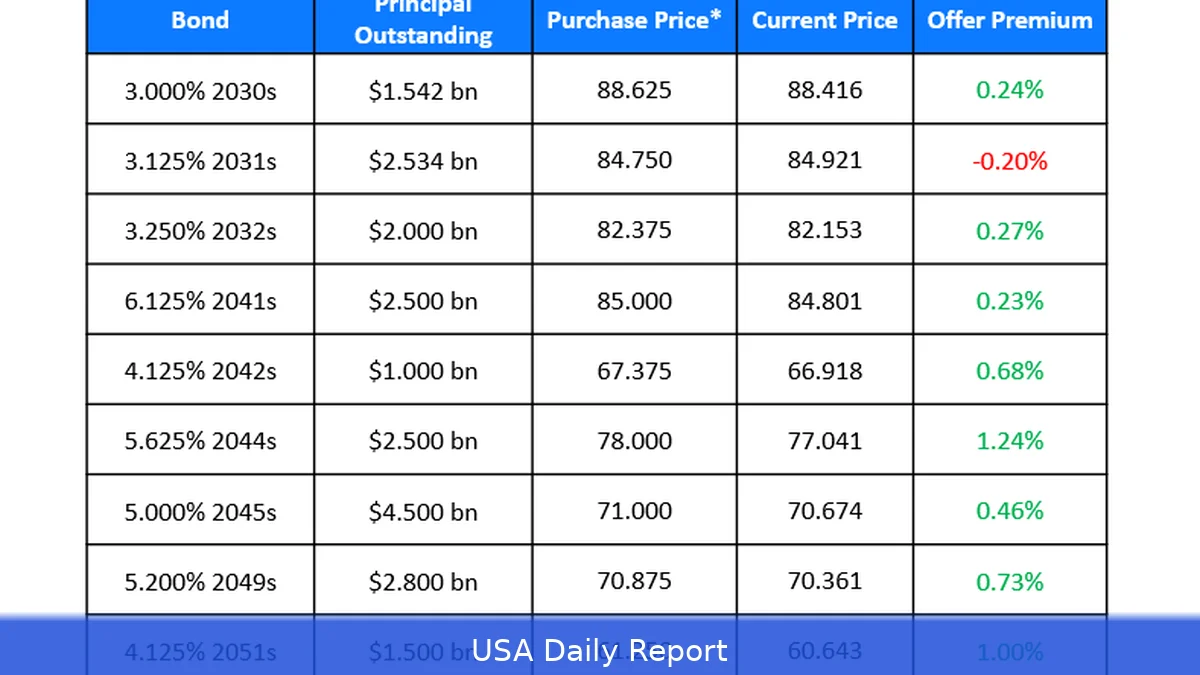
Secondary market prices barely moved: the 5.625% 2044 bond traded near 83.5 cents, implying about a 7.3% yield. Colombia’s 5.625% 2044 dollar bonds were trading around 83.5 cents on the dollar, implying a yield near 7.3% at the time the details were published. That pricing shows the market’s current view of Colombia’s long‑dated curve and the premium investors demand for sovereign paper of that maturity and credit profile.
Bond dealers and investors typically watch two things during a buyback like this: which tranches the sovereign targets and how much paper they can actually retire. Retiring expensive tranches can be effective only if the government can reach holders at prices that make economic sense and if the operation doesn’t unduly tighten secondary‐market liquidity.
Cuellar framed the buyback as both tactical and opportunistic — tactical because it reduces the roll‑over burden on specific high‑coupon paper, and opportunistic because it follows earlier swaps and operations that reshaped the maturity and currency mix of Colombia’s debt.
Short‑term risks and the broader picture
There are real constraints. A buyback that removes a meaningful chunk of tradable stock can temporarily reduce liquidity in specific bonds, making price moves larger for remaining holders. That matters for institutional portfolios that rely on predictable market depth.
This operation won't fix Colombia's fiscal problems; the government still faces a larger projected primary deficit for 2026. The government still needs to address a bigger primary deficit forecast for 2026. But by lowering the share of high‑coupon liabilities, officials hope to ease coupon payments and reduce immediate refinancing pressure.
Analysts have noted the buyback could cut short‑term refinancing risk by trimming near‑term maturities and costly coupons. At the same time, the sovereign’s overall debt dynamics will keep responding to macro trends: growth, commodity prices, and market sentiment about emerging‑market credits.
What to watch next
Monitor participation rates by tranche. If the government secures a large share of the targeted outstanding amounts, the effect on debt service could be meaningful. If few holders accept the offer, the buyback won't significantly cut rollover needs and the government will still face the same near‑term refinancing schedule.
Also watch secondary‑market yields on the targeted bonds after the offer closes. If yields fall sharply on nearby comparable issues, that will signal the operation helped tighten spreads. If yields move little, market participants may conclude the buyback was too small or priced too high to change investor expectations.
Finally, pay attention to official communication from the Ministry of Finance and Public Credit. Clear, timely disclosure of results — how much nominal value was repurchased by tranche and at what prices — will shape market reaction. When officials tie buyback results to the broader debt profile plan, investors can better judge whether this is a one‑off or part of a sustained push to alter the sovereign’s funding mix.
Context on Colombia’s external funding
Colombia is an emerging‑market sovereign with a diversified financing program. In recent operations, officials have used swaps and liability management to adjust currency exposure and to extend maturities. The new buyback follows that pattern — an attempt to smooth out peaks in coupon payments and to buy time while broader fiscal adjustments are sorted.
These liability moves tend to boost investor confidence more than they change headline debt ratios in the near term because they reshape cash‑flow timing rather than the total stock of debt. If the sovereign can show it's actively managing its cost and maturity profile, that can help keep borrowing costs contained while the government deals with fiscal gaps.
But the underlying fiscal story — a bigger primary deficit projection for 2026 and the suspension of certain borrowing limits — remains. Debt managers say operations can buy breathing room. Still, fiscal consolidation or growth that outpaces projections will be needed to change the medium‑term math.
Related Articles
- I'm 37 with $1.3 million. Should I quit a $165,000 job to be a stay-at-home dad?
- Slate Auto Raises $650 Million to Push Cheap EV Pickup Into Production
- Goldman Sachs Flags Iran War as Growing Drag After Solid Quarter
The offer for Colombia’s dollar bonds expires on November 19, while the two non‑USD notes’ tender window closes on November 21.


