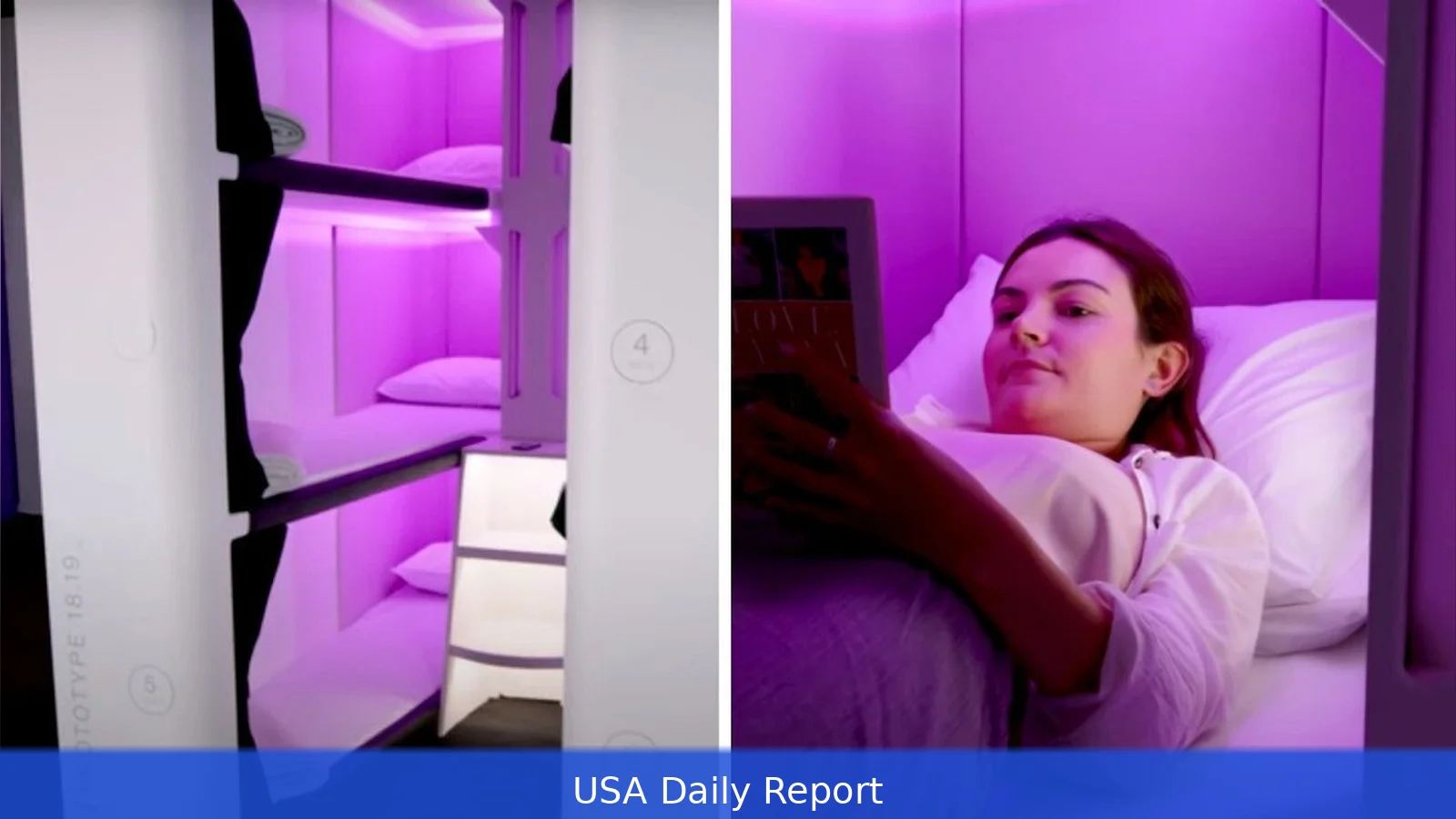
Air New Zealand is charging for four-hour bunk naps on long-haul flights.
What the product is
Air New Zealand will let economy and premium economy passengers book curtained, triple-tier Skynest pods for four-hour sleep sessions on its Boeing 787-9 Dreamliner fleet starting in November 2026. Each Skynest block holds six lie-flat berths arranged in two stacks of three. The airline says each berth is about 80 inches long and narrows from roughly 25 inches at the shoulders to 16 inches at the foot. Access requires bending, kneeling, crawling or climbing into the space.
The airline will limit use to pre-booked, timed slots. Passengers must change into socks supplied by the carrier, fasten a seatbelt over the blanket while inside the pod and leave food and strong fragrances outside. Children and additional visitors won’t be allowed in the space. Air New Zealand’s website includes the directive: “That means solo snoozes only please, no musical nests or tag-teaming.”
Sheets, pillows and blankets will be refreshed between users, the airline says. A gentle change in cabin lighting will signal the end of a session, and a flight attendant will check on sleepers if they don’t wake promptly.
Price, bookings and ancillary revenue logic
The carrier will charge separately for each four-hour block, with fares starting at 495 New Zealand dollars — about $291 — on top of an economy ticket.
Many airlines now add optional services to boost revenue per passenger without hiking base fares.
Six pods booked at the starting rate generate 2,970 NZD, or roughly $1,747, for a single four-hour window. That’s a clear way to translate a cabin retrofit into a quantifiable revenue stream per rotation. The pods could be sold multiple times across a long-haul sector depending on scheduling and cleaning turnaround, producing recurring revenue during the same flight cycle.
Air New Zealand first flagged development of economy lie-flat sleeping areas in 2020. The company has meanwhile raised some fares and pared back domestic flying as jet fuel costs surged amid geopolitical turmoil in the Middle East. In March 2026, the carrier suspended its earnings outlook, citing fuel-price volatility.
Customer experience, safety and limits
Air New Zealand frames Skynest as a sleep-first product. Leanne Geraghty, chief customer and sales officer, pointed to passenger research showing the difficulty of sleeping away from home and the airline’s efforts to create a calmer cabin environment through lighting, on-board rituals and sleep-focused content. Geraghty said the airline designed the four-hour session around common sleep-cycle lengths to let customers wind down, sleep and wake with less disruption.
Aside from sleep aids, the product comes with strict etiquette. Snacking inside pods is prohibited. Perfumes, oils or other scented products are banned. Passengers must wear the provided socks while inside. The airline won't allow passengers to share a berth; each pod is for single occupancy only.
Those rules are meant to address proximity: the pods sit between cabins, and users lie close to people in neighboring berths. Air New Zealand says it will refresh linens between uses, provide ear plugs and a pillow, and offer a ventilation outlet and reading light for each berth.
How airlines treat ancillary fees
Ancillary charges have become a core profit engine for many carriers.
Selling upgrades, baggage fees, premium seating and onboard experiences lets airlines keep advertised base fares competitive while raising average revenue per passenger. Air New Zealand’s Skynest is squarely in that playbook: a higher-margin add-on that doesn’t require every customer to pay but does increase yield if a meaningful share opts in.
The financial side is simple. A retrofit that costs money up front can be amortized across flights if pods remain saleable at reasonable take rates. Each sold session brings incremental cash that bypasses the fixed-cost portion of an air ticket. Over time, management calculates whether the extra per-seat revenue offsets installation, maintenance, cleaning and any impacts on seat count and cargo or weight distribution.
Airlines think about different types of customers. Business travelers with expense accounts may pay for convenience; leisure travelers may see the pods as a way to avoid a business-class fare for sleep. Families might prefer a Skycouch-style option that converts a row into a lie-flat surface, a product Air New Zealand is also rolling out in modified economy seating.
Operational and investor implications
Adding Skynest changes how the cabin is arranged and how crews work. Crews must manage bedding logistics and enforce pod rules, cleaning teams must turn spaces quickly, and ground handlers must support any weight or balance changes. Those operational costs aren't spelled out in the airline’s announcement, but they matter to profitability and reliability.
Investors will see if the pods improve profits amid fluctuating fuel prices. Air New Zealand has already adjusted capacity and fares this year because of rising jet fuel prices. Selling ancillary services is a common response; it boosts revenue without increasing base fares and can be a quicker lever to pull than capacity or route changes.
How many passengers buy the pods will decide their success. If pods sell out regularly at 495 NZD, the product will improve yields on affected flights. If demand is weak, the carrier still carries the fixed cost of the retrofit. How aggressively Air New Zealand markets the feature, and how well it balances price with passenger demand, will shape the financial return.
Industry context and competition
Lie-flat beds and convertible seats have long been revenue-generators in premium cabins. Air New Zealand says its Skynest will be the first lie-flat pods available to economy travelers, a claim aimed at creating differentiation. Other airlines have experimented with Skycouch-like seating and expanded premium-economy options; not all have moved to beds for standard-fare passengers.
Whether competitors follow will depend on customer interest, regulatory approval and retrofit cost. Airlines prioritizing ancillary growth may see the pods as an attractive case study if they increase per-flight revenue materially without harming overall passenger satisfaction.
Related Articles
- ChiNext Tech Surge Raises Concentration Risk
- Stocks Pause as Peace Deal Awaits
- ECB Likely to Raise Rates in June, Markets and Banks Say
“Research shows us the first night away from home is the hardest to get a good night’s sleep,” said Leanne Geraghty, Air New Zealand chief customer and sales officer.


