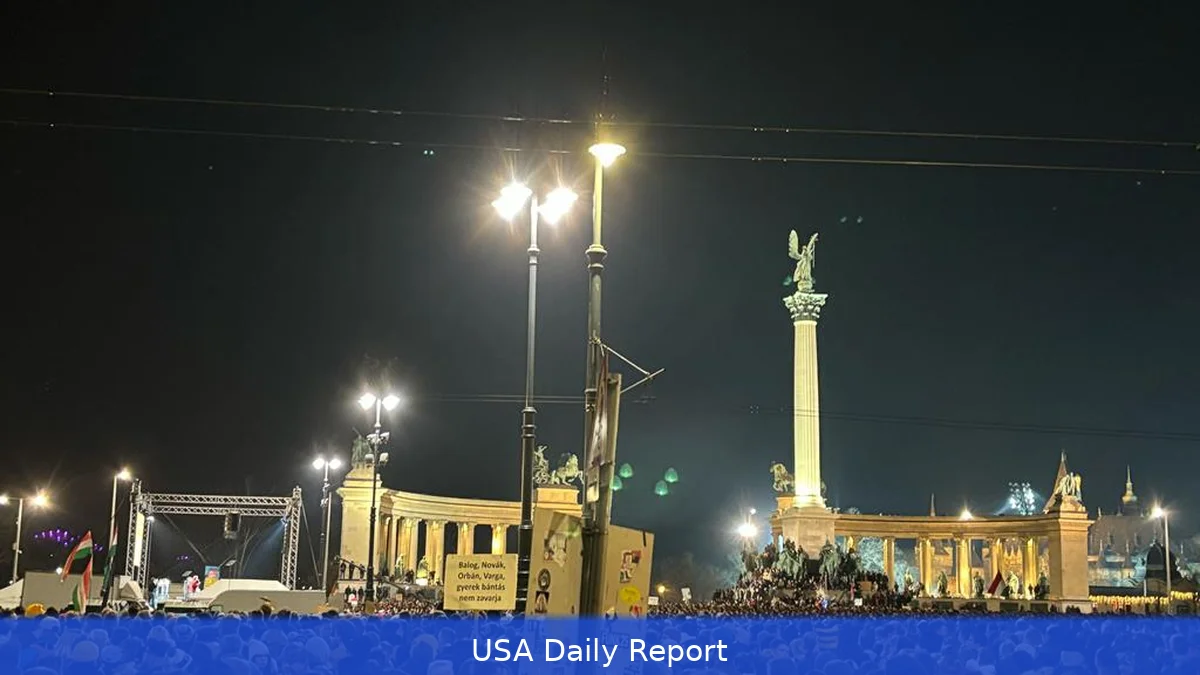
Thousands filled Heroes' Square in Budapest Sunday.
Music as protest
Thousands of people came together in Budapest's Heroes' Square for an event called Rendszerbont Nagykoncert — literally, the concert for tearing down the system. The crowd was there to register a political message as much as to hear music. Organizers and musicians used the stage to criticize Hungarian Prime Minister Viktor Orbán, who has led Hungary for 16 straight years and faces a nationwide election on Sunday.
Look, the gathering looked like a festival. But the message was pointed — a rejection of the governing order and a demand for change.
Who showed up and why it mattered
The lineup mixed established acts and newer bands. One of the groups was Imre Fia Imre, a heavy metal band whose members said they signed on because the concert was unusual for Hungary: a cultural event openly framed as political. Zsolt Tornai, keyboardist for Imre Fia Imre, said: "What's new is, this kind of concert or this kind of cultural event has never happened in the country before, so we don't know what to expect either. So this is very exciting."
Frontman Imre Gyorgy described the band name as a family joke — three generations named Imre — but he and his bandmates made clear they weren't at the concert for novelty. They wanted to turn a cultural moment into pressure on a political system many in the crowd see as entrenched.
Drummer Gergo Barat put it bluntly: "So everything is subjected to this kind of power factory that they have built in the past years." Barat used the phrase to criticize what he sees as a political machine focused on expanding authority rather than responding to citizens' concerns.
Setting and symbolism
Heroes' Square is one of Budapest's most visible public spaces — a place of monuments and national memory. Choosing it for a mass concert with a political thrust was deliberate, organizers said.
The setting turned a musical event into a highly visible demonstration ahead of national voting.
Point is, staging the event in such a symbolic place sent a clear signal: the protesters wanted their message to be seen and heard by as many people as possible, and to register in the national conversation in the crucial days before the vote.
How participants described the moment
Behind the scenes, the mood mixed nervousness and determination. In a rehearsal space in an old factory, the band members joked about family names and small details. Then they spoke about stakes. Tornai said the novelty of the event made it exciting. Barat said frustration with the governing structures had reached a boiling point.
Rob Schmitz, host at NPR who reported from the concert, described the scene as more than entertainment. He said the crowd came ready to express political discontent and that many attendees hoped to see Orbán lose power in the upcoming elections.
Political context in a few words
Viktor Orbán has been Hungary's prime minister for 16 straight years. The concert's stated aim — to "tear down the system" — was a direct rebuke to his long tenure. Organizers and artists framed the event as cultural resistance: music played as a form of political speech during the final stretch of a national campaign.
So the concert was loud and public. It was also timed: happening just days before the nationwide election, it was part of a last push to mobilize voters and shape public debate.
Domestic implications
For Hungary, events like this matter for more than symbolism.
Mass cultural mobilization can influence turnout and public narratives. Musicians and public figures acting as vocal critics give voters a different kind of endorsement than standard party communications.
Artists involved in the concert framed their participation as an expression of civic duty. They said they hoped to prompt conversation and spur participation among people who might otherwise stay home on election day. Whether that effect translates into votes is an open question — but the organizers clearly wanted to change the political temperature.
U.S. Interest and broader ties
While the concert itself was a local event, it intersects with issues Washington watches closely: democratic practices, rule of law, and political stability in Europe. Hungarian elections aren't just domestic matters; they shape how Budapest engages with allies and institutions abroad.
Frankly, what happens in Hungary can affect diplomatic and economic ties — including with the United States — through policy choices and coalition dynamics in European forums. A change in leadership could shift priorities; continued rule by the same government could mean continued approaches that have stirred debate among foreign partners.
That said, the reporting focused on the scene in Budapest and the people who came out to sing and shout. The immediate takeaway was the energy on the square and the political message many in the crowd wanted to send at the ballot box.
On-the-ground tactics and tone
Organizers emphasized peaceful intent. The event's promoters framed the goal as systemic change rather than tearing communities apart. Musicians mixed satire, anger and calls for civic engagement — not violent rhetoric. The crowd reacted with cheers and chanting that echoed across the square.
And bands that are normally associated with nightlife or subculture used that platform to deliver political messages. That crossover between culture and politics is a marker of how opposition movements sometimes try to broaden their reach beyond traditional party structures.
What participants said next
After rehearsing in an old factory and loading gear into a freight elevator without a door, the band members walked onto the stage with a sense of purpose. Gyorgy joked about future generations of Imres. Then they set aside the humor and told reporters they wanted to be part of a gathering that could change Hungary's direction at the ballot box.
Barat's description of a "power factory" echoed throughout the event. It captured the feeling of those in the crowd: power concentrated at the top, with many citizens eager for a different balance.
Related Articles
- Hungary’s razor-thin vote puts Washington and Moscow on edge
- How Viktor Orbán Pushed a Leading University Out of Hungary — and Why JD Vance Thinks the U.S. Should Copy It
- AfD Adopts New 'Radical' Manifesto as Court Blocks Intelligence Label Ahead of German Votes
Viktor Orbán has been Hungary's prime minister for 16 straight years.


