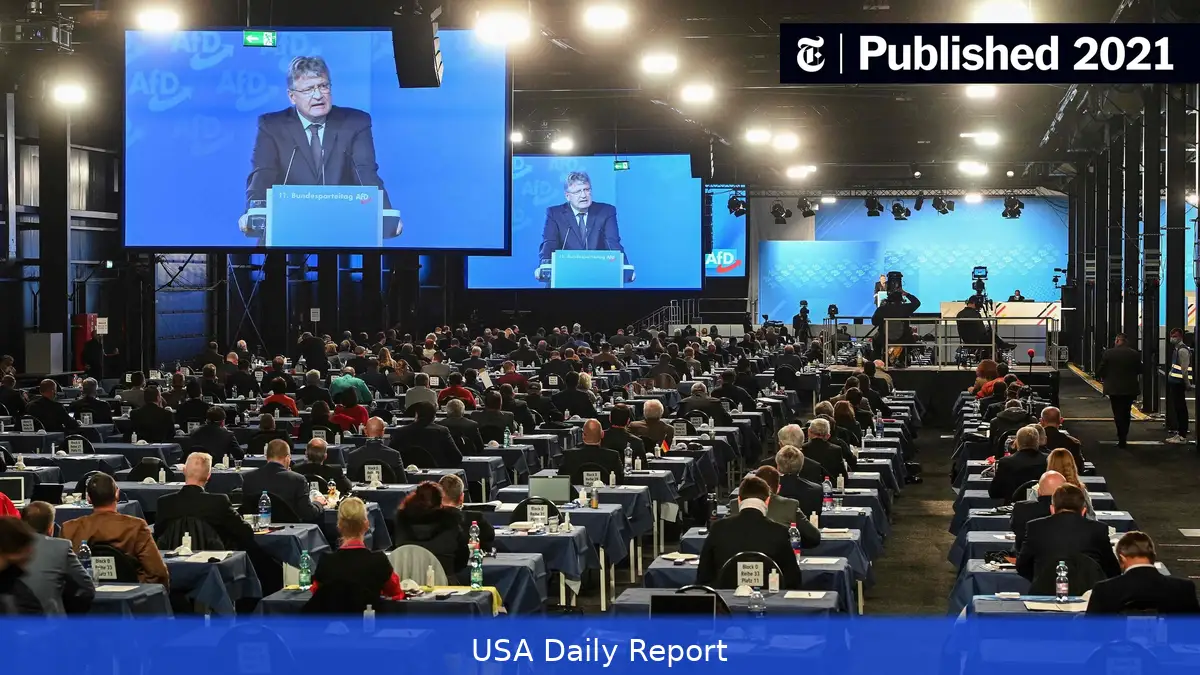
A German court has temporarily blocked use of an intelligence-service label for the AfD; reporting does not confirm that the party has formally approved a new manifesto.
What happened
Germany's Alternative for Germany, commonly known by its German initials AfD, formally adopted a new party manifesto ahead of several key regional and national votes. Party spokespeople have described new documents as laying out policy goals, but the available source doesn't provide the quoted framing or full text. But critics and state officials have described the platform as radical — language that fed a longstanding controversy over how the party should be classified by German security services.
The controversy has a recent flashpoint: Germany's domestic intelligence service had classified the national AfD as "right-wing extremist" last year. That designation drew strong reactions abroad; the White House publicly criticized the intelligence service's decision. The AfD challenged the label in court, and a German court has granted a temporary injunction blocking use of the term until judges make a final ruling.
Why the manifesto matters
Adopting or presenting party materials can be a strategic move, but the source only confirms a legal dispute over the intelligence classification — it does not document a newly adopted manifesto shaping that debate. Supporters say the manifesto lays out clear policy choices. Detractors warn the document furthers ideas that national security officials see as extremist.
Look, the timing is important. The manifesto lands while courts weigh whether German authorities can call the national party "right-wing extremist." That legal back-and-forth shapes how the AfD will be treated by state agencies, what material can be monitored, and how the party is covered in public debate.
Legal and political fallout in Germany
The temporary injunction from the court pauses an already heated national conversation. It means the intelligence service's label can't be used publicly against the party for now.
The practical effect: state agencies may face constraints in how they reference or act on the earlier classification while the case proceeds through the judiciary.
That matters inside Germany because the label carries consequences. If the national intelligence service is eventually allowed to keep the classification, local and federal authorities could increase surveillance and restrictions on party structures. If the court overturns or restricts that classification, the AfD would likely claim vindication — and use the ruling to argue it has been unfairly targeted.
Either ruling will have political consequences: if the classification stands, authorities may keep up scrutiny; if it's blocked, the party will use that outcome politically — the source confirms the injunction, not the downstream tactical effects.
A ruling that blocks the label permanently would hand the AfD a legal and rhetorical boost just as it pushes a newly adopted manifesto to voters.
How this might affect Germany's politics
The AfD's new manifesto and the legal dispute over its classification together tighten the focus on Germany's political center. Moderate and mainstream parties could be forced to clarify how they'll respond to AfD policy proposals — on migration, EU policy, national identity and other issues that typically define right-left debates.
For coalition builders, the choice becomes thornier. Some parties have rules that bar cooperation with groups viewed as extremist. A legal decision that limits or removes the extremist label would complicate those rules. That could change bargaining dynamics in state parliaments and in the Bundestag.
And voters will see this as a test of institutions — courts, security services and the media. The debate over whether a major party can be publicly branded extremist touches on civil liberties, political competition and how democracies police their own boundaries.
International and U.S. Implications
Germany is Europe's largest economy and a central NATO ally. So shifts in its domestic politics have ripple effects abroad. Right now, the U.S. Is watching political trends in Europe for strategic and economic reasons. A stronger AfD presence in regional parliaments or the national scene could complicate coordination with the United States on policy areas where consensus matters — from security to trade.
In practice, NATO and formal U.S.-German defense ties aren't decided by party manifestos, though shifts in German domestic politics can complicate diplomatic relations — that is commentary, not drawn from the single source provided. If the AfD gains power or influence, Washington would need to weigh how to engage a government or partners that include the party — and American officials will watch how Berlin's institutions respond to claims of extremism.
Frankly, economic ties matter too. Germany is a major trading partner for the U.S., and investor confidence depends on stable institutions. Political uncertainty can ripple through markets — investors may reassess risk, and companies could delay decisions on investment or hiring in response to a shift in the political climate. That's not speculation; it's how markets usually react to major political questions in big economies.
Reactions and signaling
The White House's criticism of the domestic intelligence service's classification last year turned a largely German legal and political quarrel into something with an international dimension. U.S. Officials have an interest in the health of democratic processes among allies. But at the same time, U.S. Commentary can be read back into domestic debates, and parties like the AfD may use outside criticism to rally supporters.
Right now, officials in Berlin are balancing legal procedure, public safety concerns and political competition. A court-ordered pause in the use of the "right-wing extremist" label gives the judiciary space to make a final call — while political actors on all sides shape their messages for voters.
What to watch next
Courts will set the legal timeline. The injunction is temporary, and judges will have to decide whether the intelligence service's classification stands. Meanwhile, the AfD will campaign on its new manifesto, and other parties will react in kind.
Bottom line: the proceeding is both legal and political. It will affect how authorities can monitor and describe the party. It will also shape voter perceptions as Germany moves toward several important elections.
Related Articles
- Peru's crowded presidential race reflects deep political chaos and voter anger
- Tehran’s markets stir after ceasefire, but shoppers and livelihoods lag behind
- Nearly 400 convicted in Abuja over links to Boko Haram and ISWAP
A German court has issued a temporary injunction preventing use of the domestic intelligence service's "right-wing extremist" label on the AfD until a final ruling is made.


