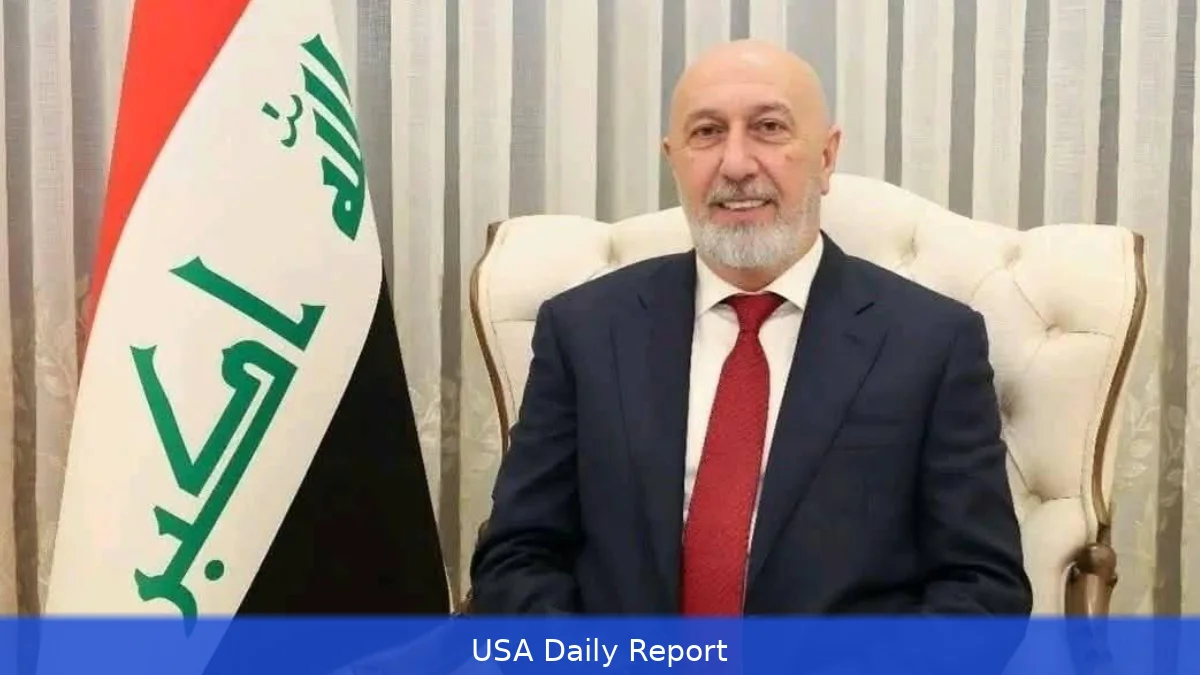
Iraq’s parliament elected Nizar Amidi as president on Saturday. His victory comes five months after a fractured election failed to produce a clear majority. The choice removes a key obstacle to forming a new government.
Vote breaks stalemate
The Iraqi legislature moved to elect a president more than two months after the constitutional deadline, choosing Nizar Amidi of the Patriotic Union of Kurdistan (PUK) in a second-round vote, sources in the chamber said.
Amidi, who serves on the PUK’s political bureau and who once worked as an aide to former presidents Jalal Talabani and Fouad Massoum, won 227 votes to 15 against Muthanna Amin Nader, a parliamentarian from the Kurdistan Islamic Union, after no candidate reached the two-thirds threshold in the first round, according to AP News.
The vote wasn’t just a formality. It ended a political deadlock that kept Iraq without a fully empowered president for almost five months and delayed naming a prime minister to form a cabinet.
The delay is important since Iraq’s power-sharing system assigns the president, who is Kurdish, the constitutional role of starting government formation.
What the numbers mean
Right now, amidi’s 227 votes in the runoff showed broad parliamentary support relative to other contenders, but he fell short of the supermajority in the first round, which forced the second-round plurality rule, AP reported. Muthanna Amin Nader received 15 votes in the final tally.
Amidi is an engineer by training from Dohuk province and previously served as environment minister between 2022 and 2024, as well as a senior presidential aide in earlier administrations, according to reporting by Yahoo News and AP.
Next: a prime minister choice that could upset Washington
Under the constitution, the newly elected president has 15 days to formally task the nominee of the largest parliamentary bloc with forming a cabinet. That step hands control of Iraq’s next government to the Shiite bloc known as the Coordination Framework, which holds a parliamentary edge and said in January it planned to nominate former prime minister Nouri al-Maliki.
The prime minister’s selection matters more than the presidency because they handle daily policy and control security appointments. And the Coordination Framework’s public backing of al-Maliki has already provoked pushback from Washington, which has opposed his return, according to multiple reports.
Security and regional fallout
The choice of president happens against the backdrop of a wider regional clash that heavily involved Iraq. Iran-backed militias operating inside Iraq launched strikes on U.S. Bases and diplomatic sites, and U.S. And Israeli counterstrikes hit those groups — in some cases killing members of the Iraqi military, AP and CNBC reported.
Those hostilities, together with Tehran’s temporary closure of the Strait of Hormuz earlier this month, sharply curtailed Iraqi oil exports, the mainstay of government revenue. Oil revenues fund public salaries and services; their interruption deepened Baghdad’s fiscal squeeze and made a timely formation of a stable cabinet more urgent.
Economic stakes
Iraq depends on crude sales to finance roughly two-thirds of its budget. When exports slow, state income plunges. The disruption of shipments during the Strait of Hormuz closure and the security-induced damage to energy infrastructure tightened Baghdad’s fiscal room just as a new government should be setting budgets and spending priorities.
Experts say a long fight over the prime minister could hold up budget decisions and hurt investor confidence. The caretaker government led by Prime Minister Mohammed Shia al-Sudani has limited authority to enact deep economic reforms or sign long-term contracts. That means repair of pipelines, ports and other energy assets might remain on hold while major political actors jockey for influence.
U.S. Interests and the broader alliance
The United States maintains troops and diplomatic facilities in Iraq. Attacks on U.S. Positions and the targeting of diplomatic compounds drew American military responses, and Washington has publicly signaled concern about any Iraqi government that deepens ties with Iran or returns powerful figures opposed by the U.S.
Yahoo News reported that then-President Donald Trump had warned of withdrawing U.S. Support if Nouri al-Maliki were chosen to form a government. U.S. Worries about al-Maliki center on his past record of politicizing security forces and on his record of close ties with Iran-aligned factions inside Iraq’s political system.
What Amidi said
After being declared the winner, Nizar Amidi addressed parliament and acknowledged the difficulty ahead. “I am fully aware of the scale of challenges facing our country,” Amidi said, and pledged to put "Iraq First," according to Yahoo News.
Amidi condemned attacks on Iraqi soil during the recent U.S.-Israeli conflict with Iran, showing he wants to focus on Iraq’s stability while managing outside pressures.
Political rivalries and Kurdish dynamics
Amidi’s nomination came from the PUK, one of the two dominant Kurdish parties. The rival Kurdistan Democratic Party (KDP) had backed Iraq’s foreign minister, Fuad Hussein, as its preferred candidate, and the split among Kurdish blocs was one reason the presidential vote was repeatedly postponed, Al Jazeera reporting cited in Yahoo noted.
That internal Kurdish competition has ripple effects. The Kurdish parties control seats that can swing parliamentary decisions, and their agreement or disagreement with Baghdad’s Shiite blocs will shape who ends up prime minister and what kind of cabinet gets formed.
Domestic expectations and the road ahead
Many Iraqis want a government that can restore services, revive the battered oil sector and keep foreign actors from turning Iraq into a battleground. But forming a cabinet will mean hard bargaining over ministries, security posts and economic portfolios — and rival blocs have shown little appetite for compromise since the November election.
Still, Amidi’s election eliminates one hurdle. It gives the Coordination Framework a legal opening to present a candidate for prime minister. The political horse-trading that follows will determine whether Iraq can quickly move to stabilize its finances and secure energy exports — or whether paralysis returns.
Related Articles
- Thousands Gather in Budapest’s Heroes' Square as Music and Politics Collide Ahead of Election
- Hungary’s razor-thin vote puts Washington and Moscow on edge
- AfD Adopts New 'Radical' Manifesto as Court Blocks Intelligence Label Ahead of German Votes
Under the constitution, Amidi has 15 days to task the nominee of the largest parliamentary bloc with forming a government.


