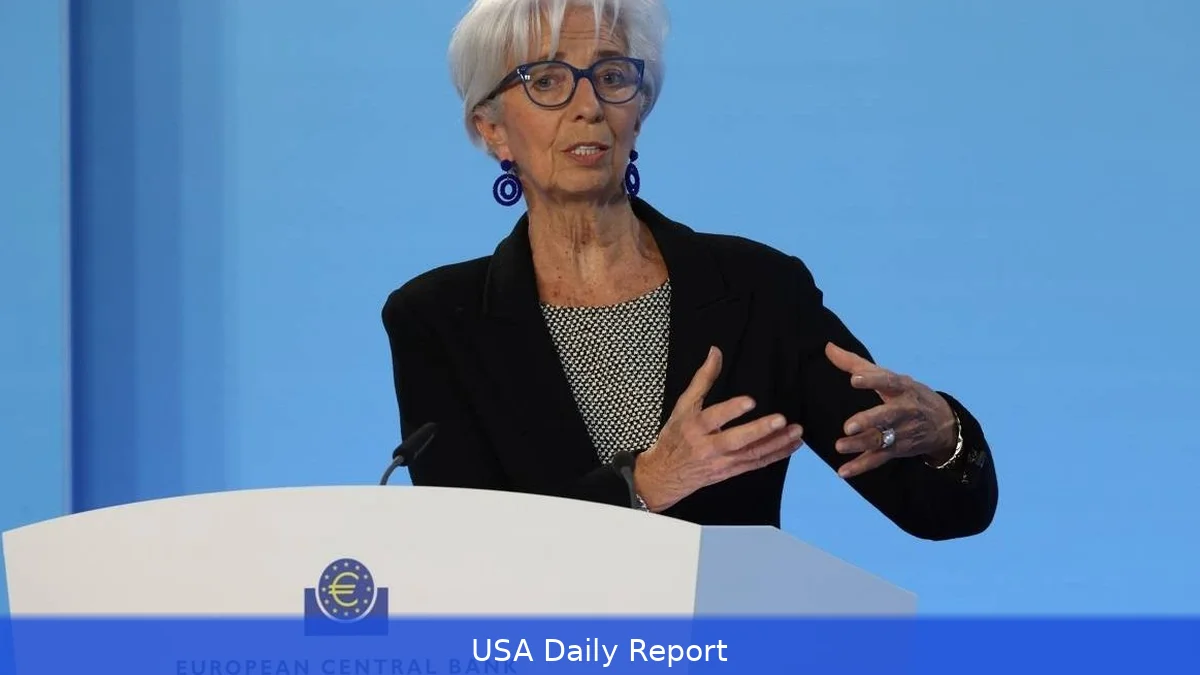
Lagarde says eurozone growth has moved below the ECB's base case.
Where the economy stands
Christine Lagarde, president of the European Central Bank, told Bloomberg Television in Washington that the eurozone economy is now sitting between the ECB's baseline and its adverse scenario. She spoke while attending the International Monetary Fund's spring meetings, and she was blunt about the shift: "We are in between the baseline and the adverse," Lagarde said.
Look, that's a material change in tone. The baseline the ECB used at the start of the year assumed that the war in the Middle East would cause a shock to energy markets but that the effect would be limited.
Now that shock has brightened the risk of a more persistent bout of inflation, and Lagarde and other officials are watching whether higher oil and gas prices start showing up in wages and in prices across the economy. If that happens, the bank may have to reconsider its policy stance.
One sentence can sum up the ECB's immediate problem: energy prices jumped after fighting in the Middle East, and how firms and workers react will determine whether higher inflation takes hold.
How big the shock might be
The IMF this week updated its global outlook and projected consumer prices in the 21-country euro area would rise about 2.6% this year. That projection roughly matches the ECB's own forecast, but officials say the baseline scenario now looks less likely if the conflict continues or if shipping routes such as the Strait of Hormuz are disrupted.
The ECB has sketched two upside scenarios in recent forecasts: an "adverse" path in which inflation could peak near 4.2% and a severe path that could push price gains above 6% while triggering a short recession. Several members of the ECB's governing council have flagged that those worse outcomes become more plausible the longer energy prices stay high.
Eurostat data shows why officials are sensitive. Inflation in the euro area peaked at 10.6% in October 2022 after Russia's invasion of Ukraine sent energy prices soaring. By February, Eurostat reported inflation had eased to 1.9% — a steep fall, but one that followed aggressive rate moves by the ECB in 2022 and 2023.
Firms, workers and the memory of 2022
Lagarde warned in a separate speech in Frankfurt that businesses and employees may be quicker to pass on cost increases now than they were before the Ukraine shock. "The response of firms and workers may be faster than last time," she said, pointing to a more recent memory of high inflation across Europe.
Point is, an entire generation of workers and managers has lived through a bout of double-digit inflation. That experience changes behavior. Firms may feel compelled to raise prices sooner when energy costs climb, and workers might press for faster pay increases to protect purchasing power.
Those reactions can create a feedback loop. If companies boost prices and workers win higher wages, inflation risks becoming embedded in the economy.
Central banks then face a much harder task — raising rates enough to slow demand without tipping the economy into recession.
Where policy stands now
The ECB left its key interest rate unchanged at 2% at its March 19 meeting. Lagarde has been clear that monetary policy can't lower oil prices directly, so the bank's response depends on how widespread and persistent the inflationary effects become.
"If the energy shock is seen to be limited in size and short-lived, the classical prescription of looking through should apply," Lagarde said in Frankfurt, referring to the idea that central banks let temporary spikes pass without tightening. But she added that if higher energy costs start feeding into wages and other prices, the ECB will act "appropriately forceful or persistent."
Market pricing currently expects multiple quarter-point moves this year if headline inflation keeps rising. Traders have priced in more than two hikes, though the odds of a move at the ECB's April meeting on April 29-30 were slipping as investors weighed the outlook for peace talks and new data.
What officials are watching
Lagarde and her colleagues are focused on fresh data for wages, core inflation and services prices. Those series show whether energy-driven cost increases are spreading beyond fuel and utilities into the wider economy.
Wage growth is a particularly sensitive indicator. After inflation topped 10% in 2022, pay demands rose sharply in many parts of Europe. If that pattern re-emerges, officials worry it could lock in higher inflation expectations.
The ECB is also monitoring financial conditions. Rapidly rising interest rates would chill investment and borrowing, but a delay in tightening when inflation is embedding would leave the central bank behind the curve.
Practical implications for households and markets
For households, the immediate worry is energy bills.
Higher oil and gas prices hit consumers through fuel costs, electricity and home heating. For businesses, the question is whether they can absorb higher input costs or must pass them on to buyers.
Lagarde's remarks fed into a broader conversation about how quickly price pressures ripple through supply chains. If firms expect energy costs to be temporary, they might absorb some of the hit. If they expect it to stick, prices go up faster.
Honestly, that trade-off is why the ECB has stressed data dependency: it wants clear signs that inflation isn't just transitory before it tightens. But the bank has also warned it won't hesitate to act if the data show a sustained uptick in underlying inflation.
Still, the policy path will depend on the war's trajectory and on how quickly Europe can secure alternative energy supplies and stabilize markets.
Related Articles
- March CPI Forecast Hits 3.3% Annual Pace; Energy Shock from Iran War Could Send Inflation Above 4%
- Markets Ignore a 70% Oil Surge. Earnings Estimates Might Not Be So Lucky.
- Goldman Sachs Flags Iran War as Growing Drag After Solid Quarter
"We are in between the baseline and the adverse," Lagarde said.


