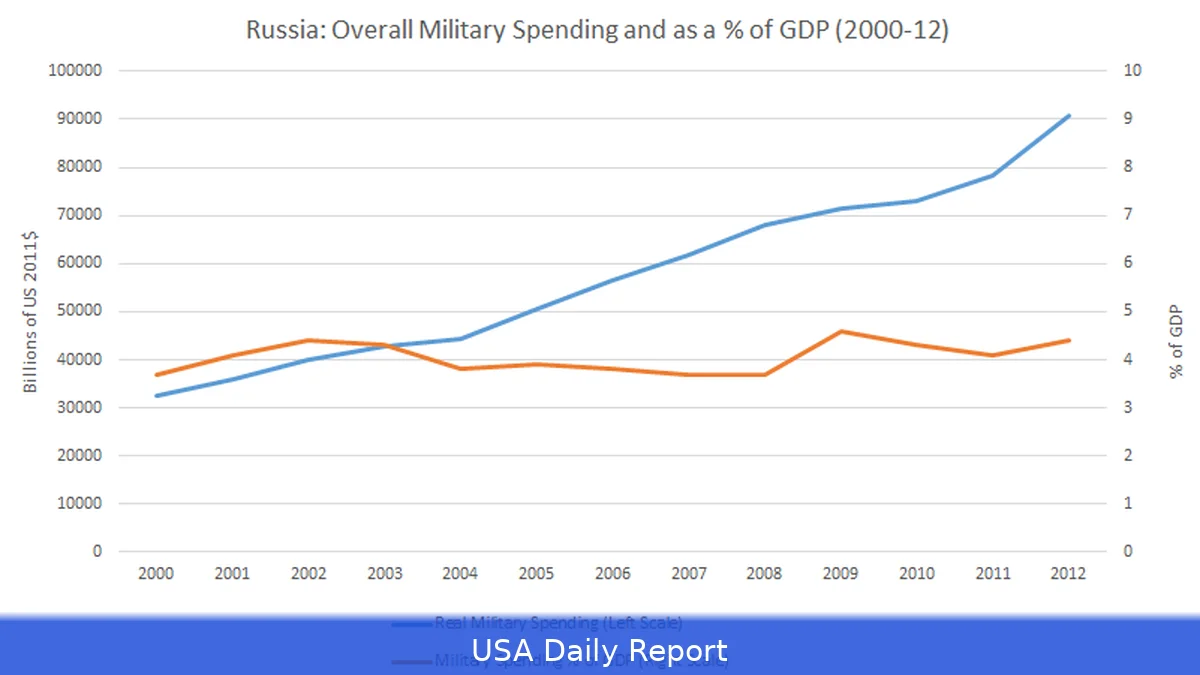
Russia plans to increase its military spending to the highest levels since the Cold War, reallocating a significant part of its 2025 budget to defense. This decision comes as the Kremlin faces challenges funding the war in Ukraine and deals with economic problems at home.
Budget Draft Reveals rare Military Investment
The Russian government’s draft budget for 2025 reveals plans to allocate roughly 13.5 trillion roubles, or about $139 billion, to military expenditures. That’s about one-third of the total budget spending, representing 6.3% of Russia’s gross domestic product (GDP)—the highest share since the Cold War era. Defense spending will be twice as much as social services for the first time, showing the government is prioritizing the military over welfare.
Finance Minister Anton Siluanov highlighted that the government is working through nearly 900 amendments to the budget, with many aimed at boosting defense and security, particularly to support what Moscow calls its "special military operation" in Ukraine. The draft has already passed its first reading in the Russian parliament and will probably undergo further revisions before final approval.
Economic Pressures Mount as Military Costs Balloon
Russia’s move to ramp up military expenditure comes amid significant economic strain. Inflation in the country has surged well above the central bank’s targets, currently running at over double the desired level. The key interest rate has climbed to 21%, the highest since the early 2000s, as authorities try to contain inflationary pressures.
Adding to the challenge, the ruble has weakened to a one-year low against the dollar. Western sanctions have effectively cut off Russia’s access to international bond markets, limiting its ability to raise funds externally.
Moscow has little choice but to raise taxes and shift budget funds to cover defense expenses.
Tax increases planned for 2025 include higher corporate and personal income taxes, a new car recycling tax, and other changes. These are expected to generate an additional 14.7 trillion roubles over three years, but economists warn this may still fall short of covering the rising military expenses.
Oil Prices and Revenue Uncertainty Cloud Outlook
Russia’s budget remains heavily dependent on oil revenues, which account for a large share of government income.
The draft budget projects oil prices will drop from an average of $70 per barrel in 2024 to around $65.50 by 2027. That decline threatens to reduce state income just as military spending is ramping up.
Experts warn that if oil prices don’t rise, Moscow will struggle even more to find new revenue. Alexei Klimyuk of Alfa Wealth said tax adjustments will stay a focus for the government, with more initiatives to amend tax laws expected. Natalia Orlova, chief economist at Alfa-Bank, warned that Russia’s reliance on oil revenues means the government will likely need to keep seeking additional funds to balance the budget.
Geopolitical Implications and NATO Response
The Kremlin’s budgetary focus on defense reflects the ongoing conflict in Ukraine, which has dragged into its third year with no clear end in sight. NATO Secretary General Jens Stoltenberg has warned member states to prepare for a prolonged confrontation with Russia, urging them to adopt a "wartime mindset" and increase defense spending.
Stoltenberg noted that Russia’s defense budget might increase further, possibly hitting 8% of GDP. He noted that Russia compensates for shortcomings in military quality by producing large quantities of tanks, armored vehicles, and ammunition, aided by support from countries like China, Iran, and North Korea.
For the United States, Russia’s military buildup poses a direct challenge to European security and NATO’s deterrence capabilities. The Biden administration has repeatedly emphasized the importance of supporting Ukraine with military aid and strengthening NATO’s eastern flank to counter Moscow’s ambitions.
Domestic Implications for Russia
Even with economic pressures and higher taxes, Russia’s economy has remained surprisingly resilient. Unemployment remains historically low, and wage growth has hit record highs, which has helped temper public discontent. Still, the strain of funding a costly military campaign while managing inflation and a weakening currency creates a delicate balancing act for Kremlin policymakers.
Finance Minister Siluanov warned last year that unchecked spending increases could lead to higher inflation or tax burdens falling on citizens and businesses. The current budget draft reflects efforts to contain spending overall but prioritizes defense above other sectors.
The reallocation of funds within the 41.5 trillion rouble total budget allows the government some flexibility. But the scale of the military increase means other areas, especially social programs, may face cuts or stagnation, affecting vulnerable populations.
Related Articles
- US War Goals in Iran Remain Unmet Despite Leadership Changes
- Trump and NATO Chief Discuss Partnership Amid Ongoing Gulf Tensions
- What Is ‘Soft Power’ and Why Does It Matter More Than Ever in the Trump Era?
With Russia dedicating a record share of its economy to military spending, the economic and geopolitical effects will extend beyond its borders. The Kremlin’s budget choices reveal a government gearing for a long conflict, even as domestic economic challenges mount and Western nations brace for a more entrenched confrontation.


