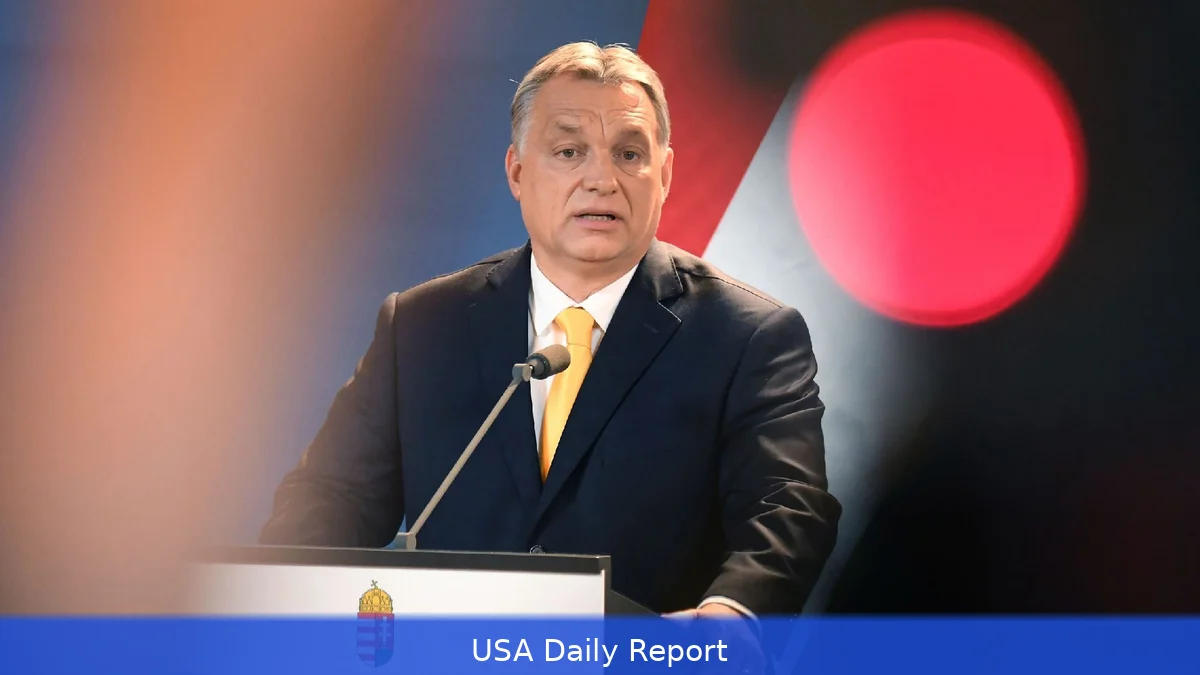
Hungary votes Sunday, April 12. The outcome will test a model of government that has drawn attention far beyond Budapest.
1. A long run of power changed the rules
Viktor Orbán's return to government in 2010 marked a turning point. Over the next decade and a half, his Fidesz party rewrote Hungary's constitution, retooled the courts and tightened control over a range of state institutions. Those moves reshaped how power works in a country of almost 10 million people.
Independent monitors now say Hungary's democracy looks a lot different than it did 20 years ago. Freedom House, a U.S.-based group that tracks political rights and civil liberties, rates Hungary as "partly free." The V-Dem Institute in Sweden classifies the country as an "electoral autocracy."
Look, Orbán didn't start out this way. He served as a center-right, pro-European prime minister from 1998 to 2002. But since 2010 he's called his preferred system an "illiberal state" and has invoked ideas such as "national foundations" and "Christian democracy" to describe his approach.
2. Control goes beyond politics
Critics say the government's reach now extends well past parliament and the courts. Public broadcasting has been effectively shut down, and many private outlets are now owned by business networks seen as close to Fidesz.
That consolidation has critics warning that independent journalism has been squeezed.
Academia has also been caught up in the changes. The Central European University, founded with support from Hungarian-American philanthropist George Soros, was forced to leave Budapest after a 2017 law often called "Lex CEU." That law required the university to open a campus in the United States or face closure, and CEU moved to Vienna at substantial cost. Michael Ignatieff, CEU's former president, has said Hungary became a "training ground" for a broader illiberal movement.
3. Elections still happen — but the deck is stacked
Regular voting remains part of the system. Opposition parties campaign openly, and ballots are cast. But analysts point out the playing field favors the incumbent. Changes to electoral rules, executive influence over courts and broad control of media all give Fidesz structural advantages. That means challengers need to win by a lot to change the government.
Point is, winning fair and square has gotten harder. State resources and the information environment are tilted toward the ruling party. Voters can still choose, but the conditions under which they choose have shifted.
4. A challenger unsettled the race
The final days of the campaign saw a new opposition contender shake up expectations. The emergence of that challenger forced opposition forces to rethink strategy and has injected uncertainty into a contest many assumed would be routine. Opposition candidates have argued that a change in leadership would restore some institutions and loosen partisan control over media and public life.
But the electoral system's structural biases remain. Analysts warn that even sizable public dissatisfaction doesn't automatically translate into a change of government when the state apparatus and much of the information ecosystem favor incumbents.
5. Why the United States cares
The U.S. Took notice in the campaign's final stretch. U.S. Vice President Vance traveled to Hungary to show support for the incumbent leadership — a signal of close ties between Budapest and some elements of American politics. Orbán's approach and rhetoric have won him allies on parts of the American right, and Washington figures have visited Hungary in recent years to show those connections.
That political alignment has consequences. Hungary sits inside the European Union and NATO; shifts in Budapest can ripple across alliances and policy debates about trade, security and democratic norms. Washington officials and U.S. Political movements watch Hungary as an example — or a warning — about how a modern European democracy can change under long-ruling leadership.
Economic and broader implications
When state power expands into media and business, the private sector changes too. The source material shows private networks are often tied to pro-government business groups. That sort of alignment can affect the marketplace for information and for commerce.
The CEU episode showd wider costs. Moving a major university out of Budapest was expensive and drew international attention. It also signaled that legal and regulatory shifts can reshape where institutions choose to operate — and where donors and students decide to invest their time and money.
At the same time, Hungary's political model is being watched by conservative movements in other countries. If Orbán's model holds, it will provide proof to like-minded leaders and political groups that democratic institutions can be reshaped without a total break from electoral politics. If it collapses, it could undercut similar experiments elsewhere.
What to watch on election day
Pay attention to turnout, to whether opposition parties form effective coalitions, and to how independent observers assess the vote's fairness. The structural advantages that Fidesz enjoys mean the margin of victory will matter as much as the winner. Opposition strategists say they need clear, decisive wins in districts across the country — not narrow majorities in a few places.
International observers will also be looking at media access and whether state resources appear to be used to benefit one side. The way institutions manage the post-election period — courts, election officials, and administrative bodies — will determine how smoothly any transition, if it happens, proceeds.
Politics beyond Hungary
Hungary's election carries symbolic weight. For parts of the U.S. Right that admire Orbán's stance on migration, national identity and skepticism of liberal institutions, a win would be a political boost. For those concerned about democratic backsliding, a loss for the opposition would be worrisome.
Frankly, the fight in Hungary has become part of a larger debate about what democracy should look like across Europe and in allied countries. And because American officials and politicians have publicly engaged with Budapest, the result has implications for transatlantic relations.
Who said what
Viktor Orbán, Hungary's prime minister, has used phrases such as "illiberal state," "national foundations" and "Christian democracy" to describe his political project. Michael Ignatieff, former president of Central European University, labeled Hungary a "training ground" for illiberal politics. Freedom House called Hungary "partly free," and the V-Dem Institute described it as an "electoral autocracy." U.S. Vice President Vance visited Budapest in the campaign's final days to show support for the incumbent leadership.
Related Articles
- Ukraine Looms Large as Hungary’s Ruling Party Levels Sabotage Allegations Ahead of Vote
- Trump Says He’s ‘Optimistic’ on Iran Truce as Questions Grow Over Hormuz and Next Steps
- Beijing Demands Answers After Chinese Researcher Found Dead at University of Michigan
Voting is scheduled for Sunday, April 12.


